Colorado · Real estate exam prep

Colorado Real Estate Practice Test

20 free Colorado practice questions with no signup required. When you're ready for more, the full RealReady bank has 1,095 questions for the 2026 exam that cover both national principles and Colorado law.

Practice below

Practice

20 Colorado Real Estate Test Questions & Answers

Use this like a free Colorado real estate practice test: read the question, commit to an answer, then tap to reveal the correct answer and a plain-English explanation. The ones you miss tell you where to focus next.

Q1 of 20 Licensing & Regulation

The Colorado Real Estate Commission issues position statements. These statements serve to:

  1. Establish binding legal precedent
  2. Create new statutory requirements
  3. Override existing court rulings
  4. Clarify how the Commission interprets law
Show answer & explanation

Correct: D Clarify how the Commission interprets law

Position statements clarify the Commission's interpretation of existing law. They do not create new law, override courts, or establish binding precedent.

Q2 of 20 Licensing & Regulation

What is unique about Colorado's real estate license structure compared to most states?

  1. Agents must also hold a law degree
  2. Salesperson licenses are temporary
  3. There is only a broker license
  4. There are three license levels
Show answer & explanation

Correct: C There is only a broker license

Colorado has one license type — broker. There is no separate salesperson or agent license. New licensees work under an employing broker.

Q3 of 20 Licensing & Regulation

Which type of insurance is required for all active Colorado real estate licensees?

  1. General liability insurance
  2. Errors and omissions insurance
  3. Professional bonding coverage
  4. Title insurance on each transaction
Show answer & explanation

Correct: B Errors and omissions insurance

Colorado requires all active licensees to maintain errors and omissions (E&O) insurance (C.R.S. 12-10-204). The Division of Real Estate contracts for a group E&O policy after a competitive bid, but licensees may instead obtain independent coverage meeting the Division's minimum requirements.

Q4 of 20 Licensing & Regulation

Colorado's state fair housing law is called the:

  1. Colorado Civil Rights Act
  2. Colorado Anti-Discrimination Act
  3. Colorado Fair Housing Statute
  4. Colorado Equal Housing Opportunity Act
Show answer & explanation

Correct: B Colorado Anti-Discrimination Act

The Colorado Anti-Discrimination Act (CADA) is the state's fair housing law. It is enforced by the Colorado Civil Rights Division (CCRD) within DORA.

Q5 of 20 State Practice

In Colorado, if a broker and client have no written agreement specifying the relationship, the default is:

  1. Dual agency
  2. Single agency for the buyer
  3. Single agency for the seller
  4. Transaction-brokerage
Show answer & explanation

Correct: D Transaction-brokerage

Colorado's default brokerage relationship is transaction-brokerage. Unless the broker and client agree in writing to a different relationship, the broker acts as a transaction-broker.

Q6 of 20 State Practice

All real estate advertising in Colorado must include:

  1. The Commission's approval stamp
  2. The individual broker's license number
  3. The property's assessed tax value
  4. The employing broker's name or trade name
Show answer & explanation

Correct: D The employing broker's name or trade name

Rule 6.10 requires advertising to be made clearly and conspicuously in the name of the brokerage firm as licensed — blind ads are prohibited. Exception: a broker advertising their own property that is not listed with their firm need not use the firm name, though licensed status must still be disclosed when selling.

Q7 of 20 State Practice

In Colorado, who bears ultimate responsibility for the licensed activities of associated brokers?

  1. The Real Estate Commission
  2. The employing broker
  3. Each individual broker
  4. The Division Director
Show answer & explanation

Correct: B The employing broker

The employing broker is responsible for ALL licensed activities conducted under their supervision, including compliance with trust accounts, advertising, and real estate law.

Q8 of 20 State Practice

Which of the following may NOT be used as a Colorado trust or escrow account?

  1. An insured statement account
  2. An insured passbook savings account
  3. An FDIC-insured checking account
  4. A certificate of deposit with a fixed maturity term
Show answer & explanation

Correct: D A certificate of deposit with a fixed maturity term

C.R.S. 12-10-217(1)(i) permits any checking, demand, passbook, or statement account insured by a U.S. government agency. Rule 5.6 prohibits placing money belonging to others in any account with a fixed maturity term or a fee/penalty for early withdrawal — funds must be available on demand — so CDs are not permitted.

Q9 of 20 State Practice

Colorado requires sellers to complete a property disclosure form by statute. True or false?

  1. True — but only for homes over $500K
  2. False — it is voluntary, not mandatory
  3. True — but only for homes built before 1978
  4. True — all residential sellers must
Show answer & explanation

Correct: B False — it is voluntary, not mandatory

Colorado has no general statute mandating a comprehensive seller disclosure form — the SPD is a Commission form delivered under the contract. But specific disclosures ARE statutorily required in residential sales: radon (C.R.S. 38-35.7-112), source of potable water (38-35.7-104), special taxing districts (38-35.7-101), and methamphetamine (38-35.7-103), plus federal lead-based paint. Under the standard contract the seller also agrees to deliver a completed SPD.

Q10 of 20 State Transactions

The Colorado Contract to Buy and Sell Real Estate exists in how many versions?

  1. One single universal version
  2. Two: residential and commercial
  3. Four: residential, income-residential, commercial, land
  4. Three: residential, commercial, and land
Show answer & explanation

Correct: C Four: residential, income-residential, commercial, land

The Division of Real Estate publishes four primary Commission-approved Contract to Buy and Sell forms: CBS1 (Residential), CBS2 (Income-Residential), CBS3 (Commercial), and CBS4 (Land). Additional variants exist for Foreclosure Protection Act transactions and lot-lease-only sales.

Q11 of 20 State Transactions

Under an exclusive right-to-sell listing, the broker earns a commission if:

  1. The property sells, no matter who finds the buyer
  2. Only if the seller accepts the full price
  3. Only if the broker personally finds the buyer
  4. Only if the property sold through the MLS
Show answer & explanation

Correct: A The property sells, no matter who finds the buyer

An exclusive right-to-sell listing guarantees the broker's commission regardless of who procures the buyer — even if the seller finds the buyer independently.

Q12 of 20 State Transactions

Colorado licensees are required to use forms approved by the:

  1. Division of Real Estate
  2. Colorado Bar Association
  3. National Association of REALTORS
  4. Colorado Real Estate Commission
Show answer & explanation

Correct: D Colorado Real Estate Commission

The Colorado Real Estate Commission approves standard forms for use in real estate transactions. Licensees are required to use these Commission-approved forms.

Q13 of 20 State Transactions

Property taxes in Colorado are paid in:

  1. Advance
  2. Real-time monthly installments
  3. Arrears
  4. At the time of purchase only
Show answer & explanation

Correct: C Arrears

Colorado property taxes are paid in arrears — the seller owes taxes for the period they owned the property, and these are prorated at closing.

Q14 of 20 State Transactions

Which deed provides the broadest protection for the buyer in Colorado?

  1. Quitclaim deed
  2. Special warranty deed
  3. General warranty deed
  4. Bargain and sale deed
Show answer & explanation

Correct: C General warranty deed

A general warranty deed provides the broadest protection — the grantor warrants title against all defects, including those that arose before the grantor owned the property.

Q15 of 20 State Transactions

Colorado follows which water law doctrine?

  1. Correlative rights
  2. Reasonable use
  3. Riparian rights
  4. Prior appropriation
Show answer & explanation

Correct: D Prior appropriation

Colorado follows the prior appropriation doctrine — 'first in time, first in right.' Water rights are separate from land ownership, unlike riparian rights states.

Q16 of 20 Licensing & Regulation

What is the maximum fine the Colorado Real Estate Commission can impose per violation?

  1. $10,000
  2. $1,000
  3. $5,000
  4. $2,500
Show answer & explanation

Correct: D $2,500

The Commission can impose fines up to $2,500 per violation. It can also censure, suspend, or revoke licenses.

Q17 of 20 Licensing & Regulation

A newly licensed Colorado broker must practice under the supervision of:

  1. An employing broker
  2. The Real Estate Commission
  3. A designated mentor broker
  4. Any licensed attorney
Show answer & explanation

Correct: A An employing broker

New licensees must work under an employing broker — the broker responsible for supervising all brokers in the firm. The Commission does not directly supervise individual licensees.

Q18 of 20 Licensing & Regulation

The Division of Real Estate makes a group E&O policy available to licensees. A broker who prefers a different insurer may:

  1. Obtain equivalent coverage independently
  2. Not opt out of the group policy
  3. Use any policy regardless of coverage
  4. Only use the group policy provider
Show answer & explanation

Correct: A Obtain equivalent coverage independently

Licensees can enroll in the group E&O policy the Division contracts for, or obtain coverage independently — but an independent policy must comply with the Division's minimum coverage requirements.

Q19 of 20 Licensing & Regulation

Which agency enforces the Colorado Anti-Discrimination Act?

  1. Colorado Civil Rights Division
  2. Division of Real Estate
  3. Real Estate Commission
  4. Attorney General's Office
Show answer & explanation

Correct: A Colorado Civil Rights Division

CADA is enforced by the Colorado Civil Rights Division (CCRD), which operates within DORA. The Real Estate Commission handles licensing discipline, not fair housing enforcement.

Q20 of 20 State Practice

A transaction-broker in Colorado owes which duty to both parties?

  1. Obedience to all instructions
  2. Undivided loyalty
  3. Reasonable skill and care
  4. Advocacy for one party's negotiating goals
Show answer & explanation

Correct: C Reasonable skill and care

A transaction-broker must exercise reasonable skill and care, present all offers timely, account for money, and disclose adverse material facts. A TB owes no loyalty or advocacy to either party, but under C.R.S. 12-10-407(3) may NOT disclose either party's negotiating position or motivations without informed consent.

Want the rest of Colorado's 1,095-question bank?

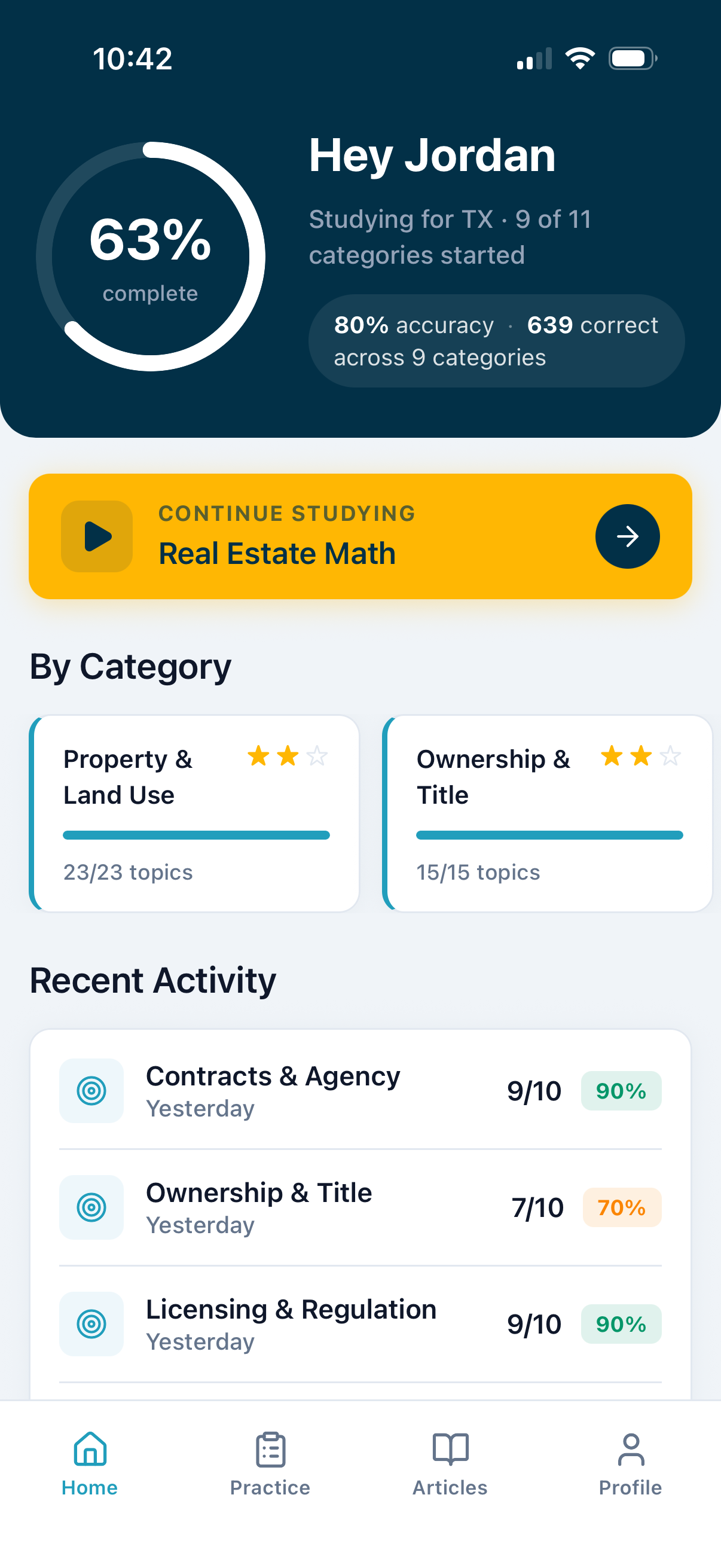
The RealReady app has all 1,095 questions covering both national real estate principles and Colorado-specific law. The full app also includes:

  • Short articles that walk you through the why behind each topic
  • A missed-question drill mode
  • Detailed explanations on every question
  • Progress tracking with per-category accuracy

Unlike other real estate prep apps, we don't cut off access or charge a monthly subscription fee. It's a one-time $17.99, and it's yours forever.

About the exam

More about the Colorado real estate exam

Fewer than 6 in 10 candidates clear Colorado's state exam portion on the first try. Colorado is the only state that issues a single broker-level license. There is no salesperson tier, so every new licensee sits the same examination, and the Division of Real Estate (DRE) scores the National and State portions separately. That makes Colorado-specific preparation matter as much as the national material.

Colorado's mandatory Transaction-Broker default relationship under C.R.S. §12-10-403(2), the state-mandated Contract to Buy and Sell Real Estate and other Commission-approved standard forms, designated brokers, the 168-hour qualifying education requirement, the Errors and Omissions insurance mandate under C.R.S. §12-10-204, the Colorado Foreclosure Protection Act, water rights and well disclosures, and the three-tier Associate, Independent, and Employing Broker structure all show up on the State portion. None of that looks like the material a candidate in a neighboring state studies. A generic real estate practice test won't cut it. You need Colorado-specific practice questions.

FAQ

Colorado real estate exam: your questions answered

How many questions are on the Colorado real estate exam?

The Colorado Real Estate Broker Examination has 154 scored multiple-choice questions. 80 are on the National portion covering real estate principles common to every state, and 74 are on the State portion covering Colorado law, Commission rules, position statements, and the state's standard forms and contracts. PSI also includes 5 to 10 unscored experimental items that aren't identified to candidates.

What's the passing score for the Colorado real estate exam?

You need 60 of 80 correct on the National portion (75%) and 53 of 74 correct on the State portion (about 72%). The two portions are scored separately and you must pass both. If you pass one and fail the other, you only have to retake the one you failed, and a passing score on either part is valid for one year.

How much does the Colorado real estate exam cost?

PSI charges $44.95 for a first attempt covering both portions and $42.50 for any retake. Fees are paid directly to PSI when you schedule and are not refundable. The exam fee is separate from the Division of Real Estate's broker license application fees and the cost of the Errors and Omissions insurance every active licensee must carry.

How long is the Colorado real estate exam?

230 minutes total. You get 120 minutes for the 80-question National portion and 110 minutes for the 74-question State portion. Both are taken at the same PSI test center or via PSI's remote-proctor option, and your score is reported on screen at the end of the sitting.

Who administers the Colorado real estate exam?

The Colorado Real Estate Broker Examination is administered by PSI for the Colorado Division of Real Estate (DRE), part of the Department of Regulatory Agencies (DORA). You register and schedule your exam date through PSI.

Is the Colorado real estate exam hard?

First-time pass rates on the National portion sit around 65%, and the State portion typically runs lower at about 50 to 58%. The questions aren't tricky for the sake of being tricky. They're written to test whether you actually understand Colorado real estate law and the state's contract forms in practice. Most candidates who fail aren't lazy; they underestimated how much Colorado-specific material is on the State portion, particularly the 23 questions on Colorado Forms and Contracts and the 11 on brokerage relationships, and over-prepared on national principles. Honest practice on a Colorado-specific practice exam is the difference between passing on the first try and rebooking the $44.95 sitting.

What's on the Colorado real estate exam?

The 80-question National portion covers eleven areas. Contracts is the heaviest at about 19%, followed by agency at 13%, practice of real estate at 12%, property ownership at 10%, financing at 9%, valuation at 8%, property disclosures at 7%, transfer of title and real estate math each at about 6%, and land use controls and property management each at about 5%. The 74-question State portion is dominated by Colorado Forms and Contracts at 23 items (Contract to Buy and Sell, listing agreements, counterproposals, deeds of trust, disclosures), followed by Brokerage Relationships at 11 items (transaction brokerage, single agent, designated brokers), Requirements Governing Licensee Activities at 11 items, Closing and Settlement at 10 items, Additional Topics at 7 items (Landlord-Tenant Act, water rights, Colorado taxes, Fair Housing Act, Foreclosure Protection Act), Licensing Requirements at 5 items, Record Keeping and Trust Accounts at 5 items, and Duties and Powers of the Real Estate Commission at 2 items.

What's the best way to prepare for the Colorado real estate exam?

After finishing your 168-hour qualifying education, the highest-leverage thing you can do is grind through Colorado-specific practice questions with honest feedback on every miss. The National portion is the same content you'd see on any PSI real estate exam, but Colorado's State portion is dense and the topics are narrower than the national syllabus, particularly the state's standardized contract forms and the transaction-broker default. The RealReady app gives you the full bank of Colorado questions, plus progress tracking and a missed-question mode so you can drill what you're weak on. Most users study 30 to 60 minutes a day for 2 to 4 weeks before sitting the PSI exam.

Is RealReady free?

The 20 Colorado practice questions on this page are free, no account or signup needed. Unlocking the rest of the Colorado bank is a single in-app purchase you pay once and own, with no recurring charge and no time limit on access.

Does RealReady cover the Colorado real estate exam?

Yes. RealReady has a dedicated Colorado question bank built for the Colorado real estate exam, covering the national principles every candidate sees plus the Colorado law that trips people up, like the default Transaction-Broker relationship, the state-mandated Contract to Buy and Sell Real Estate, and the Colorado Foreclosure Protection Act.

Is RealReady a real estate license course?

No. RealReady is exam practice, not a pre-license course, so it doesn't count toward Colorado's required pre-license education hours. Use it after or alongside your coursework to drill realistic practice questions and find your weak spots before exam day.