Minnesota · Real estate exam prep

Minnesota Real Estate Practice Test

20 free Minnesota practice questions with no signup required. When you're ready for more, the full RealReady bank has 1,075 questions for the 2026 exam that cover both national principles and Minnesota law.

Practice below

Practice

20 Minnesota Real Estate Test Questions & Answers

Use this like a free Minnesota real estate practice test: read the question, commit to an answer, then tap to reveal the correct answer and a plain-English explanation. The ones you miss tell you where to focus next.

Q1 of 20 Licensing & Regulation

Under Minnesota Statute §82.55, which term describes a person authorized to close real estate transactions on behalf of others?

  1. Title representative
  2. Closing agent
  3. Escrow coordinator
  4. Settlement officer
Show answer & explanation

Correct: B Closing agent

Minnesota Statute §82.55, subd. 4, defines a 'closing agent' as a person who, for another, directly or indirectly provides closing services incident to the sale, trade, lease, or loan of residential real estate. It is a distinct statutory term in Minnesota law — 'settlement officer,' 'escrow coordinator,' and 'title representative' are not defined in the statute. Closing agents are separately licensed under §82.641.

Q2 of 20 Licensing & Regulation

A nonresident with an active Illinois real estate license applies for a Minnesota real estate license. Illinois is not a reciprocal state. What exam component must she pass?

  1. The Minnesota state-specific exam portion
  2. Both the national and state portions
  3. Only the national portion of the exam
  4. No exam is required for nonresidents
Show answer & explanation

Correct: A The Minnesota state-specific exam portion

Actively licensed applicants from non-reciprocal states such as Illinois must pass only the state portion of the Minnesota exam — the national portion is waived. However, Minnesota does not waive education for them: they must still complete the full 90 hours (Courses I, II, and III). Licensees from Minnesota's reciprocal states (Colorado, Iowa, Nebraska, North Dakota, South Dakota, and Oklahoma) are licensed without any Minnesota exam or pre-license education.

Q3 of 20 Licensing & Regulation

Where must a Minnesota broker maintain a trust account for client funds?

  1. At whichever bank the salesperson who collected the funds chooses
  2. In the broker's general business account, tracked by a separate ledger
  3. Only at a financial institution physically located in Minnesota
  4. In a separate trust account at a bank, savings association, or credit union, which need not be in Minnesota
Show answer & explanation

Correct: D In a separate trust account at a bank, savings association, or credit union, which need not be in Minnesota

Minnesota Statutes 82.75 require client money to be held in a separate trust account, never commingled with the broker's own funds. The depository may be a Minnesota bank or trust company, a savings association, a credit union, or even an out-of-state (foreign) bank that authorizes the commissioner to examine its records, so it does not have to be located in Minnesota. Brokers hold these funds in a pooled interest-bearing trust account, with the interest remitted to the Minnesota Housing Finance Agency.

Q4 of 20 Licensing & Regulation

Which official heads the agency that regulates real estate licensees in Minnesota?

  1. The Commissioner of Commerce
  2. The Attorney General
  3. The Real Estate Commission chair
  4. The Governor
Show answer & explanation

Correct: A The Commissioner of Commerce

Minnesota does not have a separate real estate commission. The Commissioner of Commerce heads the Department of Commerce, which is the sole regulatory authority over real estate licensees. This is a key structural difference from many other states that use a dedicated real estate commission.

Q5 of 20 Licensing & Regulation

What is the primary purpose of the Minnesota Real Estate Recovery Fund?

  1. To reimburse licensees for uncollected commissions
  2. To insure brokers' trust accounts against bank failure
  3. To provide loans for first-time homebuyers
  4. To compensate consumers harmed by licensee fraud
Show answer & explanation

Correct: D To compensate consumers harmed by licensee fraud

The Recovery Fund's core purpose is compensating consumers who suffer financial losses due to licensee fraud, deception, or dishonesty. The fund also supports real estate education and research, but it does not provide homebuyer loans, reimburse licensees for commissions, or insure trust accounts.

Q6 of 20 State Practice

A licensee represents the seller but discovers a major foundation crack during a showing. What duty applies to the buyer?

  1. Disclose the material fact to the buyer
  2. Refer the buyer to a home inspector
  3. No duty since the buyer is not a client
  4. Only disclose if the buyer asks directly
Show answer & explanation

Correct: A Disclose the material fact to the buyer

Minnesota licensees must deal honestly and in good faith with ALL parties, not just their clients. This includes disclosing known material facts to the buyer even when representing the seller. Waiting to be asked or simply referring to an inspector does not satisfy this obligation.

Q7 of 20 State Practice

When must a Minnesota licensee provide a written agency disclosure to a consumer?

  1. Within 48 hours of showing a property
  2. At the time an offer is submitted
  3. At first substantive contact
  4. At the closing table before signing
Show answer & explanation

Correct: C At first substantive contact

Minnesota law requires written agency disclosure at the first substantive contact with a consumer, before providing any real estate services. Waiting until an offer is made or closing occurs is too late to satisfy this requirement.

Q8 of 20 State Practice

Which type of property requires a seller's property condition disclosure in Minnesota?

  1. Commercial office buildings only
  2. Residential real property
  3. Vacant agricultural land only
  4. Industrial warehouse properties only
Show answer & explanation

Correct: B Residential real property

Minnesota requires sellers to provide a property condition disclosure for residential real property. Commercial, industrial, and agricultural properties are generally not subject to the same residential disclosure requirements.

Q9 of 20 State Practice

A seller asks their listing agent what the standard commission rate is in Minnesota. The agent should respond:

  1. The state sets rates based on property value
  2. Commissions are fully negotiable
  3. The standard rate is 6% of sale price
  4. The MLS determines rates for all listings
Show answer & explanation

Correct: B Commissions are fully negotiable

Commissions in Minnesota are fully negotiable between broker and client. Minn. Stat. § 82.66 requires every listing agreement and buyer's broker agreement to carry a boldface notice that compensation 'shall be determined between each individual broker and the broker's client.' No state agency, MLS, or trade organization sets rates, and quoting a fixed 'standard' rate misrepresents the law.

Q10 of 20 State Practice

Which protected class is covered under the Minnesota Human Rights Act but NOT under federal fair housing law?

  1. Physical disability and familial status
  2. Religion, creed, and religious denomination
  3. Sexual orientation and gender identity
  4. Race, color, and national origin
Show answer & explanation

Correct: C Sexual orientation and gender identity

The Minnesota Human Rights Act extends beyond federal fair housing protections to cover sexual orientation, gender identity (made a standalone protected class by a 2023 amendment), marital status, and status with regard to public assistance. Race, national origin, religion, color, disability, and familial status are covered under both federal and state law.

Q11 of 20 State Practice

Under Minnesota law, a residential lease must be in writing when the term exceeds:

  1. Three months
  2. One year
  3. Six months
  4. Two years
Show answer & explanation

Correct: B One year

Minnesota's statute of frauds requires leases with terms exceeding one year to be in writing. Shorter leases may be oral, though written agreements are recommended for all tenancies.

Q12 of 20 State Transactions

A married couple in Minnesota owns a home titled solely in the husband's name. The husband wants to sell. Who must sign the deed?

  1. Neither spouse if a power of attorney exists
  2. Both spouses must sign the deed
  3. Only the spouse with higher income
  4. Only the husband since he holds title
Show answer & explanation

Correct: B Both spouses must sign the deed

Minnesota homestead law requires both spouses to sign the deed for homestead property, even when title is held in only one spouse's name. This protects the non-titled spouse's homestead interest in the property.

Q13 of 20 State Transactions

A developer creates a planned community in Minnesota in 2024. Which statute governs this development?

  1. Chapter 500, the Uniform Planned Community Act
  2. Chapter 515, original condominium statute
  3. Chapter 515B, the MN CIO Act
  4. Chapter 515A, the Uniform Condo Act
Show answer & explanation

Correct: C Chapter 515B, the MN CIO Act

Chapter 515B, the Minnesota Common Interest Ownership Act, governs condos, co-ops, townhomes, and planned communities created after June 1, 1994. A 2024 planned community falls under this statute.

Q14 of 20 State Transactions

Minnesota uses a dual recording system. What are the two systems?

  1. Race-notice and pure notice
  2. Abstract (regular) and Torrens
  3. County recorder and state registrar
  4. Grantor-grantee and tract index
Show answer & explanation

Correct: B Abstract (regular) and Torrens

Minnesota maintains two parallel recording systems: the abstract (regular) system recorded with the county recorder, and the Torrens system administered by the county registrar of titles.

Q15 of 20 State Transactions

When are Minnesota property taxes due each year?

  1. March 1 and September 1
  2. January 1 and July 1
  3. April 15 and November 15
  4. May 15 and October 15
Show answer & explanation

Correct: D May 15 and October 15

Minnesota property taxes are due in two installments: May 15 and October 15. These dates apply statewide regardless of county.

Q16 of 20 State Transactions

Minnesota is classified as which type of security instrument state?

  1. A title theory state
  2. A hybrid mortgage and deed of trust state
  3. A deed of trust state
  4. A mortgage state
Show answer & explanation

Correct: D A mortgage state

Minnesota uses mortgages as the primary security instrument for real estate loans. It does not use deeds of trust, which are common in many western states.

Q17 of 20 Licensing & Regulation

A real estate professional in Minnesota holds a license but works under a broker's supervision. Under §82.55, this person is classified as a:

  1. Associate broker
  2. Salesperson
  3. Broker intern
  4. Licensed assistant
Show answer & explanation

Correct: B Salesperson

Under Minnesota's statutory definitions in §82.55, a salesperson is a licensee who practices real estate under the direct supervision of a licensed broker. Minnesota does not use the term 'associate broker' or 'broker intern' as a license classification.

Q18 of 20 Licensing & Regulation

A broker deposits $500 of personal funds into her trust account to cover monthly bank fees. Is this permissible under Minnesota law?

  1. No, any personal funds constitute commingling
  2. Yes, a small amount to keep the account open is allowed
  3. Yes, up to $5,000 of personal funds is allowed
  4. No, bank fees must be paid from a separate account
Show answer & explanation

Correct: B Yes, a small amount to keep the account open is allowed

Minnesota Statutes 82.75, subdivision 4 prohibits commingling, but allows a broker to deposit and maintain a sum of personal funds in the trust account if the sum is specifically identified and used to pay service charges or satisfy the bank's minimum balance requirements. The statute sets no dollar cap; the limitation is purpose — the personal funds may be used only for account maintenance. Depositing $500 to cover monthly bank fees fits squarely within this exception.

Q19 of 20 Licensing & Regulation

A licensee asks which statutes govern real estate practice in Minnesota. Which two chapters are most relevant?

  1. Chapter 82 and Chapter 100
  2. Chapter 82 and Chapter 45
  3. Chapter 45 and Chapter 116
  4. Chapter 82 and Chapter 500
Show answer & explanation

Correct: B Chapter 82 and Chapter 45

Minnesota real estate practice is primarily governed by Chapter 82, which contains the real estate license law, and Chapter 45, which grants general regulatory authority to the Department of Commerce. Together these chapters provide the legal framework for licensure, practice standards, and enforcement.

Q20 of 20 Licensing & Regulation

Beyond compensating consumers, the Minnesota Recovery Fund also supports which activities?

  1. Marketing campaigns for licensed agents
  2. Legal defense for licensees facing lawsuits
  3. Real estate education and research
  4. Property inspection training programs
Show answer & explanation

Correct: C Real estate education and research

The Recovery Fund serves a dual purpose: compensating consumers harmed by licensee misconduct and supporting real estate education and research. It does not fund licensee marketing, legal defense, or property inspection training.

Want the rest of Minnesota's 1,075-question bank?

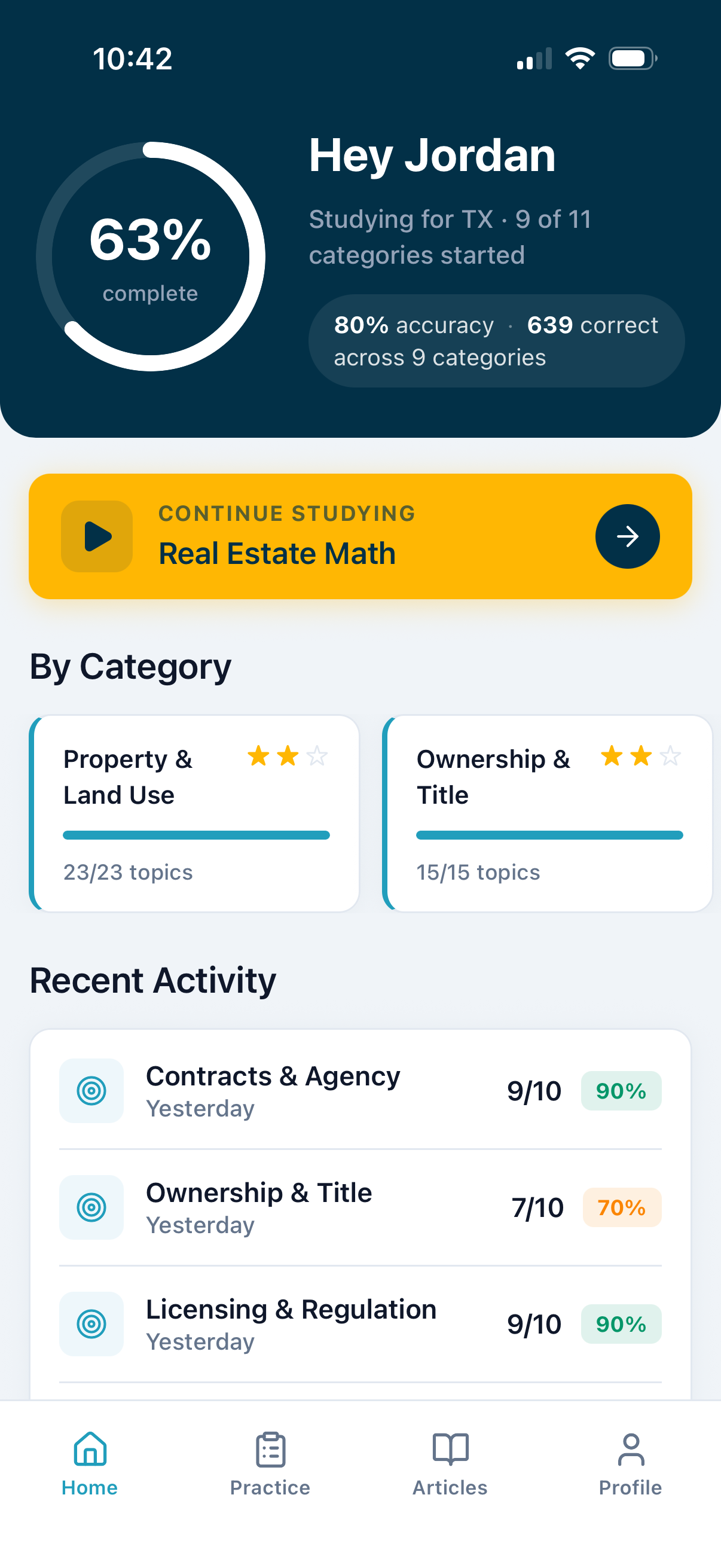
The RealReady app has all 1,075 questions covering both national real estate principles and Minnesota-specific law. The full app also includes:

  • Short articles that walk you through the why behind each topic
  • A missed-question drill mode
  • Detailed explanations on every question
  • Progress tracking with per-category accuracy

Unlike other real estate prep apps, we don't cut off access or charge a monthly subscription fee. It's a one-time $17.99, and it's yours forever.

About the exam

More about the Minnesota real estate exam

Minnesota scores the national and 50-question state portions separately, so a strong national score won't save you if your grasp of Minnesota law is thin. The Minnesota Department of Commerce licenses agents, and that makes Minnesota-specific preparation just as important as the national material.

Minnesota tests its own rules in ways a national course never covers, from the license law in Chapter 82 that the Department of Commerce enforces, to the statutory agency-relationships disclosure and Minnesota's facilitator option that lets a licensee work a deal without representing either party, the seller's property disclosure and well disclosure required before closing, the Minnesota Common Interest Ownership Act that governs condominiums and townhomes, and the broker trust-account rules for earnest money. None of that looks like the material a candidate in a neighboring state studies. A generic real estate practice test won't cut it. You need Minnesota-specific practice questions.

FAQ

Minnesota real estate exam: your questions answered

How many questions are on the Minnesota real estate exam?

The Minnesota Real Estate Salesperson Examination has 130 scored multiple-choice questions, split into an 80-question national portion and a 50-question Minnesota state-law portion. PSI delivers both portions back-to-back in one computer-based session and mixes in a small number (5 to 10) of unscored experimental questions that look identical to the scored ones — they don't affect your score, but they do use up exam time.

What's the passing score for the Minnesota real estate exam?

You need at least 75 percent on each portion, scored separately. That works out to 60 of 80 on the national portion and 38 of 50 on the state portion. If you pass one portion and fail the other, you only retake the portion you failed, and the single-portion retake costs less than sitting the whole exam again.

How much does the Minnesota real estate exam cost?

PSI charges $68 to sit the salesperson exam (both portions), and a single failed portion can be retaken for $45. After you pass, the initial salesperson license costs $110 through the Minnesota Department of Commerce — a $70 license fee plus a $30 recovery-fund fee and a $10 technology surcharge. You pay the exam fee to PSI when you schedule, and there is no limit on how many times you can retake.

How long is the Minnesota real estate exam?

Four hours total. PSI allots two and a half hours for the 80-question national portion and ninety minutes for the 50-question Minnesota portion, taken back-to-back in one sitting. PSI runs Minnesota test centers in St. Paul, Woodbury, Eagan, Blaine, Rochester, Mankato, Willmar, Brainerd, and Duluth, and your result appears on screen the moment you finish, and PSI emails your score report.

Who administers the Minnesota real estate exam?

The Minnesota Real Estate Salesperson Examination is administered by PSI for the Minnesota Department of Commerce. You register and schedule your exam date through PSI.

Is the Minnesota real estate exam hard?

It's a serious test, and the part that trips people up is the 50-question Minnesota portion. The national half covers the same principles taught in every state, but the state questions reward candidates who actually studied Minnesota's license law, the agency-relationships disclosure and facilitator option, the seller's property and well disclosures, and the Common Interest Ownership Act. Most people who fail leaned too heavily on national material and underprepared on Minnesota law. Honest reps on Minnesota-specific practice questions are the difference between a first-time pass and a $45-per-portion retake.

What's on the Minnesota real estate exam?

The 80-question national portion covers property ownership, land-use controls, valuation, financing, general principles of agency, property disclosures, contracts, property management, transfer of title, the practice of real estate, and real estate calculations, in proportions set by PSI's content outline. The 50-question Minnesota portion covers four areas, real estate brokerage license law, interests in real property, conveyance procedures and protection of the parties, and financial instruments with their obligations, rights, and remedies. Minnesota-specific law runs through that whole state portion, especially Chapter 82 license law, the agency-relationships disclosure, the seller's property and well disclosures, and the Common Interest Ownership Act.

What's the best way to prepare for the Minnesota real estate exam?

After you finish Minnesota's 90-hour salesperson prelicense education, the three thirty-hour courses known as Course I, Course II, and Course III, the highest-leverage move is grinding Minnesota-specific practice questions with honest feedback on every miss. National principles you can pick up from any course, but the 50-question state portion rewards repetition on Minnesota agency rules, the required disclosures, and Chapter 82 license law. The RealReady app gives you the full Minnesota question bank plus the national bank, detailed explanations, a missed-question drill mode, and per-category progress tracking so you can see exactly where you are weak.

Is RealReady free?

The 20 Minnesota practice questions on this page are free, no account or signup needed. Unlocking the rest of the Minnesota bank is a single in-app purchase you pay once and own, with no recurring charge and no time limit on access.

Does RealReady cover the Minnesota real estate exam?

Yes. RealReady has a dedicated Minnesota question bank built for the Minnesota real estate exam, covering the national principles every candidate sees plus the Minnesota law that trips people up, like the license law in Chapter 82, Minnesota's facilitator option, and the Minnesota Common Interest Ownership Act.

Is RealReady a real estate license course?

No. RealReady is exam practice, not a pre-license course, so it doesn't count toward Minnesota's required pre-license education hours. Use it after or alongside your coursework to drill realistic practice questions and find your weak spots before exam day.