Louisiana · Real estate exam prep

Louisiana Real Estate Practice Test

20 free Louisiana practice questions with no signup required. When you're ready for more, the full RealReady bank has 1,080 questions for the 2026 exam that cover both national principles and Louisiana law.

Practice below

Practice

20 Louisiana Real Estate Test Questions & Answers

Use this like a free Louisiana real estate practice test: read the question, commit to an answer, then tap to reveal the correct answer and a plain-English explanation. The ones you miss tell you where to focus next.

Q1 of 20 Licensing & Regulation

Which of the following is a power of the Louisiana Real Estate Commission?

  1. Filing criminal charges
  2. Setting commission rates
  3. Approving mortgage loans
  4. Issuing cease and desist orders
Show answer & explanation

Correct: D Issuing cease and desist orders

LREC has authority to issue cease and desist orders against unlicensed activity. The Commission also has rulemaking, licensing, investigation, discipline, education oversight, and trust account audit powers.

Q2 of 20 Licensing & Regulation

Which of the following license types does Louisiana issue for real estate professionals?

  1. Salesperson, broker, and appraiser
  2. Broker and appraiser only
  3. Salesperson and broker only
  4. Salesperson, broker, certified instructor
Show answer & explanation

Correct: D Salesperson, broker, certified instructor

Louisiana issues three types of real estate licenses: salesperson, broker, and certified instructor. Appraisers are licensed separately. Each license type has distinct education and experience requirements.

Q3 of 20 Licensing & Regulation

What are the minimum E&O insurance coverage limits for an individual Louisiana licensee?

  1. $100,000 per claim, $300,000 aggregate
  2. $50,000 per claim, $150,000 aggregate
  3. $100,000 per claim, $100,000 aggregate
  4. $250,000 per claim, $500,000 aggregate
Show answer & explanation

Correct: A $100,000 per claim, $300,000 aggregate

Louisiana mandates E&O insurance for all active licensees (R.S. 37:1466), with terms set by LREC. For an individual licensee the policy must provide at least $100,000 per claim and $300,000 annual aggregate, with a maximum deductible of $1,000 per claim for damages (no deductible for defense costs). Firm-held policies carry higher minimums. This coverage protects consumers from licensee negligence.

Q4 of 20 Licensing & Regulation

How does LREC typically initiate an investigation against a licensee?

  1. Only from court referrals
  2. Only from consumer complaints
  3. Only from law enforcement requests
  4. From complaints or its own findings
Show answer & explanation

Correct: D From complaints or its own findings

LREC can initiate investigations based on complaints filed by consumers or other licensees, or based on the Commission's own findings during audits or reviews. The Commission is not limited to waiting for external complaints.

Q5 of 20 State Practice

What must every real estate advertisement in Louisiana include?

  1. The property's assessed tax value
  2. The salesperson's personal phone number
  3. The LREC license number of the agent
  4. The licensed broker or firm name
Show answer & explanation

Correct: D The licensed broker or firm name

Louisiana law requires every real estate advertisement to include the name of the licensed broker or firm. This ensures the public can identify the responsible broker. Personal phone numbers, license numbers, and tax values are not required elements.

Q6 of 20 State Practice

Under Louisiana law, a salesperson must work under which type of licensee?

  1. Any licensed salesperson with seniority
  2. A certified real estate appraiser
  3. A sponsoring broker
  4. An LREC-appointed supervisor
Show answer & explanation

Correct: C A sponsoring broker

Louisiana requires every salesperson to be associated with and work under the supervision of a sponsoring broker. A salesperson cannot operate independently or under another salesperson, appraiser, or LREC-appointed individual.

Q7 of 20 State Practice

Where must a Louisiana broker maintain a trust account?

  1. At a bank approved by the state treasurer
  2. At a bank or financial institution in Louisiana
  3. At the broker's out-of-state corporate headquarters
  4. At any FDIC-insured bank in the United States
Show answer & explanation

Correct: B At a bank or financial institution in Louisiana

Louisiana requires trust accounts to be maintained at a bank or financial institution located within the state. Out-of-state banks do not satisfy this requirement, even if they are FDIC-insured. The account must be accessible for LREC audit purposes.

Q8 of 20 State Practice

Who completes the Louisiana property disclosure document?

  1. The buyer's agent after the inspection
  2. A licensed home inspector
  3. The seller, in good faith
  4. The listing broker on behalf of the seller
Show answer & explanation

Correct: C The seller, in good faith

Louisiana law requires the seller to complete the LREC-prescribed property disclosure document in good faith. The broker does not complete it on the seller's behalf, and it is not a substitute for a professional home inspection.

Q9 of 20 State Practice

Under Louisiana Section 3892, which act does NOT create an agency relationship?

  1. Performing a ministerial act
  2. Accepting a dual agency consent form
  3. Signing a written buyer agreement
  4. Executing a listing contract
Show answer & explanation

Correct: A Performing a ministerial act

Under La. R.S. 9:3892, a licensee is presumed to be the designated agent of the person with whom he is working unless a written agreement provides for a different relationship or the licensee performs only ministerial acts. Ministerial acts are informative in nature — for example, responding to pricing inquiries, conducting an open house, or setting an appointment to view a property (R.S. 9:3891(12)) — and do not by themselves create an agency relationship. Signing a buyer agreement or listing contract creates a brokerage engagement, and a dual agency consent form establishes dual representation.

Q10 of 20 State Practice

Under Louisiana law, when is dual agency permitted?

  1. Only in commercial property transactions
  2. With written consent from both parties
  3. Whenever the broker agrees to represent both
  4. It is never permitted in Louisiana by law
Show answer & explanation

Correct: B With written consent from both parties

Louisiana permits dual agency only when both the buyer and seller provide informed written consent. The broker must fully explain the implications before either party signs the consent form.

Q11 of 20 State Transactions

Under Louisiana civil law, land and buildings are classified as what?

  1. Immovables by nature
  2. Corporeal movables
  3. Incorporeal immovables
  4. Immovables by declaration
Show answer & explanation

Correct: A Immovables by nature

Land and buildings are immovables — the civil-law counterpart of common-law 'real property.' Under Civil Code articles 462 and 463, tracts of land with their component parts (buildings, other constructions permanently attached to the ground, standing timber, and unharvested crops belonging to the landowner) are immovables. 'Immovables by nature' is the traditional Louisiana label for this category.

Q12 of 20 State Transactions

Under Louisiana law, what is a servitude?

  1. A building restriction imposed by local zoning
  2. A tax lien recorded by the parish clerk
  3. A charge on property benefiting an estate or person
  4. A lease agreement between neighboring owners
Show answer & explanation

Correct: C A charge on property benefiting an estate or person

A servitude in Louisiana civil law is a charge on property for the benefit of another. A predial servitude is a charge on a servient estate for the benefit of a dominant estate (Civil Code article 646); a personal servitude, such as usufruct, habitation, or a right of use, is a charge on a thing for the benefit of a person (article 534). Predial servitudes correspond to what common-law states call easements.

Q13 of 20 State Transactions

What right does every co-owner of an immovable have under Louisiana law?

  1. Receive rent from other co-owners
  2. Claim exclusive possession of a portion
  3. Demand partition at any time
  4. Veto any sale of the property
Show answer & explanation

Correct: C Demand partition at any time

Under Civil Code article 807, no one may be compelled to hold a thing in indivision, and any co-owner may demand partition of co-owned property at any time. Co-ownership is considered a temporary arrangement. The one exception: co-owners may agree to exclude partition for a period of up to fifteen years.

Q14 of 20 State Transactions

What form is required for a donation inter vivos of an immovable in Louisiana?

  1. A private written instrument
  2. An oral declaration before witnesses
  3. An authentic act
  4. A court-approved petition
Show answer & explanation

Correct: C An authentic act

Louisiana Civil Code requires that a donation inter vivos of an immovable must be made by authentic act (executed before a notary and two witnesses) to be valid. Private acts are insufficient for immovable donations.

Q15 of 20 State Transactions

Which four elements are required to form a valid contract under Louisiana Civil Code?

  1. Capacity, consent, cause, and object
  2. Offer, acceptance, consideration, and legality
  3. Consent, witnesses, notarization, and recording
  4. Capacity, writing, delivery, and acceptance
Show answer & explanation

Correct: A Capacity, consent, cause, and object

Louisiana Civil Code requires four elements for a valid contract: capacity of the parties, consent free of vices, a lawful cause (motive), and a lawful, possible, and determinate object. Louisiana uses 'cause' rather than 'consideration.'

Q16 of 20 State Transactions

What form is required for a valid sale of an immovable in Louisiana?

  1. An unsigned memorandum recorded in the conveyance records
  2. Authentic act or act under private signature
  3. An oral agreement before two witnesses
  4. A handshake agreement confirmed by the listing broker
Show answer & explanation

Correct: B Authentic act or act under private signature

Civil Code article 2440 requires that a sale of an immovable be made by authentic act or by act under private signature. (Exceptionally, under article 1839 an oral transfer is valid between the parties only if the property has actually been delivered and the transferor admits the transfer under oath.) Recording in the parish conveyance records is not required for validity between the parties, but the sale is without effect against third persons until recorded (articles 1839, 2442, 3338).

Q17 of 20 Licensing & Regulation

LREC receives a complaint that a non-licensee is brokering real estate deals. What enforcement tool can LREC use specifically for unlicensed activity?

  1. Suspend the person's broker status
  2. Impose continuing education hours
  3. Issue a cease and desist order
  4. Revoke the person's license
Show answer & explanation

Correct: C Issue a cease and desist order

LREC can issue cease and desist orders specifically to stop unlicensed real estate activity. Since the person is not licensed, revocation and suspension are not applicable. Cease and desist is the appropriate enforcement tool.

Q18 of 20 Licensing & Regulation

An investor hires a friend to find and negotiate the purchase of rental properties, paying the friend a percentage of each deal. Does this activity require a license?

  1. Only if the friend is a licensed REALTOR
  2. Yes, brokering for pay requires a license
  3. Only if more than three properties are involved
  4. No, friends are exempt from licensing
Show answer & explanation

Correct: B Yes, brokering for pay requires a license

Buying, selling, exchanging, or leasing real estate for others for compensation requires a Louisiana real estate license. The relationship between the parties does not create an exemption from licensing requirements.

Q19 of 20 Licensing & Regulation

A broker is shopping for an individual E&O insurance policy. One policy offers a $2,500 deductible at a lower premium. Can the broker select this policy to meet LREC requirements?

  1. No, the maximum deductible is $1,000
  2. Yes, any deductible amount is permitted
  3. No, E&O policies cannot have deductibles
  4. Yes, if the premium is paid in full
Show answer & explanation

Correct: A No, the maximum deductible is $1,000

For individual licensee policies, LREC requires a maximum deductible of $1,000 per claim for damages, with no deductible allowed for defense costs. A $2,500 deductible exceeds the LREC limit and would not satisfy the mandatory insurance requirement, regardless of premium savings. (Firm-held policies follow a different standard: deductible up to 1 percent of policy limits.)

Q20 of 20 Licensing & Regulation

During an investigation, LREC demands to review a broker's trust account records. Does the broker have the right to refuse?

  1. Only if the complaint is from a client
  2. Yes, if the broker hires an attorney
  3. No, LREC has authority to examine records
  4. Yes, without a court subpoena
Show answer & explanation

Correct: C No, LREC has authority to examine records

LREC has statutory authority to examine records and audit trust accounts as part of its investigative process. Brokers are required to maintain records and make them available to the Commission upon request.

Want the rest of Louisiana's 1,080-question bank?

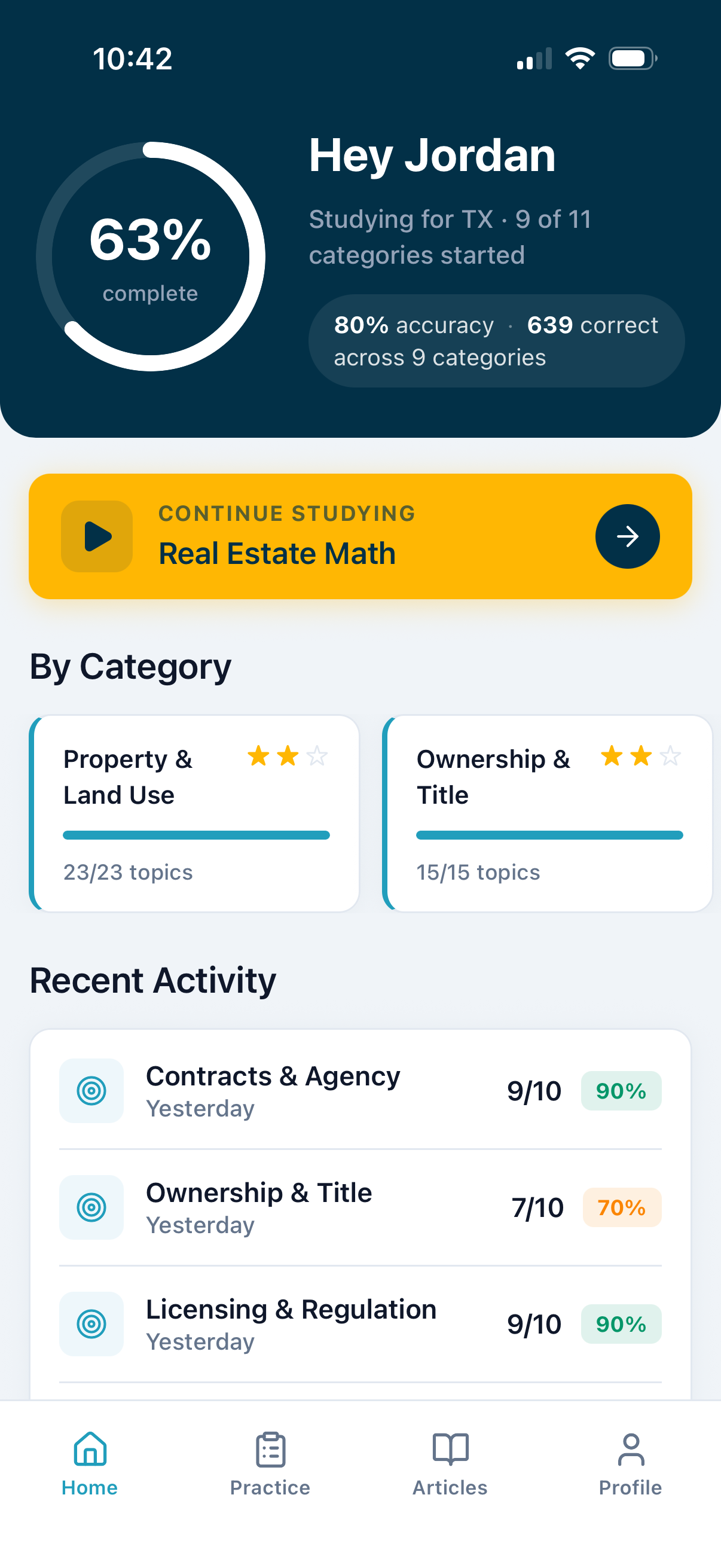
The RealReady app has all 1,080 questions covering both national real estate principles and Louisiana-specific law. The full app also includes:

  • Short articles that walk you through the why behind each topic
  • A missed-question drill mode
  • Detailed explanations on every question
  • Progress tracking with per-category accuracy

Unlike other real estate prep apps, we don't cut off access or charge a monthly subscription fee. It's a one-time $17.99, and it's yours forever.

About the exam

More about the Louisiana real estate exam

Louisiana stacks one of the largest state portions anywhere onto its real estate exam, grounded in the state's unique civil-law system overseen by the Louisiana Real Estate Commission. Because Louisiana is the only state that runs on a civil law system instead of English common law, Louisiana-specific prep is non-negotiable and national content alone won't get you to a pass.

Louisiana's exam leans on its civil law roots, usufruct and servitudes and the other rights in immovables, community property and separate property, lesion beyond moiety, redhibition for hidden defects, bond for deed sales, and the way the Commission regulates designated agency, dual agency, and the mandatory agency disclosure pamphlet. None of that looks like the material a candidate in a neighboring state studies. A generic real estate practice test won't cut it. You need Louisiana-specific practice questions.

FAQ

Louisiana real estate exam: your questions answered

How many questions are on the Louisiana real estate exam?

The Louisiana Real Estate Salesperson Examination has 135 scored multiple-choice questions, split into an 80-question national portion on general real estate principles and a 55-question Louisiana state portion on the state's laws, rules, and civil law. Pearson VUE also mixes in 10 to 15 unscored pretest questions that look identical to the scored ones, which is why the combination exam is sometimes described as having around 150 questions. Those pretest items don't count toward your score.

What's the passing score for the Louisiana real estate exam?

You need a scaled score of 70 on each portion, graded separately. Pearson VUE converts your raw answers to a scaled score from 0 to 100 to keep different versions of the test fair, so a strong national score won't carry a weak state score. If you pass one portion and fail the other, you only retake the part you failed, as long as you finish both within one year of passing the first one.

How much does the Louisiana real estate exam cost?

The Pearson VUE fee for the combination salesperson exam is $81 for your first attempt, which covers both the national and state portions in one sitting. A repeat of the full combination exam is $96. If you only need to retake one portion, the national-only exam is $42 and the state-only exam is $39. Exam fees are paid to Pearson VUE and are forfeited if you miss your appointment or cancel with less than 48 hours' notice.

How long is the Louisiana real estate exam?

Four hours (240 minutes) total when you take both portions in one sitting. Taken separately, Pearson VUE allots 150 minutes for the 80-question national exam and 90 minutes for the 55-question Louisiana exam. You take it on a computer at a Pearson VUE test center, with Louisiana sites in Baton Rouge, Metairie, New Orleans, Shreveport, Lafayette, Lake Charles, and several others, and you get your pass or fail result before you leave.

What makes the Louisiana real estate exam different from other states?

Louisiana is the only state whose property law comes from the civil law tradition rooted in the French and Spanish codes rather than English common law, and the state exam reflects it. You'll see concepts that simply don't exist elsewhere, like usufruct, naked ownership, servitudes, lesion beyond moiety, redhibition for hidden defects, acquisitive prescription, and the rules of succession. Even familiar ideas use different names and work differently here, so a candidate who only studied national material walks into the state portion at a real disadvantage.

Who administers the Louisiana real estate exam?

The Louisiana Real Estate Salesperson Examination is administered by Pearson VUE for the Louisiana Real Estate Commission (LREC). You register and schedule your exam date through Pearson VUE.

Is the Louisiana real estate exam hard?

The state portion is where most first-time candidates lose ground. The 80-question national portion is the same general content you'd see on any Pearson VUE real estate exam, but Louisiana's 55 state-law questions are dense and unusual. Two of the largest buckets are the Louisiana civil law system and the Louisiana law of agency, each carrying roughly 13 to 15 questions, and they cover material a national prep course never touches. Honest practice on a Louisiana-specific practice exam is the difference between passing on the first try and paying to retake a portion.

What's on the Louisiana real estate exam?

The 80-question national portion covers real property characteristics and land use, forms of ownership and transfer of title, property value and appraisal, real estate contracts and agency, the practice of real estate, property disclosures and environmental issues, financing and settlement, and real estate math. The 55-question Louisiana portion is weighted by Pearson VUE as roughly 13 to 15 questions on the Louisiana civil law system, 13 to 15 on the Louisiana law of agency, 13 to 15 on the statutory rules governing licensee activities, 7 to 9 on licensing requirements, and 4 to 6 on the duties and powers of the Real Estate Commission.

What's the best way to prepare for the Louisiana real estate exam?

After you finish your Louisiana pre-license coursework, the highest-leverage thing you can do is grind through Louisiana-specific practice questions with honest feedback on every miss. Generic real estate practice tests will help with the national portion but won't catch you on Louisiana's civil law concepts and agency rules, which make up more than half of the state portion. The RealReady app gives you the full bank of Louisiana questions plus the national bank, with progress tracking and a missed-question mode so you can drill what you're weak on. Most users study 30 to 60 minutes a day for 2 to 4 weeks before sitting the exam.

Is RealReady free?

The 20 Louisiana practice questions on this page are free, no account or signup needed. Unlocking the rest of the Louisiana bank is a single in-app purchase you pay once and own, with no recurring charge and no time limit on access.

Does RealReady cover the Louisiana real estate exam?

Yes. RealReady has a dedicated Louisiana question bank built for the Louisiana real estate exam, covering the national principles every candidate sees plus the Louisiana law that trips people up, like usufruct and servitudes, community property and separate property, and redhibition for hidden defects.

Is RealReady a real estate license course?

No. RealReady is exam practice, not a pre-license course, so it doesn't count toward Louisiana's required pre-license education hours. Use it after or alongside your coursework to drill realistic practice questions and find your weak spots before exam day.