Utah · Real estate exam prep

Utah Real Estate Practice Test

20 free Utah practice questions with no signup required. When you're ready for more, the full RealReady bank has 1,045 questions for the 2026 exam that cover both national principles and Utah law.

Practice below

Practice

20 Utah Real Estate Test Questions & Answers

Use this like a free Utah real estate practice test: read the question, commit to an answer, then tap to reveal the correct answer and a plain-English explanation. The ones you miss tell you where to focus next.

Q1 of 20 Licensing & Regulation

A consumer believes a licensee committed fraud during a transaction. Where should they file a complaint?

  1. The local Board of REALTORS
  2. The Association of REALTORS
  3. The county district court
  4. The Division of Real Estate
Show answer & explanation

Correct: D The Division of Real Estate

The Division of Real Estate investigates complaints against licensees, conducts audits, and initiates administrative proceedings. The Association of REALTORS is a private professional organization, not a government regulatory body.

Q2 of 20 Licensing & Regulation

Which person is exempt from Utah real estate licensing requirements?

  1. An unlicensed assistant showing property
  2. An attorney acting within their practice
  3. A part-time negotiator paid per deal
  4. A property owner's friend helping for a fee
Show answer & explanation

Correct: B An attorney acting within their practice

Active attorneys acting within the scope of their legal practice are exempt from licensing. Other exemptions include persons acting under court order and government employees performing official duties.

Q3 of 20 Licensing & Regulation

What is RELMS in Utah real estate?

  1. The real estate recovery fund database
  2. The online license management system
  3. An MLS alternative for rural areas
  4. A standardized listing contract form
Show answer & explanation

Correct: B The online license management system

RELMS (Real Estate License Management System) is Utah's online system for managing license-related activities including renewals, transfers, terminations, activation/inactivation, and continuing education tracking.

Q4 of 20 Licensing & Regulation

Who may file a complaint against a Utah real estate licensee with the Division?

  1. Only parties to the transaction
  2. Any person
  3. Only licensed real estate professionals
  4. Only the Real Estate Commission
Show answer & explanation

Correct: B Any person

Anyone can file a complaint with the Division of Real Estate. The Division then investigates and may take action ranging from dismissal to formal administrative proceedings.

Q5 of 20 State Practice

Utah recognizes which types of brokerage agency relationships?

  1. Seller, buyer, designated, and transaction
  2. Seller, buyer, and limited agency
  3. Single agency and dual agency only
  4. Seller and buyer agency only
Show answer & explanation

Correct: B Seller, buyer, and limited agency

Utah recognizes three types: seller agency, buyer agency, and limited agency (dual agency where the broker represents both parties with informed consent).

Q6 of 20 State Practice

Where must a Utah principal broker maintain the brokerage trust account?

  1. The Division of Real Estate office
  2. A federally insured Utah institution
  3. Any bank located in any state
  4. A state-chartered credit union only
Show answer & explanation

Correct: B A federally insured Utah institution

Principal brokers must maintain trust accounts at a federally insured financial institution located in Utah. This ensures the funds are protected by federal deposit insurance.

Q7 of 20 State Practice

A sales agent posts a property listing on social media without including the brokerage name. This is:

  1. A blind ad, which is prohibited
  2. Allowed for listings under $300,000
  3. Acceptable on personal social media
  4. Permitted if the agent's name appears
Show answer & explanation

Correct: A A blind ad, which is prohibited

All advertising must include the brokerage name as registered with the Division. Advertising without brokerage identification is considered a blind ad and is prohibited regardless of the platform.

Q8 of 20 State Practice

Utah requires sellers of residential property to provide which document to buyers?

  1. Agent's Visual Inspection Report
  2. Seller's Property Condition Disclosure
  3. County Property Assessment Report
  4. Division of Real Estate Clearance Form
Show answer & explanation

Correct: B Seller's Property Condition Disclosure

Utah requires sellers to provide a Seller's Property Condition Disclosure form covering structural condition, systems, environmental hazards, water rights, and known defects.

Q9 of 20 State Practice

The Utah Real Estate Purchase Contract (REPC) is approved by which entities?

  1. The title company and lender
  2. The Division of Real Estate and legislature
  3. The Real Estate Commission and Attorney General
  4. The Association of REALTORS only
Show answer & explanation

Correct: C The Real Estate Commission and Attorney General

The REPC is a standardized form approved by the Utah Real Estate Commission and the Office of the Attorney General. It is the standard purchase agreement used in Utah real estate transactions.

Q10 of 20 State Practice

In Utah, managing rental property for others for compensation requires:

  1. No license for fewer than 5 units
  2. A real estate license
  3. Only a business license
  4. A property management certificate only
Show answer & explanation

Correct: B A real estate license

Utah requires a real estate license to manage property for others for compensation. Property managers must be affiliated with a principal broker, just like sales agents.

Q11 of 20 State Transactions

Who is responsible for the safekeeping of earnest money in a Utah transaction?

  1. The title company at all times
  2. The principal broker
  3. The sales agent who collected it
  4. The buyer until closing
Show answer & explanation

Correct: B The principal broker

The principal broker is responsible for the safekeeping of earnest money. It must be deposited per contract terms or Division rules into the broker's trust account.

Q12 of 20 State Transactions

Utah real estate closings are typically handled by:

  1. The buyer's lender exclusively
  2. The Division of Real Estate
  3. Real estate attorneys only
  4. Title companies or escrow agents
Show answer & explanation

Correct: D Title companies or escrow agents

In Utah, closings are typically handled by title companies or escrow agents. They manage document execution, fund disbursement, and deed recording.

Q13 of 20 State Transactions

What is the maximum amount the Utah Recovery Fund will pay per transaction?

  1. $25,000
  2. $15,000
  3. $50,000
  4. $10,000
Show answer & explanation

Correct: B $15,000

The Utah Real Estate Education, Research and Recovery Fund pays a maximum of $15,000 per single transaction and $50,000 total per licensee.

Q14 of 20 State Transactions

Utah is a trust deed state, which means most residential loans use:

  1. A deed of trust instead of a mortgage
  2. A lease-purchase agreement
  3. A mortgage with judicial foreclosure
  4. A land contract with seller financing
Show answer & explanation

Correct: A A deed of trust instead of a mortgage

Utah is a trust deed state where most real estate loans use trust deeds (deeds of trust) rather than traditional mortgages. This enables non-judicial foreclosure.

Q15 of 20 Licensing & Regulation

Which action is within the Division of Real Estate's authority?

  1. Drafting purchase contract forms
  2. Revoking a real estate license
  3. Setting commission rate schedules
  4. Appointing local board presidents
Show answer & explanation

Correct: B Revoking a real estate license

The Division has authority to issue, suspend, and revoke real estate licenses. Commission rates are negotiable between parties, and the Real Estate Commission (not Division alone) approves forms.

Q16 of 20 Licensing & Regulation

A court appoints a receiver to sell real property from an estate. Does the receiver need a real estate license?

  1. No, persons acting under court order are exempt
  2. Only if they receive a commission
  3. Yes, all property sellers need a license
  4. Only if the property exceeds $500,000
Show answer & explanation

Correct: A No, persons acting under court order are exempt

Persons acting under a court order are exempt from Utah licensing requirements. This includes court-appointed receivers, trustees, and executors selling property as ordered by the court.

Q17 of 20 Licensing & Regulation

A sales agent is transferring to a new brokerage. Which system would they use to process this change?

  1. The Association of REALTORS portal
  2. The MLS transfer portal
  3. The county recorder's office
  4. RELMS
Show answer & explanation

Correct: D RELMS

RELMS handles all license management activities including transfers between brokerages. Licensees use this online system for renewals, transfers, terminations, and CE tracking.

Q18 of 20 Licensing & Regulation

After investigating a complaint, the Division determines a violation occurred but it was minor and unintentional. The Division may:

  1. Automatically revoke the license
  2. Only dismiss or revoke the license
  3. Refer to criminal court only
  4. Pursue informal resolution
Show answer & explanation

Correct: D Pursue informal resolution

Investigation outcomes include dismissal, informal resolution, or formal administrative action. For minor or unintentional violations, the Division may choose informal resolution rather than full formal proceedings.

Q19 of 20 State Practice

A broker represents both the buyer and seller in the same transaction with the informed consent of both parties. This relationship is called:

  1. Facilitator relationship
  2. Designated agency
  3. Limited agency
  4. Transaction brokerage
Show answer & explanation

Correct: C Limited agency

In Utah, when a broker represents both parties with informed consent, it is called limited agency. The broker owes limited duties to both parties and cannot advocate for one over the other.

Q20 of 20 State Practice

A principal broker deposits $50 of personal funds into the trust account to cover monthly bank service charges. This is:

  1. Prohibited as commingling
  2. Permitted to cover bank charges
  3. Only allowed with Division approval
  4. Permitted up to $500 maximum
Show answer & explanation

Correct: B Permitted to cover bank charges

While commingling personal and trust funds is generally prohibited, a broker may maintain a small amount of personal funds in the trust account specifically to cover bank service charges.

Want the rest of Utah's 1,045-question bank?

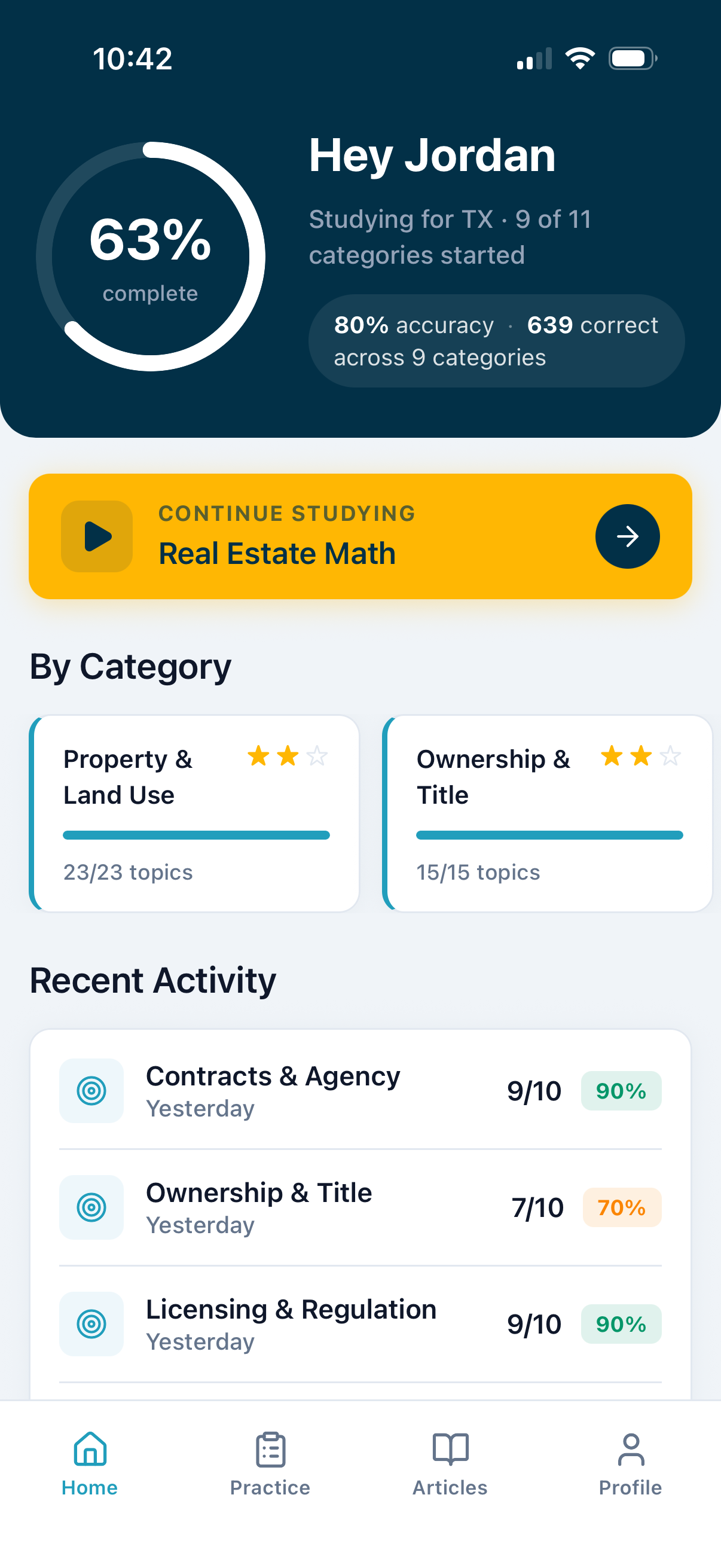
The RealReady app has all 1,045 questions covering both national real estate principles and Utah-specific law. The full app also includes:

  • Short articles that walk you through the why behind each topic
  • A missed-question drill mode
  • Detailed explanations on every question
  • Progress tracking with per-category accuracy

Unlike other real estate prep apps, we don't cut off access or charge a monthly subscription fee. It's a one-time $17.99, and it's yours forever.

About the exam

More about the Utah real estate exam

Utah's real estate exam carries a 50-question state section scored on its own, and it's where first-time candidates most often slip. A strong national score won't rescue a weak state score, so Utah-specific preparation matters more here than another pass through national review.

The Utah section leans on the Real Estate Licensing and Practice Act and Division rules, the limited agency relationship Utah uses in place of dual agency, the state-approved Real Estate Purchase Contract a sales agent fills in rather than drafts, trust account and earnest money handling, the Real Estate Education Research and Recovery Fund, and special Utah topics like prior appropriation water rights and the Lien Recovery Fund. None of that looks like the material a candidate in a neighboring state studies. A generic real estate practice test won't cut it. You need Utah-specific practice questions.

FAQ

Utah real estate exam: your questions answered

How many questions are on the Utah real estate exam?

The Utah Real Estate Sales Agent Examination has 130 scored questions, split into an 80-question national portion and a 50-question Utah state portion. Pearson VUE also mixes in unscored pretest questions, 5 on the national portion and 5 to 10 on the state portion, that don't count toward your result. You get four hours in total to finish both portions.

What's the passing score for the Utah real estate exam?

Utah uses a scaled score that runs from 0 to 100, and you need a 70 on each of the two portions, the national and the Utah state portion, scored separately. The scaled score is not the raw count or percentage of questions you got right, it is an equated score that adjusts for small differences in difficulty between exam forms. Because the portions are scored separately, a strong score on one won't offset a low score on the other. If you pass one portion and fail the other, you only retake the failed portion within six months.

How much does the Utah real estate exam cost?

Pearson VUE charges $69 to sit the Utah sales agent exam, paid by card or voucher when you make your reservation. The fee is non-refundable and non-transferable, and you pay it again for each examination reservation, including a retake of a single portion. Sales agent is the entry-level real estate license Utah issues.

How long is the Utah real estate exam?

Four hours in total. Pearson VUE runs the national and Utah portions in a single four-hour session, and the exam ends automatically when your time expires. You report to the test center about 30 minutes early and leave with an official pass or fail score report in hand.

Who administers the Utah real estate exam?

The Utah Real Estate Sales Agent Examination is administered by Pearson VUE for the Utah Division of Real Estate. You register and schedule your exam date through Pearson VUE.

Is the Utah real estate exam hard?

Plenty of first-time candidates pass, but the exam earns its reputation and the Utah state portion is where people stumble. The 80-question national portion is manageable for anyone who actually studied general principles. The 50-question state portion catches people off guard, because Utah's limited agency model, the state-approved Real Estate Purchase Contract, trust account rules, and topics like prior appropriation water rights and the Lien Recovery Fund don't match what national prep material teaches. Honest practice on Utah-specific questions is usually the difference between passing the first time and paying to retake a portion.

What's on the Utah real estate exam?

The 80-question national portion covers general real estate principles, property characteristics and ownership, valuation and appraisal, contracts and agency, real estate practice, disclosures and environmental issues, financing and settlement, and real estate math. The 50-question Utah portion focuses on the Division of Real Estate and the Real Estate Commission, licensing and license maintenance, office procedures and trust accounts, licensee practice and approved forms, agency including limited agency, enforcement, the Real Estate Education Research and Recovery Fund, and special Utah topics like water rights, the Lien Recovery Fund, and closing statements. The Utah material carries more weight than its share of questions suggests, because it is the part most candidates have never seen before.

What's the best way to prepare for the Utah real estate exam?

After you finish your 120 hours of sales agent prelicensing education, the highest-leverage move is grinding through Utah-specific practice questions with honest feedback on every miss. National practice tests help with the 80 national questions but won't catch you on Utah's limited agency rules, approved forms, and trust account requirements. The RealReady app gives you the full Utah question bank, plus a missed-question mode and per-category progress tracking so you can drill your weak spots. Most users study 30 to 60 minutes a day for two to four weeks before sitting the exam.

Is RealReady free?

The 20 Utah practice questions on this page are free, no account or signup needed. Unlocking the rest of the Utah bank is a single in-app purchase you pay once and own, with no recurring charge and no time limit on access.

Does RealReady cover the Utah real estate exam?

Yes. RealReady has a dedicated Utah question bank built for the Utah real estate exam, covering the national principles every candidate sees plus the Utah law that trips people up, like the limited agency relationship, the state-approved Real Estate Purchase Contract, and the Real Estate Education Research and Recovery Fund.

Is RealReady a real estate license course?

No. RealReady is exam practice, not a pre-license course, so it doesn't count toward Utah's required pre-license education hours. Use it after or alongside your coursework to drill realistic practice questions and find your weak spots before exam day.