Indiana · Real estate exam prep

Indiana Real Estate Practice Test

Practice Indiana real estate questions free below. RealReady has 1,045 questions in the bank covering both national real estate principles and Indiana state law. Pay $17.99 once and own it forever. No subscription like the other prep services.

The Indiana real estate broker exam is one of the toughest in the country. The Indiana Real Estate Commission contracts with Pearson VUE to administer it as a split test, 80 scored national questions and 50 scored state-specific questions, with a four-hour seat time. Indiana uses the word "broker" for what most other states call a salesperson license, so the entry-level exam covers full broker scope from day one. You have to pass each portion on a scaled score of 75 to qualify for a license.

State-specific prep matters more here than almost anywhere else. Indiana's required written agency disclosure, the seller's residential real estate sales disclosure form, the Consumer Restitution (Recovery) Fund, trust-account and earnest-money rules, psychologically affected properties statute, and the Indiana Real Estate Commission's enforcement powers under IC 25-34.1 and 876 IAC all show up on the exam. None of that looks like the material a candidate in a neighboring state studies. A generic real estate practice test won't cut it. You need Indiana-specific practice questions.

Below are 20 free Indiana real estate test questions and answers from RealReady's full Indiana bank. Each tests a specific topic with the correct answer and a plain-English explanation under the card. Read each one, commit to an answer, then reveal. Treat it like a real IREC practice test, and the ones you miss show you what to focus on next.

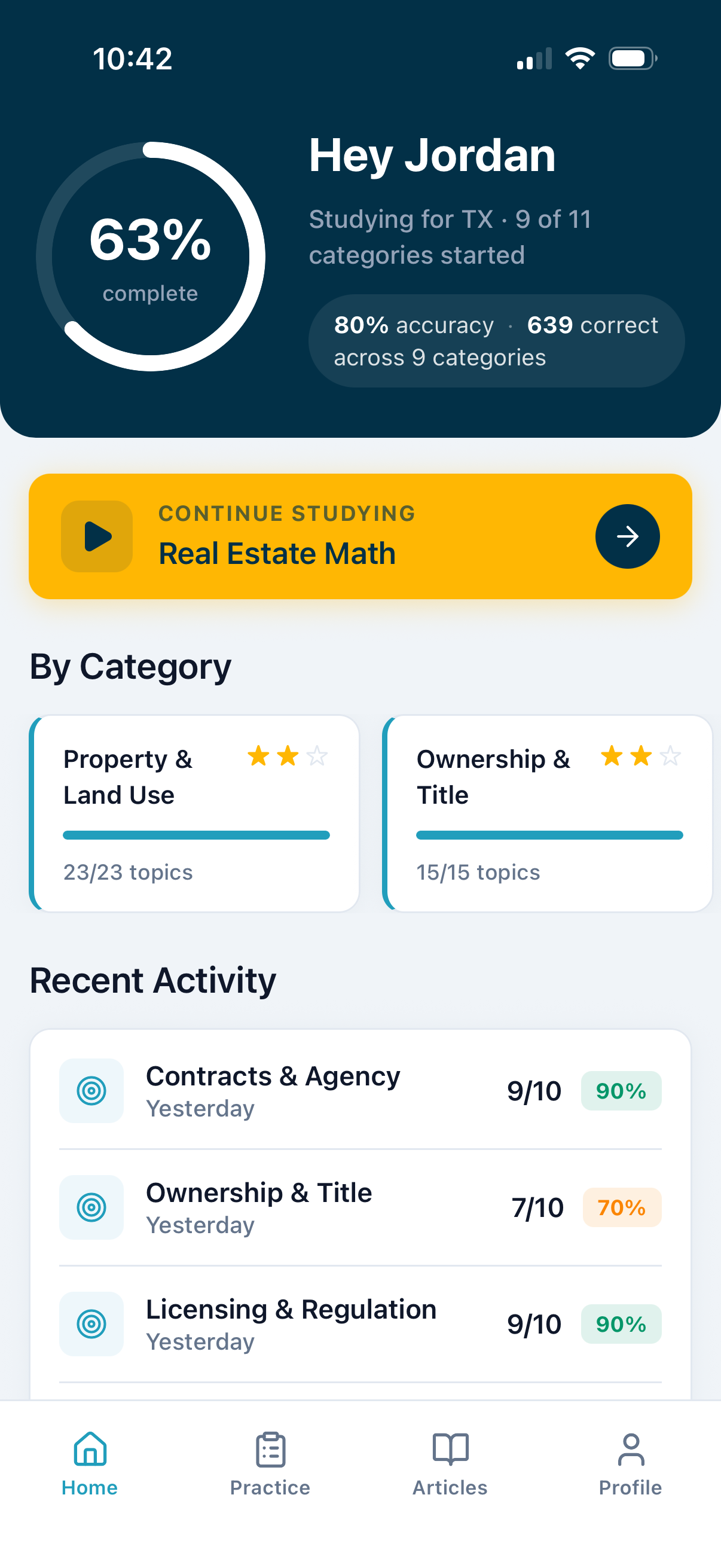
Get the RealReady app on iPhone, iPad, or Android for the rest of the Indiana question bank. The full app includes short articles that walk you through the why behind each topic, detailed explanations on every question, a missed-question drill mode, and progress tracking that shows your per-category accuracy.

Practice

20 Indiana Real Estate Test Questions & Answers

Use this like a free Indiana real estate practice test: read the question, commit to an answer, then tap to reveal the correct answer and a plain-English explanation. The ones you miss tell you where to focus next.

Q1 of 20 Licensing & Regulation

The Indiana Real Estate Commission (IREC) operates under which state agency?

  1. Secretary of State's Office
  2. Professional Licensing Agency (PLA)
  3. Department of Financial Institutions
  4. Department of Commerce
Show answer & explanation

Correct: B Professional Licensing Agency (PLA)

IREC is a division of Indiana's Professional Licensing Agency (PLA), which oversees multiple licensed professions. The PLA provides administrative support, while IREC retains authority over real estate licensing policy and discipline.

Q2 of 20 Licensing & Regulation

Who may file a complaint against a licensed broker with IREC?

  1. Any person with knowledge of a potential violation
  2. Only the buyer or seller in the transaction
  3. Only the PLA on IREC's behalf
  4. Only licensed brokers or managing brokers
Show answer & explanation

Correct: A Any person with knowledge of a potential violation

Indiana law allows any person — not just transaction parties — to file a complaint with IREC. This broad standing ensures the public can report violations they observe, even if not directly harmed.

Q3 of 20 Licensing & Regulation

Under Indiana law, which of the following activities requires a real estate license?

  1. Negotiating a lease on behalf of another for compensation
  2. Selling your own home without using a broker
  3. Referring a friend to a broker without receiving a fee
  4. Managing rental property you personally own
Show answer & explanation

Correct: A Negotiating a lease on behalf of another for compensation

Negotiating leases for others for compensation is a licensed activity in Indiana. Owners selling their own property and people managing property they own are exempt. Referring someone without receiving compensation does not trigger licensing requirements.

Q4 of 20 Licensing & Regulation

An Indiana broker is licensed but not currently affiliated with a managing broker. What status best describes her license?

  1. Unassigned status
  2. Inactive status
  3. Suspended status
  4. Referral status
Show answer & explanation

Correct: A Unassigned status

An Indiana broker who holds an active license but is not affiliated with a managing broker is in unassigned status. Inactive status means the broker has affirmatively chosen not to practice. Referral status is a separate category allowing limited referral activity. Unassigned and inactive are distinct classifications.

Q5 of 20 State Practice

A seller's broker in Indiana owes which fiduciary duty that requires placing the client's interests above all others?

  1. Fairness
  2. Loyalty
  3. Disclosure
  4. Accountability
Show answer & explanation

Correct: B Loyalty

Loyalty is the core fiduciary duty requiring a broker to place the client's interests above their own and all others. Disclosure, fairness, and accountability are duties owed to all parties, not exclusive fiduciary obligations to the client.

Q6 of 20 State Practice

Under Indiana law, the agency disclosure form provided to a consumer must include which of the following?

  1. The broker's errors and omissions insurance carrier
  2. A list of the broker's recent sales
  3. The type of agency relationship being offered
  4. The broker's commission rate
Show answer & explanation

Correct: C The type of agency relationship being offered

Indiana's agency disclosure form must identify the type of agency relationship being offered to the consumer — seller agency, buyer agency, landlord or tenant agency, or limited agency representing both sides with written consent under IC 25-34.1-10-12. Commission rates, sales history, and insurance information are not required elements of the agency disclosure form.

Q7 of 20 State Practice

Under Indiana professional standards, a broker's duty of competence requires which of the following?

  1. Performing services with reasonable skill and care
  2. Obtaining a specialist designation before assisting clients
  3. Guaranteeing transaction outcomes for clients
  4. Consulting an attorney on every real estate transaction
Show answer & explanation

Correct: A Performing services with reasonable skill and care

Indiana's professional standard of competence requires brokers to perform services with the reasonable skill and care expected of a licensed professional. This does not require specialist designations on every transaction or attorney involvement in each deal. Brokers cannot guarantee outcomes but must exercise sound professional judgment.

Q8 of 20 State Practice

An Indiana broker discovers during a listing walkthrough that the home has an active termite infestation. The seller instructs the broker to say nothing. The broker must:

  1. Withdraw from the listing rather than disclose
  2. Follow the seller's instruction — the seller controls disclosure
  3. Disclose the infestation to prospective buyers despite the seller's instruction
  4. Disclose only if asked directly by a buyer
Show answer & explanation

Correct: C Disclose the infestation to prospective buyers despite the seller's instruction

Indiana brokers have an affirmative duty to disclose known material facts that affect value or desirability, regardless of seller instructions. An active termite infestation is a material fact that must be disclosed to buyers. A seller cannot instruct a broker to withhold material defects. While withdrawal is an option, the better answer is disclosure.

Q9 of 20 State Practice

Under Indiana advertising rules, which element is required on all real estate advertisements?

  1. The firm's IPLA registration number
  2. The managing broker's personal name
  3. The individual broker's license number
  4. The brokerage firm's name
Show answer & explanation

Correct: D The brokerage firm's name

Indiana requires the brokerage firm's name to appear on all real estate advertisements. An individual broker's personal name, license number, or the firm's IPLA number are not independently required. Ads that omit the firm name are considered blind ads and are prohibited.

Q10 of 20 State Transactions

A seller asks her broker to prepare a listing agreement. Under Indiana law, which form is required for the agreement to be enforceable?

  1. Verbal agreement with written follow-up within 30 days
  2. Written agreement signed by seller only
  3. Oral agreement confirmed by email
  4. Written agreement signed by both parties
Show answer & explanation

Correct: D Written agreement signed by both parties

Indiana requires all listing agreements to be in writing and signed by both the seller and the broker to be enforceable. An oral listing agreement or one lacking the broker's signature does not satisfy the statutory requirement.

Q11 of 20 State Transactions

A listing broker receives an offer on her seller's property at 5:00 PM on a Friday. The seller is traveling. What is the broker's obligation?

  1. Present only if the offer meets the seller's minimum price
  2. Present the offer promptly, regardless of timing or inconvenience
  3. Hold the offer until Monday when the seller returns to the office
  4. Wait until a second offer arrives to present both simultaneously
Show answer & explanation

Correct: B Present the offer promptly, regardless of timing or inconvenience

Indiana requires all offers to be presented promptly to the seller. A broker cannot delay presentation based on the seller's travel schedule, the offer price, or a hope that a better offer will arrive. Withholding or delaying an offer is a violation of the broker's fiduciary duty.

Q12 of 20 State Transactions

Under IC 32-21-5, what standard must a seller meet when completing Indiana's Seller Disclosure form?

  1. Disclosure of all defects whether known or discoverable
  2. Disclosure only of defects identified by a licensed home inspector
  3. Good faith disclosure of all known material defects
  4. Certification that the property is free of all material defects
Show answer & explanation

Correct: C Good faith disclosure of all known material defects

Indiana's Seller Disclosure Act (IC 32-21-5) requires sellers to disclose known material defects in good faith. Sellers are not required to investigate for unknown defects or guarantee the property's condition — only to honestly disclose what they actually know.

Q13 of 20 State Transactions

How long must an Indiana broker retain transaction records such as listing agreements, purchase agreements, and closing documents?

  1. Until the transaction's first anniversary only
  2. A minimum of seven years to match federal tax requirements
  3. A minimum of three years
  4. A minimum of five years
Show answer & explanation

Correct: D A minimum of five years

Indiana requires brokers to retain transaction records — including listing agreements, purchase agreements, closing documents, trust account records, and correspondence — for a minimum of five years. The three-year period is incorrect; that standard applies in some other states.

Q14 of 20 State Transactions

A buyer's attorney is not present at closing in Indiana. Is the closing still legally valid?

  1. Yes, attorney attendance at closing is optional in Indiana
  2. Yes, but only for transactions under $500,000
  3. No, Indiana requires an attorney to oversee all residential closings
  4. No, an attorney must at least review all documents before closing
Show answer & explanation

Correct: A Yes, attorney attendance at closing is optional in Indiana

Indiana is an attorney-optional state for real estate closings. Title companies typically conduct closings without attorney involvement, which is legally valid. Buyers and sellers may choose to hire attorneys, but it is not required by Indiana law.

Q15 of 20 Licensing & Regulation

How are members of the Indiana Real Estate Commission appointed?

  1. Elected by licensed brokers statewide
  2. Appointed by the PLA director
  3. Appointed by the Governor
  4. Selected by the Indiana General Assembly
Show answer & explanation

Correct: C Appointed by the Governor

IREC members are appointed by the Governor of Indiana, consistent with the structure of most Indiana professional licensing boards. This gubernatorial appointment process ensures public accountability for the commission's oversight role.

Q16 of 20 Licensing & Regulation

During an IREC disciplinary hearing, which type of official typically presides and issues a recommended decision?

  1. A PLA staff attorney without judicial authority
  2. The IREC chairperson acting as sole adjudicator
  3. A circuit court judge appointed by the Governor
  4. Administrative Law Judge (ALJ)
Show answer & explanation

Correct: D Administrative Law Judge (ALJ)

Indiana disciplinary hearings are conducted by Administrative Law Judges (ALJs), who are neutral hearing officers. The ALJ issues a recommended order, which IREC may adopt, modify, or reject. This separates the prosecutorial and adjudicative functions.

Q17 of 20 Licensing & Regulation

A licensed auctioneer is hired to auction a parcel of real property at a public auction. Does this person also need an Indiana real estate license?

  1. Yes, all real property sales require a real estate license regardless of method
  2. No, licensed auctioneers conducting public auctions are exempt under IC 25-34.1-3-2
  3. Yes, unless the auction is conducted on the property itself
  4. No, but only if the auctioneer does not advertise the property beforehand
Show answer & explanation

Correct: B No, licensed auctioneers conducting public auctions are exempt under IC 25-34.1-3-2

Indiana's licensing statute (IC 25-34.1-3-2) explicitly exempts licensed auctioneers conducting sales at public auction under IC 25-6.1. This is one of several statutory exemptions from the real estate licensing requirement, alongside exemptions for attorneys, government employees, and court-appointed fiduciaries.

Q18 of 20 Licensing & Regulation

A broker on referral status in Indiana receives a request from a former client to show properties and write a contract. Can the broker do this?

  1. No, the broker must first upgrade to unassigned status before showing property
  2. No, referral status limits activity to referring clients to active brokers
  3. Yes, but only for former clients with whom the broker has a prior relationship
  4. Yes, referral status allows all licensed activities if unpaid
Show answer & explanation

Correct: B No, referral status limits activity to referring clients to active brokers

Referral status restricts the broker to making referrals only — showing property and writing contracts are full brokerage activities that require active affiliated status. The broker would need to change to active affiliated status before engaging in these activities. The restriction applies regardless of whether compensation is involved.

Q19 of 20 State Practice

A buyer's broker in Indiana negotiates a purchase price well below the seller's asking price, saving the buyer $15,000. This is an example of which fiduciary duty?

  1. Disclosure — revealing seller motivation to the buyer
  2. Loyalty — acting in the buyer's best financial interest
  3. Obedience — following the buyer's exact instructions
  4. Confidentiality — protecting buyer financial information
Show answer & explanation

Correct: B Loyalty — acting in the buyer's best financial interest

Aggressively negotiating to save the buyer money is the duty of loyalty — placing the client's interests paramount. While obedience is also a fiduciary duty, it applies to following lawful instructions, not proactive advocacy. Confidentiality and disclosure are separate duties.

Q20 of 20 State Practice

A buyer calls an Indiana broker to inquire about a listed property. After briefly discussing the neighborhood, the broker begins asking about the buyer's budget and financing. At what point must the agency disclosure be made?

  1. When the buyer submits a written offer
  2. Before the discussion about budget and financing begins
  3. At or before the signing of a buyer agency agreement
  4. At the first in-person showing of the property
Show answer & explanation

Correct: B Before the discussion about budget and financing begins

Indiana requires agency disclosure before substantive discussions about a specific property — including the buyer's financial situation, which directly relates to the transaction. Waiting until the showing or the offer is too late. The disclosure must occur before the conversation moves beyond general inquiry.

Want the rest of Indiana's 1,045-question bank?

The RealReady app has all 1,045 questions covering both national real estate principles and Indiana-specific law. The full app also includes:

  • Short articles that walk you through the why behind each topic
  • A missed-question drill mode
  • Detailed explanations on every question
  • Progress tracking with per-category accuracy

Unlike other real estate prep apps, we don't cut off access or charge a monthly subscription fee. Once you buy, it's yours forever.

FAQ

Indiana real estate exam — questions answered

How many questions are on the Indiana real estate broker exam?

The Indiana Real Estate Broker Examination has 145 total items, with 80 scored questions on the national portion and 50 scored questions on the state-specific portion. The exam also includes 5–10 unscored pretest items per portion that look identical to scored questions, so you should answer everything.

What's the passing score for the Indiana broker exam?

Indiana uses a scaled score of 75 on each portion, set by the Indiana Professional Licensing Agency together with Pearson VUE. The scaled score isn't the same as a raw percentage. You must pass both the national and state portions individually. If you pass one and fail the other, you only need to retake the failed part.

How much does the Indiana real estate broker exam cost?

The Pearson VUE examination fee is $55 per attempt, paid by credit card, debit card, or voucher at the time you reserve your seat. The fee is non-refundable and non-transferable. After you pass, the broker license application fee paid to the Indiana Professional Licensing Agency is $60, and the license renews every three years for another $60.

How long is the Indiana real estate broker exam?

Total seat time is 240 minutes (four hours), which covers both the national and state portions plus the tutorial and a short candidate survey. Pearson VUE administers the exam in person at testing centers across the state.

Is the Indiana real estate broker exam hard?

Yes, more than most candidates expect. Indiana is one of a smaller group of states where the entry-level license is the broker license, and the exam tests full broker scope (agency relationships, trust accounts, brokerage agreements, supervision of unlicensed assistants) instead of just salesperson basics. The state portion is dense with statute and rule, and a single missed concept on something like the written agency disclosure or the seller's disclosure form can pull your scaled score below 75. Honest practice on Indiana-specific questions, not generic national content, is what gets people across the line on the first try.

What's on the Indiana real estate broker exam?

The 80-question national portion covers property ownership and land use, forms of ownership and transfer of title, property value and appraisal, real estate contracts and agency, practice of real estate and fair housing, property conditions and financing, and settlement. The 50-question state portion covers five areas: the Indiana Real Estate Commission's general powers and disciplinary authority (5 items); licensing categories and maintenance (9 items); statutory and regulatory requirements like advertising, commissions, brokerage agreements, earnest money, the seller's residential real estate sales disclosure, and psychologically affected properties (12 items); statutes and rules governing agency relationships and licensee conduct (17 items); and real estate office procedures including trust accounts, branch offices, and the managing broker relationship (7 items).

What's the best way to prepare for the Indiana broker exam?

After finishing your 90-hour broker pre-licensing course, the highest-leverage thing you can do is grind through Indiana-specific practice questions with honest feedback on every miss. Generic real estate practice tests will help with the national portion but won't catch you on Indiana's unique rules like the written agency disclosure timing, the Consumer Restitution Fund cap, or the managing-broker supervision requirements. The RealReady app gives you the full bank of Indiana questions, plus progress tracking and a missed-question mode so you can drill what you're weak on. Most users study 30–60 minutes a day for 2–4 weeks before sitting the exam.