Delaware · Real estate exam prep

Delaware Real Estate Practice Test

Practice Delaware real estate questions free below. RealReady has 1,025 questions in the bank covering both national real estate principles and Delaware state law. Pay $17.99 once and own it forever. No subscription like the other prep services.

The Delaware real estate salesperson exam is one of the toughest in the country. The Delaware Real Estate Commission, working through Pearson VUE, administers it as a split exam, 80 scored questions on national real estate principles plus 40 scored questions on Delaware law and practice, in a single four-hour sitting. Most candidates underestimate the Delaware portion because it's smaller, but you have to pass it independently of the national side at a scaled score of 70, so state-specific prep is non-negotiable.

State-specific prep matters more here than almost anywhere else. Delaware's Real Estate Guaranty Fund, the Consumer Information Statement due at the earliest of the first scheduled appointment, the first showing of a property, or making an offer, the Delaware Uniform Common Interest Ownership Act for condo and HOA resale packages, the Unit Property Act, the Seller's Disclosure of Real Property Condition and radon disclosures, DNREC wastewater regulations on unimproved land, the Clear Zone sign-placement law, and Form 5403 nonresident real estate tax withholding all show up on the state portion. None of that looks like the material a candidate in Pennsylvania, Maryland, or New Jersey studies. A generic real estate practice test won't cut it. You need Delaware-specific practice questions.

Below are 20 free Delaware real estate test questions and answers from RealReady's full Delaware bank. Each tests a specific topic with the correct answer and a plain-English explanation under the card. Read each one, commit to an answer, then reveal. Treat it like a real DREC practice test, and the ones you miss show you what to focus on next.

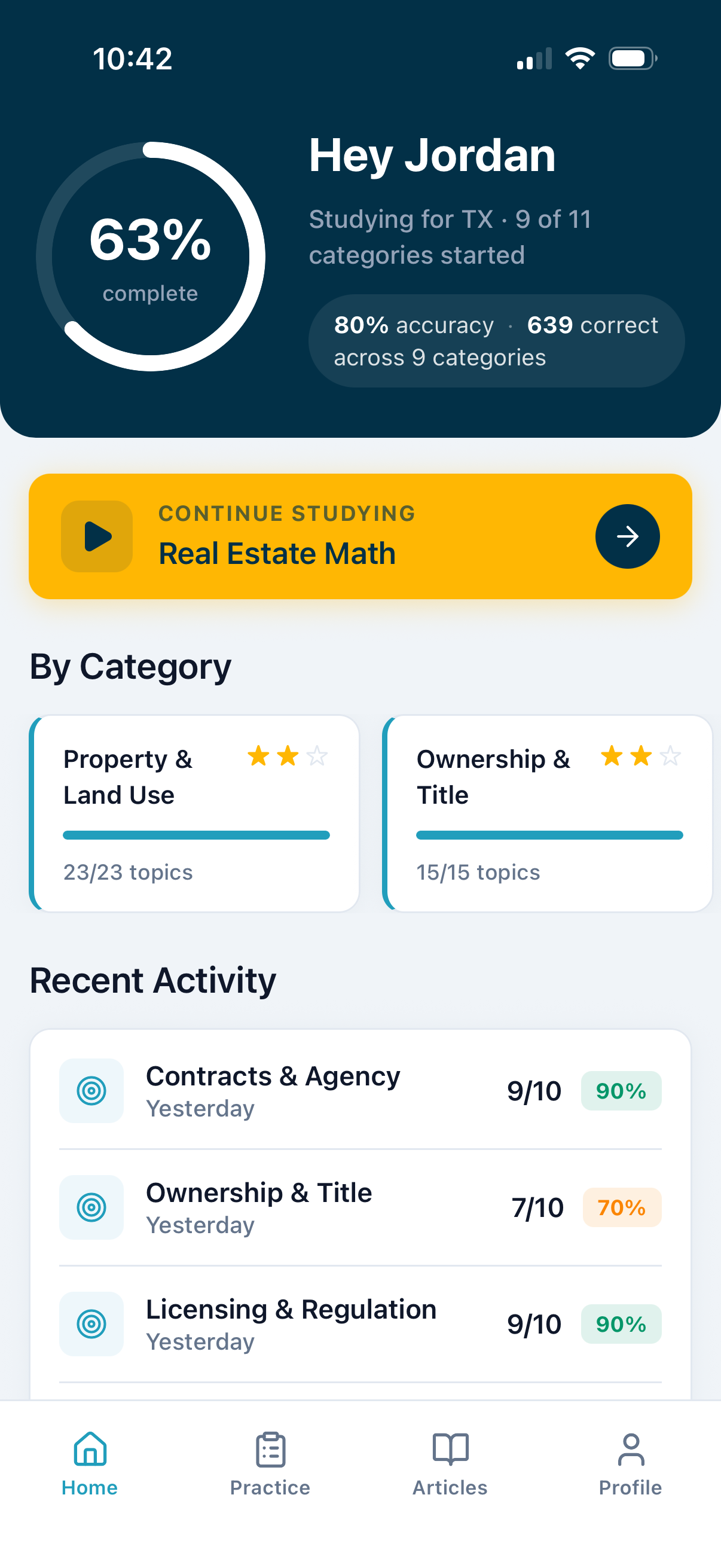
Get the RealReady app on iPhone, iPad, or Android for the rest of the Delaware question bank. The full app includes short articles that walk you through the why behind each topic, detailed explanations on every question, a missed-question drill mode, and progress tracking that shows your per-category accuracy.

Practice

20 Delaware Real Estate Test Questions & Answers

Use this like a free Delaware real estate practice test: read the question, commit to an answer, then tap to reveal the correct answer and a plain-English explanation. The ones you miss tell you where to focus next.

Q1 of 20 Licensing & Regulation

How many members serve on the Delaware Real Estate Commission?

  1. 9 members total
  2. 7 members total
  3. 5 members total
  4. 11 members total
Show answer & explanation

Correct: A 9 members total

The Delaware Real Estate Commission has 9 members: 5 professional members (3 brokers representing each county, 1 associate broker, and 1 salesperson) plus 4 public members. This composition ensures both industry expertise and public accountability.

Q2 of 20 Licensing & Regulation

A newly licensed individual wants to list and sell properties independently. Which license type does she need?

  1. Associate broker license
  2. Salesperson license
  3. Provisional broker license
  4. Broker license
Show answer & explanation

Correct: D Broker license

Only a broker may operate independently and supervise other licensees in Delaware. Salespersons and associate brokers must work under a licensed broker. The broker license is the highest level and carries full supervisory authority.

Q3 of 20 Licensing & Regulation

What is the primary purpose of the Delaware Real Estate Guaranty Fund?

  1. Fund Commission operations and staff
  2. Protect the public from licensee misconduct
  3. Insure licensees against client lawsuits
  4. Cover property damage during transactions
Show answer & explanation

Correct: B Protect the public from licensee misconduct

The Guaranty Fund exists to compensate members of the public who suffer financial loss due to the misconduct of a licensed real estate professional. It does not insure licensees, fund operations, or cover property damage.

Q4 of 20 Licensing & Regulation

A licensee struggling with alcohol dependency wants to seek help without losing her license. What Delaware provision addresses this?

  1. Mandatory substance abuse reporting rules
  2. Rule 14 voluntary treatment program
  3. The Guaranty Fund reimbursement process
  4. The Commission's automatic suspension policy
Show answer & explanation

Correct: B Rule 14 voluntary treatment program

Rule 14 provides a voluntary treatment pathway for licensees dealing with substance abuse or mental health issues. It offers an alternative to or can run alongside disciplinary proceedings, encouraging licensees to seek help proactively rather than hiding their condition.

Q5 of 20 State Practice

When must a Delaware licensee provide the Consumer Information Statement to a prospective buyer?

  1. At first substantive contact
  2. At the time of contract signing
  3. After the buyer requests one
  4. Within 48 hours of meeting
Show answer & explanation

Correct: A At first substantive contact

Under 24 Del. C. §2938, Delaware licensees must provide the CIS at the earliest of three triggers: the first scheduled appointment, the first showing of a property, or making an offer. In short, first substantive contact, before any confidential information passes between licensee and consumer.

Q6 of 20 State Practice

How many types of seller disclosure forms does Delaware require for residential property?

  1. One universal form
  2. Three different forms
  3. Two different forms
  4. Four different forms
Show answer & explanation

Correct: B Three different forms

The Delaware Real Estate Commission publishes three Seller's Disclosure of Real Property Condition Report forms: the standard residential form (used for 1-4 family dwellings including condos), New Construction Only, and Vacant Land. A separate Exemption Property Certification covers transactions exempt under 6 Del. C. §2572 such as foreclosures, court-ordered sales, and intra-family transfers.

Q7 of 20 State Practice

What must appear on every real estate advertisement in Delaware?

  1. The MLS listing identification
  2. The salesperson's license number
  3. The brokerage phone number only
  4. The broker's licensed name
Show answer & explanation

Correct: D The broker's licensed name

Delaware requires that the broker's licensed name appear on all real estate advertisements. This applies to every medium including print, online, digital, and social media. The purpose is to ensure consumers can identify the responsible broker.

Q8 of 20 State Practice

Under Delaware law, where must a newly licensed salesperson conduct real estate activities?

  1. Through the Real Estate Commission directly
  2. Independently after passing the exam
  3. Under a licensed broker's supervision
  4. Under any experienced salesperson
Show answer & explanation

Correct: C Under a licensed broker's supervision

Delaware requires all salespersons to work under the supervision of a licensed broker. A salesperson cannot conduct real estate activities independently, regardless of experience or exam passage. The broker is responsible for overseeing the salesperson's conduct.

Q9 of 20 State Practice

In addition to the seven federal protected classes, which class is specifically protected under Delaware fair housing law?

  1. Immigration status
  2. Political affiliation
  3. Sexual orientation
  4. Veteran status
Show answer & explanation

Correct: C Sexual orientation

Delaware's fair housing law extends protections beyond the seven federal classes to include sexual orientation, gender identity, marital status, age, source of income, and creed. Veteran status, political affiliation, and immigration status are not among Delaware's additional protected classes.

Q10 of 20 State Transactions

What is the combined Delaware realty transfer tax rate?

  1. 3% of the sale price
  2. 4% of the sale price
  3. 5% of the sale price
  4. 2% of the sale price
Show answer & explanation

Correct: B 4% of the sale price

Delaware's combined realty transfer tax is 4%, split between the state (2.5%) and the county (1.5%). This makes Delaware one of the highest transfer-tax states in the country.

Q11 of 20 State Transactions

Two unmarried friends buy a Delaware property together without specifying the form of ownership. How does the law classify their estate?

  1. Joint tenancy with survivorship
  2. Tenancy in common
  3. Tenancy by the entirety
  4. Community property
Show answer & explanation

Correct: B Tenancy in common

In Delaware, when co-owners do not specify the form of ownership, the default is tenancy in common. TIC allows unequal shares and does not include a right of survivorship. Each owner can transfer their interest independently.

Q12 of 20 State Transactions

What is the primary purpose of Delaware's Unit Property Act?

  1. Sets transfer tax rates for units
  2. Governs how property becomes a condominium
  3. Regulates single-family home sales
  4. Establishes landlord-tenant procedures
Show answer & explanation

Correct: B Governs how property becomes a condominium

The Unit Property Act is Delaware's older condominium statute that governs how real property is submitted to a condominium regime. It defines common elements, unit boundaries, and association governance for condominiums created under this law.

Q13 of 20 State Transactions

A Delaware landlord collects a security deposit on a two-year lease. What is the maximum amount the landlord may require?

  1. Three months' rent
  2. Two months' rent
  3. One and a half months' rent
  4. One month's rent
Show answer & explanation

Correct: D One month's rent

For leases of one year or longer in Delaware, the maximum security deposit a landlord may collect is one month's rent. This cap protects tenants from excessive upfront costs while still giving landlords reasonable security against damages.

Q14 of 20 State Transactions

A buyer wants to install a septic system on a rural Delaware lot. What must occur before installation can begin?

  1. County zoning board approval only
  2. A federal EPA environmental audit
  3. A DNREC site evaluation of soil conditions
  4. Written consent from adjacent landowners
Show answer & explanation

Correct: C A DNREC site evaluation of soil conditions

DNREC requires a site evaluation assessing soil and site conditions before any septic system installation in Delaware. This ensures the system will function properly and protect groundwater. The evaluation examines percolation rates, soil depth, and proximity to water sources.

Q15 of 20 Licensing & Regulation

A broker from Sussex County resigns from the Commission. Who appoints the replacement?

  1. The Delaware Association of Realtors
  2. The Division of Professional Regulation
  3. The remaining Commission members
  4. The Governor alone
Show answer & explanation

Correct: D The Governor alone

Under 24 Del. C. §2903, the Governor appoints all 9 members of the Delaware Real Estate Commission. A vacancy is filled by gubernatorial appointment for the remainder of the unexpired term. The statute does not require Senate confirmation, distinguishing the Commission's appointment process from many other Delaware boards.

Q16 of 20 Licensing & Regulation

How does an associate broker differ from a salesperson in Delaware?

  1. An AB may operate an independent office
  2. An AB needs fewer pre-license hours
  3. An AB is broker-qualified but works under another
  4. An AB cannot represent buyers directly
Show answer & explanation

Correct: C An AB is broker-qualified but works under another

An associate broker has met all broker qualifications but chooses to work under another broker rather than operating independently. A salesperson is the entry-level license and has not yet met broker requirements. Both must work under a supervising broker.

Q17 of 20 Licensing & Regulation

A buyer loses $40,000 due to a licensee's fraud. What is the maximum she can recover from the Guaranty Fund?

  1. $75,000
  2. $50,000
  3. $25,000
  4. $40,000
Show answer & explanation

Correct: C $25,000

The Guaranty Fund caps recovery at $25,000 per transaction or claim regardless of the number of persons aggrieved. Even though the buyer lost $40,000, the fund will pay no more than $25,000. She must pursue other legal remedies for the remaining $15,000.

Q18 of 20 Licensing & Regulation

What types of conditions does Rule 14 voluntary treatment address?

  1. Physical disabilities affecting job duties
  2. Only illegal drug use by licensees
  3. Only alcohol-related impairment
  4. Substance abuse and mental health issues
Show answer & explanation

Correct: D Substance abuse and mental health issues

Rule 14 covers both substance abuse and mental health conditions. The program is not limited to alcohol or illegal drugs alone. It provides a supportive framework for licensees dealing with a range of conditions that could impair their professional performance.

Q19 of 20 State Practice

A licensee shows a buyer three homes but never provides the Consumer Information Statement. What violation occurred?

  1. No violation if buyer didn't ask
  2. Failure to provide CIS before sharing info
  3. Violation only if contract is signed
  4. Violation only in commercial deals
Show answer & explanation

Correct: B Failure to provide CIS before sharing info

Under 24 Del. C. §2938, the CIS is due at the earliest of the first scheduled appointment, the first showing of a property, or making an offer. By showing three homes without providing it, the licensee blew past the first-showing trigger on the very first property and was in violation from that point on.

Q20 of 20 State Practice

A bank sells a foreclosed home at auction. Must the bank provide a Delaware seller disclosure form?

  1. Only if the buyer's agent requests it
  2. Only if the price exceeds $100,000
  3. No, court-ordered sales are exempt
  4. Yes, all residential sales require one
Show answer & explanation

Correct: C No, court-ordered sales are exempt

Court-ordered sales such as foreclosures, probate transfers, and bankruptcy sales are exempt from Delaware's seller disclosure requirements. The bank would instead provide an Exemption Property Certification.

Want the rest of Delaware's 1,025-question bank?

The RealReady app has all 1,025 questions covering both national real estate principles and Delaware-specific law. The full app also includes:

  • Short articles that walk you through the why behind each topic
  • A missed-question drill mode
  • Detailed explanations on every question
  • Progress tracking with per-category accuracy

Unlike other real estate prep apps, we don't cut off access or charge a monthly subscription fee. Once you buy, it's yours forever.

FAQ

Delaware real estate exam — questions answered

How many questions are on the Delaware real estate exam?

The Delaware Real Estate Salesperson Examination has 120 scored questions. 80 of those are on the general portion (national real estate principles) and 40 are on the Delaware state portion (laws, rules, and Commission regulations). Pearson VUE also embeds 5 unscored pretest items on the general portion and 10 on the state portion that aren't identified during the test.

What's the passing score for the Delaware real estate exam?

You need a scaled score of 70 on each portion, scored separately. The scaled score is a 0 to 100 number that Pearson VUE adjusts across exam forms so candidates aren't penalized for getting a harder version of the test, not the raw percentage of questions you answered correctly. If you pass one portion and fail the other, you only have to retake the part you failed, as long as you do so within one year of completing pre-licensing.

How much does the Delaware real estate exam cost?

The Pearson VUE examination fee is $88 per attempt, paid at the time you reserve your test. After you pass, the initial Delaware salesperson license application fee is $140, submitted through the DELPROS online portal to the Delaware Real Estate Commission. Licenses renew every two years on April 30 of even-numbered years.

How long is the Delaware real estate exam?

Four hours (240 minutes) for the full exam, taken as a single sitting that covers both the 80-question general portion and the 40-question Delaware state portion. Pearson VUE recommends arriving 30 minutes early to check in, and you leave the test center with a pass or fail score report in hand.

Is the Delaware real estate exam hard?

The state portion is harder than most candidates expect. The 80-question general portion is the same national real estate content you'd see on any Pearson VUE exam, but Delaware's 40 state-law questions are dense and unforgiving. Topics like the Consumer Information Statement timing rule, DUCIOA resale-certificate disclosures, the Real Estate Guaranty Fund's $25,000 per-transaction cap, and DNREC wastewater rules on unimproved land trip up candidates who didn't drill state-specific questions. The Commission doesn't publish a first-time pass rate, but if you fail both portions in three attempts, you have to retake the 99-hour pre-licensing course before testing again.

What's on the Delaware real estate exam?

The 80-question general portion covers eight national areas: real estate contracts and agency (16 items), real property characteristics and property valuation (11 items each), real estate practice (10 items), property disclosures and environmental issues (9 items), forms of ownership and transfer of title (9 items), financing and settlement (7 items), and real estate math (7 items). The 40-question Delaware portion is weighted toward statutory requirements governing licensees (17 items, including advertising, agency, handling of monies and documents, and Delaware's required disclosures), additional state topics like DUCIOA, the Unit Property Act, the Delaware Fair Housing Act, transfer taxes, DNREC wastewater rules, the Clear Zone sign-placement law, and Form 5403 (16 items), Commission duties and the Guaranty Fund (4 items), and licensing requirements (3 items).

What's the best way to prepare for the Delaware real estate exam?

After finishing your 99-hour Delaware pre-license course, the highest-leverage thing you can do is grind through Delaware-specific practice questions with honest feedback on every miss. The general portion isn't hard to prepare for if you've used any national prep tool, but the state portion is where Delaware-specific question banks earn their keep. The RealReady app gives you the full bank of Delaware questions, plus progress tracking and a missed-question mode so you can drill what you're weak on. Most users study 30-60 minutes a day for 2-4 weeks before sitting the exam.