Connecticut · Real estate exam prep

Connecticut Real Estate Practice Test

Practice Connecticut real estate questions free below. RealReady has 1,040 questions in the bank covering both national real estate principles and Connecticut state law. Pay $17.99 once and own it forever. No subscription like the other prep services.

The Connecticut real estate salesperson exam is one of the toughest in the country. PSI delivers it for the Connecticut Real Estate Commission and the Department of Consumer Protection as a 110-question test split into an 80-question national portion and a 30-question Connecticut state-law portion, with two hours allowed for the national portion and 45 minutes for the state portion. You need at least 70 percent on each section, scored separately, so Connecticut-specific prep matters as much as the national material.

State-specific prep matters more here than almost anywhere else. Public Act 23-84 (effective April 1, 2024) restructured Connecticut licensing with two-year license terms, a new associate-broker classification, fines up to $5,000 per violation, and a strict ban on broker subagency in residential transactions. Add the Connecticut Real Estate Guaranty Fund, the agency-disclosure rule that triggers at the first personal meeting with a prospect, the Residential Property Condition Disclosure Report, the off-site conditions disclosure law, Connecticut's expansive Fair Housing law, and the state and municipal conveyance taxes, and you see why a New York or Massachusetts prep tool will not catch what Connecticut tests. None of that looks like the material a candidate in a neighboring state studies. A generic real estate practice test won't cut it. You need Connecticut-specific practice questions.

Below are 20 free Connecticut real estate test questions and answers from RealReady's full Connecticut bank. Each tests a specific topic with the correct answer and a plain-English explanation under the card. Read each one, commit to an answer, then reveal. Treat it like a real DCP practice test, and the ones you miss show you what to focus on next.

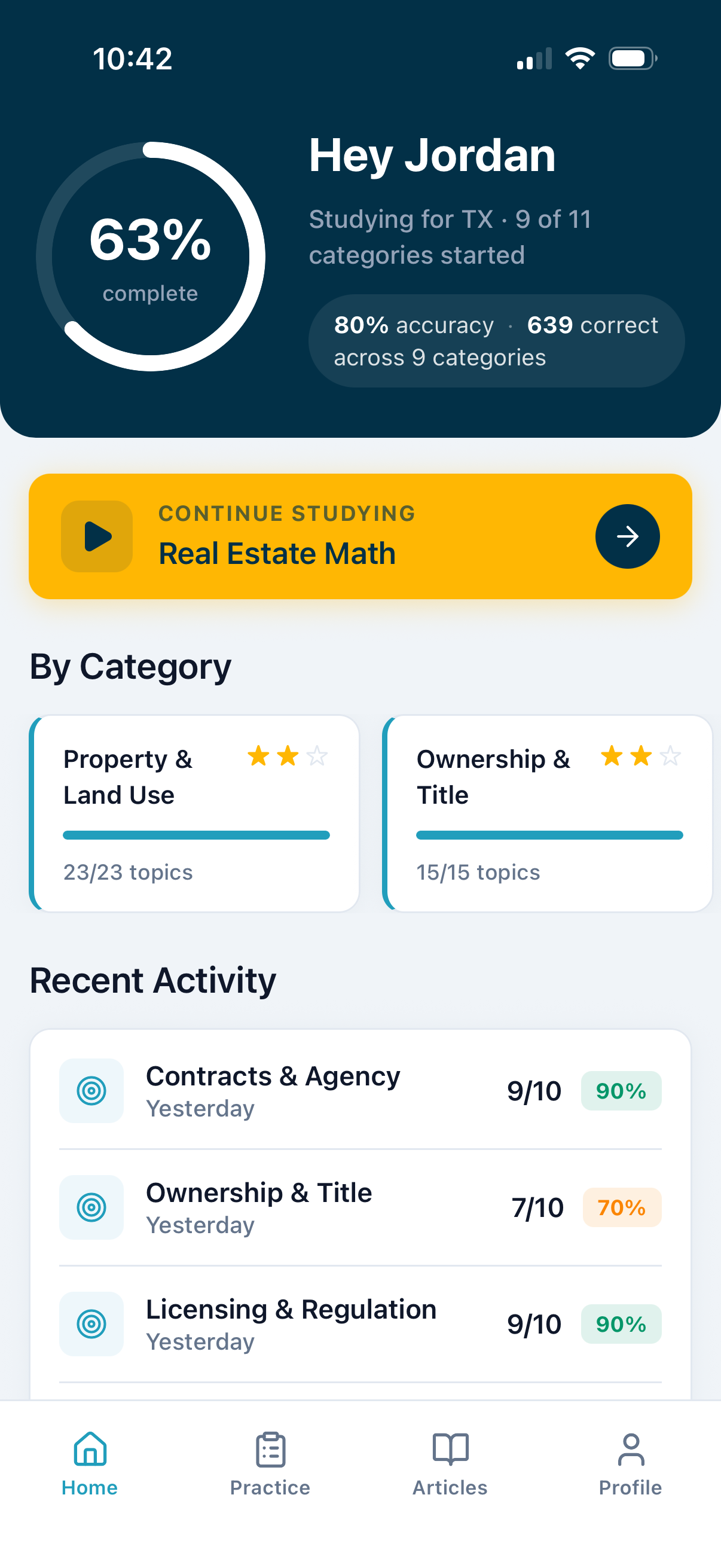
Get the RealReady app on iPhone, iPad, or Android for the rest of the Connecticut question bank. The full app includes short articles that walk you through the why behind each topic, detailed explanations on every question, a missed-question drill mode, and progress tracking that shows your per-category accuracy.

Practice

20 Connecticut Real Estate Test Questions & Answers

Use this like a free Connecticut real estate practice test: read the question, commit to an answer, then tap to reveal the correct answer and a plain-English explanation. The ones you miss tell you where to focus next.

Q1 of 20 Licensing & Regulation

The Connecticut Real Estate Commission operates within which state agency?

  1. Secretary of the State
  2. Department of Consumer Protection
  3. Department of Economic Development
  4. Department of Housing
Show answer & explanation

Correct: B Department of Consumer Protection

The Connecticut Real Estate Commission operates within the Department of Consumer Protection (DCP), Occupational and Professional Licensing Division. Unlike some states where the commission is independent, CT's commission functions under DCP.

Q2 of 20 Licensing & Regulation

Under current Connecticut law, a real estate license is valid for how many years before renewal?

  1. 2 years
  2. 4 years
  3. 1 year
  4. 3 years
Show answer & explanation

Correct: A 2 years

Since PA 23-84 (April 2024), Connecticut real estate licenses are valid for 2 years, changed from the previous 1-year term.

Q3 of 20 Licensing & Regulation

Which of the following is grounds for disciplinary action against a Connecticut licensee?

  1. Advertising a property at full list price
  2. Charging a commission below market rates
  3. Declining to represent a buyer
  4. Commingling client funds with personal funds
Show answer & explanation

Correct: D Commingling client funds with personal funds

Commingling client funds with personal or business funds is specifically listed as grounds for discipline under CGS §20-320. Commission rates are negotiable and declining representation is permitted.

Q4 of 20 Licensing & Regulation

What is the primary purpose of the Connecticut Real Estate Guaranty Fund?

  1. Compensate consumers harmed by licensee misconduct
  2. Provide down payment assistance to homebuyers
  3. Insure real estate transactions against market loss
  4. Fund continuing education programs for licensees
Show answer & explanation

Correct: A Compensate consumers harmed by licensee misconduct

The Guaranty Fund compensates consumers who suffer financial loss due to licensee misconduct when the licensee cannot pay. It is not insurance against market losses or a funding source for education.

Q5 of 20 State Practice

Which of the following is a recognized form of agency in Connecticut?

  1. Designated agent
  2. Facilitator agent
  3. Transaction agent
  4. Intermediary agent
Show answer & explanation

Correct: A Designated agent

Connecticut recognizes four agency types under Chapter 392 of the General Statutes: seller's agent, buyer's agent, dual agent (CGS 20-325g), and designated agent (CGS 20-325i). 'Transaction agent,' 'intermediary,' and 'facilitator' are terms used in other states (Florida, Colorado, Texas) and are not statutorily recognized in Connecticut.

Q6 of 20 State Practice

When must a Connecticut agent first disclose their agency status to another party?

  1. Only when a contract is signed
  2. At the beginning of the first personal meeting
  3. At the time an offer is presented
  4. Within 48 hours of showing a property
Show answer & explanation

Correct: B At the beginning of the first personal meeting

Connecticut requires agency disclosure at the beginning of the first personal meeting with any party. This ensures all parties understand the agent's role from the beginning of any substantive interaction.

Q7 of 20 State Practice

Dual agency in Connecticut requires what type of consent from both parties?

  1. Notarized consent agreement
  2. Implied consent through continued dealings
  3. Verbal acknowledgment only
  4. Informed written consent
Show answer & explanation

Correct: D Informed written consent

Connecticut requires informed written consent from both the buyer and seller before an agent may act as a dual agent. Verbal or implied consent is not sufficient.

Q8 of 20 State Practice

In Connecticut, who is responsible for ensuring salespersons comply with all real estate laws?

  1. The supervising broker
  2. Each individual salesperson
  3. The Department of Consumer Protection
  4. The Connecticut Real Estate Commission
Show answer & explanation

Correct: A The supervising broker

The broker supervises all salesperson activities and is responsible for ensuring compliance with all real estate laws and regulations. While DCP enforces the laws, the broker bears supervisory responsibility.

Q9 of 20 State Practice

All real estate advertising in Connecticut must include:

  1. The DCP educational approval number
  2. The salesperson's DCP license number
  3. The property's current assessed value
  4. The brokerage name as licensed
Show answer & explanation

Correct: D The brokerage name as licensed

Connecticut requires all advertising to include the name of the brokerage as it appears on the license. Ads without broker identification are considered 'blind ads' and are prohibited.

Q10 of 20 State Transactions

What is the default form of co-ownership when no specific form is stated in a Connecticut deed?

  1. Joint tenancy
  2. Tenancy in common
  3. Tenancy by the entirety
  4. Community property
Show answer & explanation

Correct: B Tenancy in common

Tenancy in common is the default form of co-ownership in Connecticut. To create joint tenancy, the deed must explicitly state that intent. Community property does not exist in Connecticut.

Q11 of 20 State Transactions

What is the state conveyance tax rate on the first $800,000 of a residential sale in Connecticut?

  1. 2.25%
  2. 0.75%
  3. 1.25%
  4. 0.50%
Show answer & explanation

Correct: B 0.75%

Connecticut uses a three-tier conveyance tax: 0.75% on the first $800,000, 1.25% on $800,001-$2,500,000, and 2.25% above $2,500,000 (the 'mansion tax').

Q12 of 20 State Transactions

Under Connecticut law, a seller of residential property must provide the buyer with a:

  1. Structural Safety Disclosure
  2. Property Inspection Certificate
  3. Home Warranty Agreement
  4. Residential Condition Report
Show answer & explanation

Correct: D Residential Condition Report

Connecticut requires sellers to complete a Residential Condition Report (CGS §20-327b) covering structural, mechanical, plumbing, electrical, and environmental conditions.

Q13 of 20 State Transactions

What is the maximum security deposit a Connecticut landlord can collect from a tenant under age 62?

  1. First and last month's rent
  2. 2 months' rent
  3. 3 months' rent
  4. 1 month's rent
Show answer & explanation

Correct: B 2 months' rent

Connecticut limits security deposits to 2 months' rent for tenants under age 62. Tenants age 62 or older have a lower cap of 1 month's rent.

Q14 of 20 State Transactions

The Connecticut Common Interest Ownership Act (CIOA) governs condominiums, planned communities, and cooperatives created after:

  1. January 1, 1984
  2. January 1, 1990
  3. January 1, 1975
  4. January 1, 2000
Show answer & explanation

Correct: A January 1, 1984

CIOA governs common interest communities created after January 1, 1984. Pre-1984 communities are governed by the older Connecticut Condominium Act.

Q15 of 20 Licensing & Regulation

A consumer files a complaint against a licensee in Connecticut. Which entity investigates the complaint?

  1. The Real Estate Commission directly
  2. The state Attorney General's office
  3. The Department of Consumer Protection
  4. The local municipal government
Show answer & explanation

Correct: C The Department of Consumer Protection

DCP investigates complaints and initiates disciplinary proceedings. While the Commission advises on policy and makes final disciplinary determinations, the investigative authority lies with DCP.

Q16 of 20 Licensing & Regulation

An associate broker in Connecticut is BEST described as a licensed broker who:

  1. Manages a branch office independently
  2. Operates an independent brokerage
  3. Supervises other salespersons
  4. Works under a supervising broker
Show answer & explanation

Correct: D Works under a supervising broker

An associate broker (created by PA 23-84) is a licensed broker who works for another broker in a capacity similar to a salesperson. The supervising broker must know of and consent to the associate broker's activities.

Q17 of 20 Licensing & Regulation

A salesperson is convicted of embezzlement unrelated to real estate. Can DCP take disciplinary action?

  1. No, only real estate violations apply
  2. Only if the victim was a real estate client
  3. Yes, conviction of fraud-related crimes is grounds
  4. Only if the conviction involved over $25,000
Show answer & explanation

Correct: C Yes, conviction of fraud-related crimes is grounds

Conviction of a felony or crime involving fraud, forgery, embezzlement, or extortion is grounds for discipline regardless of whether it involved real estate transactions.

Q18 of 20 Licensing & Regulation

A consumer was defrauded by an unlicensed individual posing as an agent. Can they claim from the Guaranty Fund?

  1. No, claims apply only to licensed individuals
  2. Only if the individual was previously licensed
  3. Yes, the Fund covers all real estate fraud
  4. Yes, if the loss exceeds $5,000
Show answer & explanation

Correct: A No, claims apply only to licensed individuals

The Guaranty Fund only applies to acts committed by individuals while acting in a licensed capacity. Fraud by an unlicensed person is not covered by the Fund.

Q19 of 20 State Practice

A licensee helps both the buyer and seller in a transaction with informed written consent from both. This is an example of:

  1. Dual agency
  2. Subagency
  3. Designated agency
  4. Transaction agency
Show answer & explanation

Correct: A Dual agency

Dual agency occurs when one agent represents both buyer and seller with informed written consent. Designated agency involves separate agents within the same brokerage assigned to each party.

Q20 of 20 State Practice

A buyer's agent meets a seller at an open house for the first time. What must the agent do regarding agency disclosure?

  1. Disclosure is optional at open houses
  2. Disclose their buyer's agent status to the seller
  3. Only disclose if the seller asks directly
  4. Wait until presenting an offer to disclose
Show answer & explanation

Correct: B Disclose their buyer's agent status to the seller

Agency disclosure must happen at the beginning of the first personal meeting, which includes meeting at an open house. The agent must inform the seller that they represent the buyer.

Want the rest of Connecticut's 1,040-question bank?

The RealReady app has all 1,040 questions covering both national real estate principles and Connecticut-specific law. The full app also includes:

  • Short articles that walk you through the why behind each topic
  • A missed-question drill mode
  • Detailed explanations on every question
  • Progress tracking with per-category accuracy

Unlike other real estate prep apps, we don't cut off access or charge a monthly subscription fee. Once you buy, it's yours forever.

FAQ

Connecticut real estate exam — questions answered

How many questions are on the Connecticut real estate exam?

The Connecticut Real Estate Salesperson Examination has 110 scored multiple-choice questions, split into an 80-question national portion and a 30-question Connecticut state-law portion. PSI also includes a small number of unscored experimental questions that look identical to the scored ones, and the time spent on those does not count against you.

What's the passing score for the Connecticut real estate exam?

You need at least 70 percent on each section, scored separately. That works out to 56 of 80 on the national portion and 21 of 30 on the state portion. If you pass one section and fail the other, you only have to retake the section you failed, and you have one year from your eligibility date to pass both portions.

How much does the Connecticut real estate exam cost?

The PSI examination fee is $59 per attempt, paid when you schedule the test with PSI. Before you reach scheduling, you'll also pay an $80 application fee to the Connecticut Department of Consumer Protection. After you pass, the initial salesperson license fee is $285 plus a $20 contribution to the Real Estate Guaranty Fund, and the license is valid for two years before renewal.

How long is the Connecticut real estate exam?

165 minutes total. The national portion is allotted two hours and the state portion is 45 minutes, taken back-to-back at a PSI testing center. PSI runs Connecticut sites in West Hartford and Milford, plus border sites in Auburn, Boston, Fall River, and West Springfield in Massachusetts. You receive an on-screen pass or fail notification before you leave.

Is the Connecticut real estate exam hard?

The state portion is where most first-time candidates lose ground. The national portion is the same content you'd find on any PSI real estate exam, but Connecticut's 30 state-law questions cover narrow topics like the Real Estate Guaranty Fund, the post-PA 23-84 license structure, agency disclosure at the first personal meeting, designated agency rules, the residential broker-subagency prohibition, and the Residential Property Condition Disclosure Report. Honest practice on a Connecticut-specific practice exam is the difference between passing on the first try and retaking the $59 exam.

What's on the Connecticut real estate exam?

The 80-question national portion covers property ownership, land-use controls, valuation and market analysis, financing, contracts, agency, property disclosures, transfer of title, the general practice of real estate, and real estate math, in proportions set by PSI's content outline. The 30-question Connecticut state portion covers the Real Estate Commission and licensing requirements, Connecticut laws governing licensee conduct (advertising, escrow handling, commissions, supervision, unlicensed assistants), Connecticut agency rules (representation by the first personal meeting, designated agency, the broker-subagency prohibition under PA 23-84), and Connecticut-specific principles and practices like the Residential Property Condition Disclosure Report, the off-site conditions disclosure law, the Common Interest Ownership Act, the Connecticut Fair Housing Law, conveyance tax, and the Real Estate Guaranty Fund.

What's the best way to prepare for the Connecticut real estate exam?

After finishing your 60-hour Real Estate Principles and Practices course at a DCP-approved school, the highest-leverage thing you can do is grind through Connecticut-specific practice questions with honest feedback on every miss. Generic real estate practice tests will help with national principles but won't catch you on Connecticut's unique rules, especially the changes Public Act 23-84 introduced in April 2024. The RealReady app gives you the full bank of Connecticut questions plus the national bank, with progress tracking and a missed-question mode so you can drill what you're weak on.