Massachusetts · Real estate exam prep

Massachusetts Real Estate Practice Test

20 free Massachusetts practice questions with no signup required. When you're ready for more, the full RealReady bank has 1,060 questions for the 2026 exam that cover both national principles and Massachusetts law.

Practice below

Practice

20 Massachusetts Real Estate Test Questions & Answers

Use this like a free Massachusetts real estate practice test: read the question, commit to an answer, then tap to reveal the correct answer and a plain-English explanation. The ones you miss tell you where to focus next.

Q1 of 20 Licensing & Regulation

A broker suspects a competing firm is commingling client funds. Who has the authority to examine that firm's financial records?

  1. The competing broker directly
  2. The local district attorney
  3. The Board of Registration
  4. The Massachusetts Bar Association
Show answer & explanation

Correct: C The Board of Registration

The Board of Registration has the authority to examine records of brokers and salespersons at any time. This power is fundamental to the Board's regulatory oversight.

Q2 of 20 Licensing & Regulation

A property owner hires a friend to find a buyer for their home and promises to pay $5,000 upon sale. The friend does NOT hold a real estate license. This arrangement is:

  1. Allowed if payment is after closing
  2. A violation of licensing law
  3. Permitted for single transactions
  4. Legal if the friend is a MA resident
Show answer & explanation

Correct: B A violation of licensing law

Any person who, for another and for compensation, negotiates or offers to negotiate the sale of real property must hold a license. The friend is engaging in licensed activity without a license.

Q3 of 20 Licensing & Regulation

A Massachusetts salesperson changes their home address. They must notify which entity?

  1. The Division of Banks
  2. The local Registry of Deeds
  3. The Board of Registration
  4. Their affiliated broker only
Show answer & explanation

Correct: C The Board of Registration

Licensees must notify the Board of Registration of any change of address. This is one of several mandatory Board notification requirements.

Q4 of 20 Licensing & Regulation

A homebuyer discovers that a broker intentionally concealed a known foundation defect. Under Chapter 93A, the buyer may seek up to:

  1. Double damages (2x actual damages)
  2. Actual damages only
  3. Treble damages (3x actual damages)
  4. Punitive damages capped at $50,000
Show answer & explanation

Correct: C Treble damages (3x actual damages)

For willful or knowing violations — or a bad-faith refusal to settle after the demand letter — Chapter 93A requires multiple damages of at least two and up to three times actual damages (MGL c.93A §9(3)). Reasonable attorney fees are also awarded to prevailing plaintiffs.

Q5 of 20 State Practice

When must a Massachusetts licensee provide the Massachusetts Mandatory Licensee-Consumer Relationship Disclosure form?

  1. At the time an offer is submitted to the seller
  2. At the first personal meeting about a specific property
  3. After a purchase and sale agreement is signed
  4. Only when specifically requested by the consumer
Show answer & explanation

Correct: B At the first personal meeting about a specific property

254 CMR 3.00(13) requires the Massachusetts Mandatory Licensee-Consumer Relationship Disclosure at the first personal meeting between the licensee and a prospective purchaser or seller to discuss a specific property. The form is a disclosure, not a contract, and a consumer who declines to sign it is simply noted as having declined.

Q6 of 20 State Practice

A newly licensed Massachusetts salesperson wants to begin practicing immediately. What must they do first?

  1. Register with the local Board of Health
  2. Open their own brokerage firm
  3. Complete a mentorship program
  4. Affiliate with a licensed MA broker
Show answer & explanation

Correct: D Affiliate with a licensed MA broker

A salesperson must be affiliated with a licensed Massachusetts broker before they can practice. They cannot operate independently or open their own firm without a broker license.

Q7 of 20 State Practice

A salesperson creates a flyer advertising a listing using only their own name. This advertisement is:

  1. Permitted for open house flyers only
  2. Acceptable if the salesperson has permission
  3. A violation — it must include the broker's name
  4. Legal if the property address is included
Show answer & explanation

Correct: C A violation — it must include the broker's name

Under 254 CMR 3.00(9)(b), salespersons are prohibited from advertising the purchase, sale, rental or exchange of real property under their own name at all — advertising is done by and in the name of the employing broker. All advertisements must include the name of the real estate broker (the licensed brokerage entity or its properly filed d/b/a).

Q8 of 20 State Practice

A Massachusetts broker deposits a client's earnest money into the brokerage operating account. This practice is called:

  1. Leveraging
  2. Conversion
  3. Interpleading
  4. Commingling
Show answer & explanation

Correct: D Commingling

Commingling is mixing client funds with the broker's personal or business funds. Brokers must maintain separate trust/escrow accounts for client funds. Commingling is a serious violation.

Q9 of 20 State Practice

Massachusetts fair housing law protects which class that is NOT protected under federal fair housing law?

  1. National origin
  2. Familial status
  3. Race
  4. Source of income
Show answer & explanation

Correct: D Source of income

Source of income (including housing vouchers/Section 8) is protected under MA Chapter 151B but not under the federal Fair Housing Act. Race, familial status, and national origin are federal protections.

Q10 of 20 State Practice

The Consumer/Licensee Relationship disclosure form informs a consumer about agency options. Which document actually establishes an agency relationship?

  1. An agency agreement
  2. A mortgage commitment letter
  3. The signed disclosure form itself
  4. A purchase and sale agreement
Show answer & explanation

Correct: A An agency agreement

The disclosure form explains the agency options available but does not create an agency relationship — it expressly states it is not a contract. Only an agency agreement (such as a listing or buyer agency agreement) establishes the relationship.

Q11 of 20 State Transactions

Massachusetts uses a unique two-step contract process. The first step is called:

  1. The Memorandum of Sale
  2. The Letter of Intent
  3. The Earnest Money Contract
  4. The Offer to Purchase
Show answer & explanation

Correct: D The Offer to Purchase

Massachusetts uses a two-step process: the Offer to Purchase (or 'binder') is the initial shorter document, followed by the more detailed Purchase and Sale Agreement.

Q12 of 20 State Transactions

Under Massachusetts Lead Law, properties built before which year are presumed to contain lead paint?

  1. 1950
  2. 1960
  3. 1985
  4. 1978
Show answer & explanation

Correct: D 1978

Properties built before 1978 are presumed to contain lead paint. This is consistent with the federal standard, but Massachusetts has stricter enforcement requirements.

Q13 of 20 State Transactions

Under MGL Chapter 186 Section 15B, the maximum security deposit a Massachusetts landlord may collect is:

  1. One month's rent
  2. Two months' rent
  3. Three months' rent
  4. One and a half months' rent
Show answer & explanation

Correct: A One month's rent

Massachusetts limits security deposits to one month's rent. In addition, landlords may collect first month's rent, last month's rent, and the actual cost of a lock change — but no more.

Q14 of 20 State Transactions

A married couple in Massachusetts takes title without specifying a form of ownership. The default form will be:

  1. Community property
  2. Joint tenancy
  3. Tenancy by the entirety
  4. Tenancy in common
Show answer & explanation

Correct: D Tenancy in common

Under MGL c.184 §7, a conveyance to two or more persons — including a married couple — creates a tenancy in common unless the deed expressly states otherwise. To obtain tenancy by the entirety and its survivorship and creditor protections, the deed must expressly say 'as tenants by the entirety.'

Q15 of 20 State Transactions

The most commonly used deed type in Massachusetts is:

  1. Quitclaim deed
  2. General warranty deed
  3. Bargain and sale deed
  4. Special warranty deed
Show answer & explanation

Correct: A Quitclaim deed

The quitclaim deed is the most commonly used deed in Massachusetts. Despite the name, the MA quitclaim deed under M.G.L. c.183 §11 carries limited 'quitclaim covenants' — the grantor warrants that the premises are free from encumbrances made by the grantor, and will defend the title against anyone claiming by, through, or under the grantor. In other states this same protection is called a special warranty or limited warranty deed.

Q16 of 20 Licensing & Regulation

An applicant for a Massachusetts real estate license is currently on probation for a misdemeanor. What action will the Board MOST likely take?

  1. Require additional education hours
  2. Issue a provisional license
  3. Grant the license with conditions
  4. Deny the application
Show answer & explanation

Correct: D Deny the application

The Board does not license applicants currently on probation or parole. This is part of the Board's 'Good Moral Character' standards for initial licensure.

Q17 of 20 Licensing & Regulation

Which of the following persons is EXEMPT from the Massachusetts real estate licensing requirement?

  1. A person who charges tenants a fee to find them apartments
  2. A friend selling property for a fee
  3. An attorney acting within their practice
  4. A part-time real estate consultant
Show answer & explanation

Correct: C An attorney acting within their practice

Attorneys are exempt only for services rendered to a client in the performance of their duties as an attorney (MGL c.112 §87QQ). A friend paid to sell, a paid consultant, and anyone charging tenants a fee to find them apartments must be licensed — only a licensed broker or salesperson can charge an apartment-finding fee. Owners, their regular employees, and managing agents under contract with the owner are exempt.

Q18 of 20 Licensing & Regulation

A salesperson leaves Broker A to affiliate with Broker B. Who must notify the Board of this change?

  1. Both Broker A and Broker B
  2. Only the salesperson
  3. Only the former Broker A releasing them
  4. Only the new Broker B receiving them
Show answer & explanation

Correct: A Both Broker A and Broker B

Under 254 CMR 3.00(7), brokers must furnish the Board with the names and license numbers of salespersons they engage at the start of an affiliation, and must notify the Board when the relationship is terminated. Broker A reports the termination and Broker B reports the new affiliation — the duty falls on the brokers of record, not the salesperson.

Q19 of 20 Licensing & Regulation

Before filing a Chapter 93A lawsuit, a consumer must first:

  1. Send a 30-day demand letter
  2. File a complaint with the Board
  3. Request mediation from MCAD
  4. Obtain a police report
Show answer & explanation

Correct: A Send a 30-day demand letter

Chapter 93A requires a 30-day demand letter before filing suit, giving the defendant a chance to settle. Failure to send the demand letter can result in dismissal of the case.

Q20 of 20 State Practice

A licensee assists both the buyer and seller in a transaction without representing either party. This licensee is acting as a:

  1. Seller's subagent
  2. Facilitator or transaction broker
  3. Designated agent
  4. Dual agent
Show answer & explanation

Correct: B Facilitator or transaction broker

A facilitator (transaction broker) assists both parties without representing either. This differs from dual agency, where the licensee represents both parties with written consent.

Want the rest of Massachusetts's 1,060-question bank?

The RealReady app has all 1,060 questions covering both national real estate principles and Massachusetts-specific law. The full app also includes:

  • Short articles that walk you through the why behind each topic
  • A missed-question drill mode
  • Detailed explanations on every question
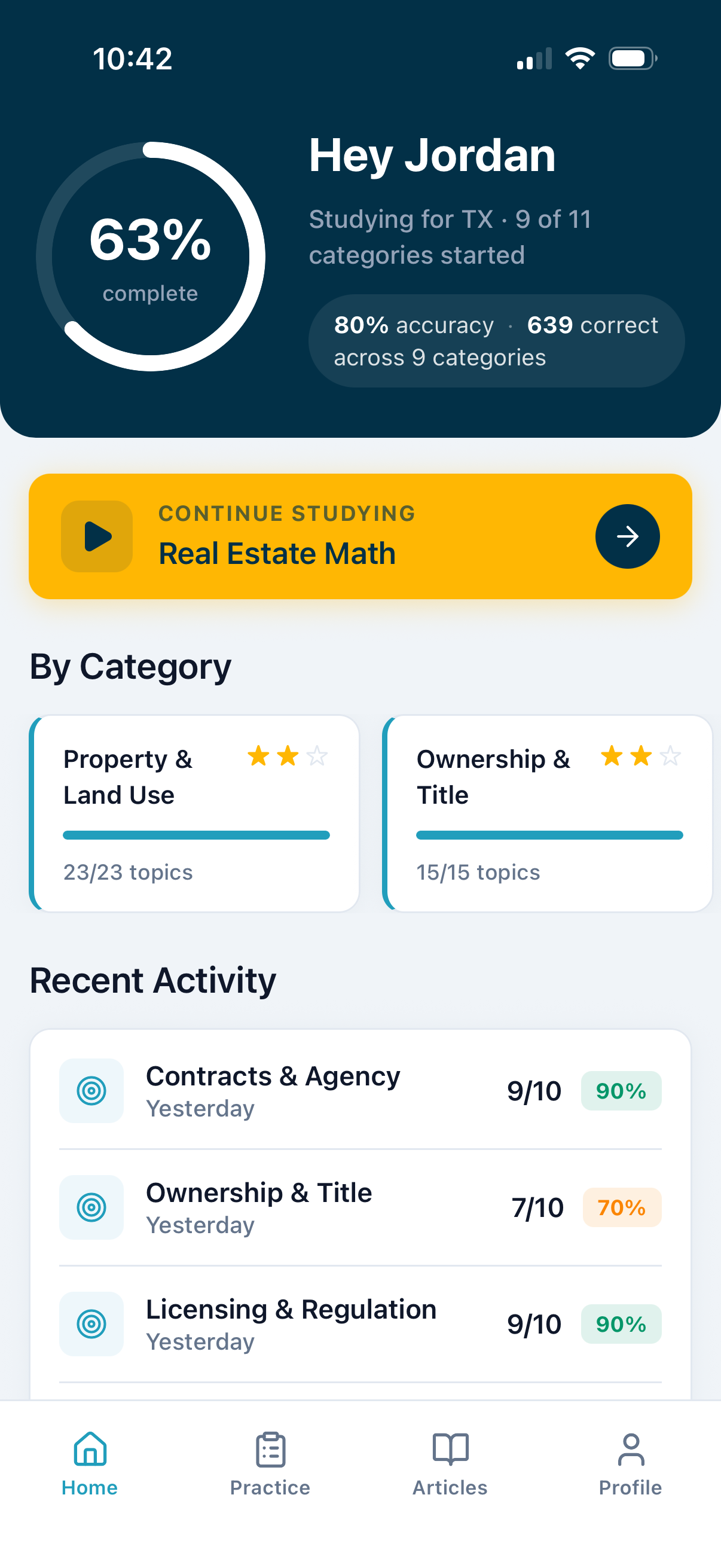
  • Progress tracking with per-category accuracy

Unlike other real estate prep apps, we don't cut off access or charge a monthly subscription fee. It's a one-time $17.99, and it's yours forever.

About the exam

More about the Massachusetts real estate exam

Massachusetts trips up candidates on its 40-question state portion, a third of which is the Requirements Governing Licensees section alone (advertising, agency disclosure, handling client money). Because the Board of Registration of Real Estate Brokers and Salespersons scores the General and State portions separately, a strong national score will not rescue a weak showing on Massachusetts law, and Massachusetts-specific preparation is the only way to clear that 40-question state half on the first try.

The State portion leans heavily on Chapter 93A consumer-protection liability, Title 5 septic inspection requirements under 310 CMR 15, the Massachusetts Lead Paint Law disclosure rules under M.G.L. c.111 §197A, smoke and carbon monoxide detector certificates under c.148 §26F, the one-month security deposit cap and Statement of Condition under c.186 §15B, the broader fair-housing protected classes in c.151B, and the Board's own advertising, agency, and conflict-of-interest rules. None of that looks like the material a candidate in a neighboring state studies. A generic real estate practice test won't cut it. You need Massachusetts-specific practice questions.

FAQ

Massachusetts real estate exam: your questions answered

How many questions are on the Massachusetts real estate exam?

The Massachusetts Real Estate Salesperson Examination has 120 scored multiple-choice questions, split into an 80-question General portion and a 40-question State portion. PSI delivers both portions back-to-back in one computer-based appointment at a Massachusetts test center. A small number of unscored experimental questions are mixed in that do not count toward your result.

What's the passing score for the Massachusetts real estate exam?

70% on each portion separately, which works out to 56 of 80 on the General portion and 28 of 40 on the State portion. If you pass one portion and fail the other, the Board lets you retake only the failed portion, but you have to clear it within two years of completing your 40-hour pre-license course or the partial pass expires and you have to retake both halves.

How much does the Massachusetts real estate exam cost?

PSI charges $56 per examination attempt, and that single fee covers both the General and State portions whether you sit them together or retake just one. The Board's $31 salesperson application fee is paid up front when you apply for exam eligibility through eLIPSE, and after passing you pay the license fee itself, prorated to your date of birth on a biennial cycle with a $103 renewal fee. Active-duty military and veterans pay the same $56 testing fee.

How long is the Massachusetts real estate exam?

240 minutes total, broken into 150 minutes for the 80-question General portion and 90 minutes for the 40-question State portion. PSI delivers both portions in one sitting at a Massachusetts test site, your score shows on screen when you finish, and PSI emails your score report. You can request a duplicate score report later by emailing scorereport@psionline.com.

Who administers the Massachusetts real estate exam?

The Massachusetts Real Estate Salesperson Examination is administered by PSI for the Massachusetts Board of Registration of Real Estate Brokers and Salespersons. You register and schedule your exam date through PSI.

Is the Massachusetts real estate exam hard?

It's a serious exam. The General portion covers the same national real estate principles tested in every state, and the State portion adds a dense layer of Massachusetts statutes and Board rules that catch candidates who only studied national material. Most people who fail underestimated the 40-question state portion, particularly the Requirements Governing Licensees section, which is one-third of the state score on its own and covers advertising, agency disclosures, commissions, handling of monies, and home-inspector referral rules. Honest reps on Massachusetts-specific practice questions are the difference between a first-time pass and a $56 retake.

What's on the Massachusetts real estate exam?

The 80-question General portion covers eleven areas, with Contracts (about 19%), Agency (about 13%), Practice of Real Estate (about 12%), Property Ownership (about 10%), Financing (about 10%), Valuation (about 8%), Property Disclosures (about 7%), Real Estate Calculations (about 7%), Transfer of Title (about 6%), Land Use Controls (about 5%), and Property Management (about 3%) carrying the weights. The 40-question State portion is heavier still on Massachusetts law. About a third tests Requirements Governing Licensees (advertising, broker-salesperson relationship, commissions, agency and non-agency relationships, handling of documents and monies, due diligence, home inspectors), with the rest spread across Consumer Protection Laws (Chapter 93A), Environmental Issues and Hazardous Materials (Lead Paint Law, Title 5, smoke and CO detectors, Wetlands Protection Act), Massachusetts Fair Housing Law under c.151B, Landlord-Tenant Law including rental deposits and the State Sanitary Code, Board duties and powers, licensing, contracts, and registered land.

What's the best way to prepare for the Massachusetts real estate exam?

After you finish the 40-hour Board-approved pre-license course, the highest-leverage move is grinding Massachusetts-specific practice questions with honest feedback on every miss. National principles you can pick up from any course, but the State portion rewards repetition on Chapter 93A, Title 5, the Lead Paint Law, c.151B fair-housing classes, the security deposit rules, and the Board's own advertising and agency requirements. The RealReady app gives you the full Massachusetts question bank, detailed explanations, a missed-question drill mode, and per-category progress tracking so you can see exactly where you are weak. Most users study 30 to 60 minutes a day for a few weeks before sitting the PSI exam.

Is RealReady free?

The 20 Massachusetts practice questions on this page are free, no account or signup needed. Unlocking the rest of the Massachusetts bank is a single in-app purchase you pay once and own, with no recurring charge and no time limit on access.

Does RealReady cover the Massachusetts real estate exam?

Yes. RealReady has a dedicated Massachusetts question bank built for the Massachusetts real estate exam, covering the national principles every candidate sees plus the Massachusetts law that trips people up, like Chapter 93A consumer-protection liability, Title 5 septic inspection requirements, and the Massachusetts Lead Paint Law disclosure rules.

Is RealReady a real estate license course?

No. RealReady is exam practice, not a pre-license course, so it doesn't count toward Massachusetts's required pre-license education hours. Use it after or alongside your coursework to drill realistic practice questions and find your weak spots before exam day.