Tennessee · Real estate exam prep

Tennessee Real Estate Practice Test

20 free Tennessee practice questions with no signup required. When you're ready for more, the full RealReady bank has 1,070 questions for the 2026 exam that cover both national principles and Tennessee law.

Practice below

Practice

20 Tennessee Real Estate Test Questions & Answers

Use this like a free Tennessee real estate practice test: read the question, commit to an answer, then tap to reveal the correct answer and a plain-English explanation. The ones you miss tell you where to focus next.

Q1 of 20 Licensing & Regulation

Under which Tennessee state department does TREC operate?

  1. Secretary of State
  2. Commerce and Insurance
  3. Revenue and Taxation
  4. Financial Institutions
Show answer & explanation

Correct: B Commerce and Insurance

TREC operates under the Tennessee Department of Commerce and Insurance, which oversees various regulatory boards including the real estate commission.

Q2 of 20 Licensing & Regulation

Under whom must a Tennessee affiliate broker work?

  1. A principal broker
  2. A managing associate broker
  3. Any licensed broker in the state
  4. The TREC executive director
Show answer & explanation

Correct: A A principal broker

Tennessee affiliate brokers must work under a principal broker, the supervising broker of a firm. The principal broker oversees the affiliate's activities and ensures compliance with all laws.

Q3 of 20 Licensing & Regulation

What type of insurance does Tennessee require all real estate licensees to maintain?

  1. Professional malpractice insurance
  2. Errors and omissions insurance
  3. Surety bond coverage
  4. General liability insurance
Show answer & explanation

Correct: B Errors and omissions insurance

Tennessee requires all licensees to maintain Errors and Omissions (E&O) insurance. E&O specifically covers claims from professional negligence, errors, or omissions in licensed activities.

Q4 of 20 Licensing & Regulation

Under T.C.A. § 62-13-312, which action is grounds for discipline by TREC?

  1. Refusing to list a property below market value
  2. Commingling trust funds with personal funds
  3. Charging a commission rate above 6% to sellers
  4. Advertising a listed property at market value
Show answer & explanation

Correct: B Commingling trust funds with personal funds

Commingling trust funds with personal or business funds is a serious violation under the License Act. Agents must keep client funds separate in a designated trust account.

Q5 of 20 State Practice

What must all Tennessee real estate advertisements include?

  1. The brokerage firm name as registered with TREC
  2. The principal broker's home address
  3. The affiliate broker's personal phone number
  4. The TREC license number only
Show answer & explanation

Correct: A The brokerage firm name as registered with TREC

All advertising must include the name of the brokerage firm as registered with TREC. This applies to all forms of advertising — print, online, signs, and social media.

Q6 of 20 State Practice

In Tennessee, how is an agency relationship between a licensee and a client created?

  1. Only by a written bilateral agreement
  2. Automatically at first substantive contact
  3. By delivering a written agency disclosure form
  4. By the licensee's conduct or verbal statements
Show answer & explanation

Correct: A Only by a written bilateral agreement

Under T.C.A. § 62-13-401, a Tennessee agency relationship cannot be assumed, implied, or created by a licensee's conduct or statements. It exists only through a written bilateral agreement, such as a listing agreement or a buyer representation agreement. Delivering an agency disclosure or confirmation form does not by itself create agency, and until an agreement is signed the licensee is a facilitator.

Q7 of 20 State Practice

What is required before a Tennessee licensee can act as a dual agent?

  1. Verbal agreement from both parties
  2. Informed written consent from both parties
  3. TREC approval of the arrangement
  4. Only the seller's written consent
Show answer & explanation

Correct: B Informed written consent from both parties

Dual agency requires informed written consent from both the buyer and seller. Both parties must understand and agree to the agent representing both sides.

Q8 of 20 State Practice

From whom may a Tennessee affiliate broker receive compensation?

  1. Directly from the buyer or seller
  2. Only through their principal broker
  3. From any licensed broker in the state
  4. From the closing attorney at settlement
Show answer & explanation

Correct: B Only through their principal broker

Tennessee law requires that affiliate brokers receive all compensation through their principal broker. Direct payment from clients, customers, or other brokers is prohibited.

Q9 of 20 State Practice

Who is responsible for maintaining transaction records in a Tennessee brokerage?

  1. TREC's records department
  2. The firm's office manager
  3. Each individual affiliate broker
  4. The principal broker
Show answer & explanation

Correct: D The principal broker

The principal broker is responsible for maintaining all transaction records for the firm, including listing agreements, contracts, closing statements, and correspondence.

Q10 of 20 State Practice

The Tennessee Residential Property Condition Disclosure Act applies to the sale of which type of property?

  1. All real property regardless of type
  2. Residential property with 1 to 4 units
  3. Only single-family detached homes
  4. Commercial properties over $500,000
Show answer & explanation

Correct: B Residential property with 1 to 4 units

The disclosure requirement applies to residential property with 1-4 units. Commercial property and larger multifamily buildings are not covered by this act.

Q11 of 20 State Transactions

Where must a Tennessee principal broker hold trust money received in a transaction?

  1. In any account, as long as the broker keeps accurate records
  2. In a TREC-operated state escrow account
  3. In a separate, federally insured escrow or trust account
  4. In the principal broker's personal bank account
Show answer & explanation

Correct: C In a separate, federally insured escrow or trust account

Under TREC Rule 1260-02-.09, each principal broker must hold trust money in a separate escrow or trustee account, in the name of the firm, at a federally insured institution. Tennessee does not require the bank to be located in Tennessee. What matters is that the account is separate and the funds are never commingled with personal or business funds.

Q12 of 20 State Transactions

What is Tennessee's position on net listings?

  1. Required for commercial properties
  2. Discouraged but allowed with written disclosure
  3. Encouraged as a standard practice
  4. Prohibited by TREC rule
Show answer & explanation

Correct: D Prohibited by TREC rule

Net listings are prohibited in Tennessee. TREC Rule 1260-02-.07 states that no broker or affiliate broker shall accept or enter a listing based on a 'net price.' Net listings create a conflict of interest because the broker keeps everything above the seller's net figure, so Tennessee bans them outright rather than merely discouraging them.

Q13 of 20 State Transactions

Does Tennessee require the use of state-mandated contract forms for real estate transactions?

  1. Yes, TREC-approved forms are mandatory
  2. No, Tennessee does not mandate specific forms
  3. Yes, all contracts must use TAR forms
  4. Only for properties over $250,000
Show answer & explanation

Correct: B No, Tennessee does not mandate specific forms

Unlike Texas, Tennessee does not require state-mandated contract forms. The Tennessee Association of Realtors (TAR) publishes standard forms, but their use is voluntary.

Q14 of 20 State Transactions

Is an attorney required to conduct a real estate closing in Tennessee?

  1. Only for transactions involving a mortgage
  2. Yes, but only for properties over $300,000
  3. Yes, an attorney must be present at closing
  4. No, Tennessee is an attorney-optional state
Show answer & explanation

Correct: D No, Tennessee is an attorney-optional state

Tennessee is an attorney-optional state. Closings can be conducted by title companies, attorneys, or other closing agents. Attorney involvement is recommended but not mandatory.

Q15 of 20 State Transactions

What is the property tax assessment ratio for residential property in Tennessee?

  1. 55% of appraised value
  2. 40% of appraised value
  3. 100% of appraised value
  4. 25% of appraised value
Show answer & explanation

Correct: D 25% of appraised value

Tennessee assesses residential and farm property at 25% of appraised value. Commercial/industrial is 40%, and public utility is 55%. The tax rate is then applied to this assessed value.

Q16 of 20 Licensing & Regulation

Which license types does TREC have authority to regulate?

  1. Broker, salesperson, and appraiser
  2. Broker, affiliate broker, timeshare, acquisition
  3. Broker, affiliate broker, and home inspector
  4. Broker and affiliate broker only
Show answer & explanation

Correct: B Broker, affiliate broker, timeshare, acquisition

Tennessee issues four license types: Broker, Affiliate Broker, Timeshare Salesperson, and Acquisition Agent. All four fall under TREC's regulatory authority.

Q17 of 20 Licensing & Regulation

An affiliate broker's E&O insurance policy lapses. What is the consequence?

  1. A 30-day grace period applies automatically
  2. The license cannot be renewed
  3. The broker receives a warning letter only
  4. The affiliate can practice for 60 more days
Show answer & explanation

Correct: B The license cannot be renewed

E&O insurance is mandatory — no license can be issued or renewed without proof of coverage. A lapse in coverage means the licensee cannot legally practice until coverage is restored.

Q18 of 20 Licensing & Regulation

An affiliate broker pays a $500 referral fee to an unlicensed friend who referred a buyer. What is the consequence?

  1. Acceptable if the amount is under $1,000
  2. Permitted if disclosed to the buyer
  3. Grounds for TREC disciplinary action
  4. Legal if the friend signs a waiver
Show answer & explanation

Correct: C Grounds for TREC disciplinary action

Paying referral fees to unlicensed persons is expressly listed as grounds for discipline under T.C.A. § 62-13-312. The amount and disclosure do not change this prohibition.

Q19 of 20 State Practice

An affiliate broker places an ad for a listing that shows only the affiliate's name and phone number. What violation has occurred?

  1. Only a violation for commercial property
  2. Acceptable for online ads only
  3. This is a prohibited blind ad
  4. No violation if the listing is accurate
Show answer & explanation

Correct: C This is a prohibited blind ad

A 'blind ad' omits the firm name, which is prohibited in Tennessee. All ads must identify the brokerage firm, even when the affiliate broker's name also appears.

Q20 of 20 State Practice

A licensee assists both buyer and seller without representing either party. What is this role called in Tennessee?

  1. Transaction coordinator
  2. Facilitator
  3. Dual agent
  4. Neutral mediator
Show answer & explanation

Correct: B Facilitator

Tennessee calls this role a 'facilitator' (equivalent to transaction broker in other states). A facilitator assists with paperwork and showings but does not represent either party.

Want the rest of Tennessee's 1,070-question bank?

The RealReady app has all 1,070 questions covering both national real estate principles and Tennessee-specific law. The full app also includes:

  • Short articles that walk you through the why behind each topic
  • A missed-question drill mode
  • Detailed explanations on every question
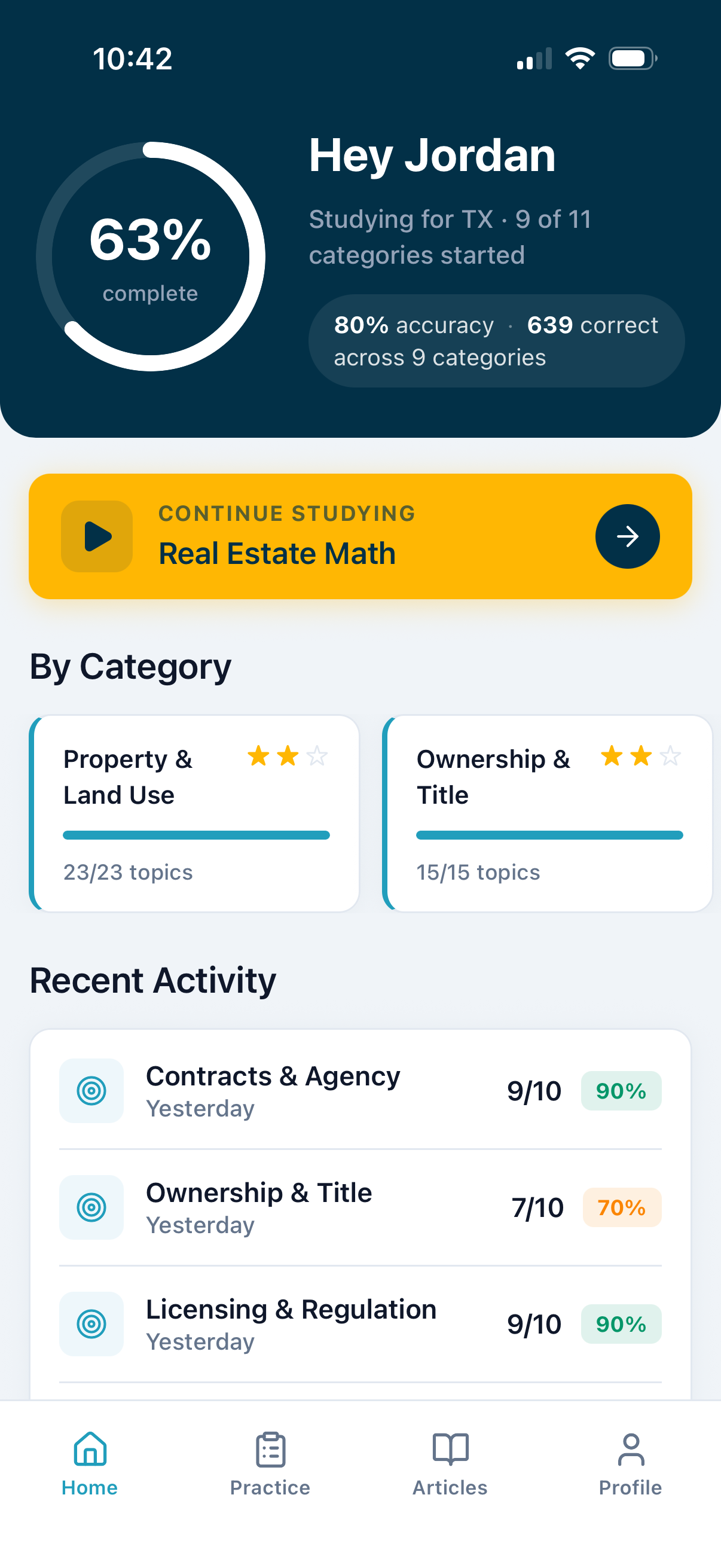
  • Progress tracking with per-category accuracy

Unlike other real estate prep apps, we don't cut off access or charge a monthly subscription fee. It's a one-time $17.99, and it's yours forever.

About the exam

More about the Tennessee real estate exam

The Tennessee real estate affiliate broker exam trips up plenty of first-time candidates. The Tennessee Real Estate Commission (TREC) scores the national and Tennessee state portions separately, so a strong national score won't rescue a weak state score. That gap on the state section is why Tennessee-specific preparation matters more than another round of national review.

The Tennessee state portion leans on the Tennessee Real Estate Broker Act of 1973, the designated agent and facilitator brokerage relationships that Tennessee defines by statute, the Tennessee residential property condition disclosure, the Real Estate Education and Recovery Account, the errors and omissions insurance every licensee must carry, and the trust and escrow rules TREC enforces. None of that looks like the material a candidate in a neighboring state studies. A generic real estate practice test won't cut it. You need Tennessee-specific practice questions.

FAQ

Tennessee real estate exam: your questions answered

How many questions are on the Tennessee real estate exam?

The Tennessee affiliate broker exam has 120 scored questions, split into an 80-question national portion and a 40-question Tennessee state portion. PSI also mixes in 5 to 10 unscored experimental questions that don't count toward your result. You get 240 minutes in total, 160 for the national portion and 80 for the state portion.

What's the passing score for the Tennessee real estate exam?

You need 70 percent on each portion, and the two are scored separately. That works out to 56 of 80 correct on the national portion and 28 of 40 on the state portion. You have to pass both to get licensed, so a high score on one portion doesn't make up for falling short on the other.

How much does the Tennessee real estate exam cost?

PSI charges $63 to sit both portions of the affiliate broker exam. If you only need to retake a single portion, it's $37 for the national portion or $26 for the state portion. After you pass, Tennessee's initial affiliate broker license fee is $91, and affiliate broker is the entry-level license the state issues.

How long is the Tennessee real estate exam?

240 minutes in total. PSI gives you 160 minutes for the 80-question national portion and 80 minutes for the 40-question state portion, plus up to 15 minutes for an introductory tutorial that doesn't count against your testing time. Each portion is timed and scored on its own, and your result appears on screen as soon as you finish.

Who administers the Tennessee real estate exam?

The Tennessee Real Estate Affiliate Broker Examination is administered by PSI for the Tennessee Real Estate Commission (TREC). You register and schedule your exam date through PSI.

Is the Tennessee real estate exam hard?

Plenty of first-time candidates pass, but the exam earns its reputation, and the state portion is where people stumble. The national portion is manageable for most candidates who actually studied. The state portion catches people off guard, because Tennessee's brokerage-relationship rules, disclosure requirements, and the way the Real Estate Commission is structured don't match what national prep material teaches. Honest practice on Tennessee-specific questions is usually the difference between passing the first time and paying to retake a portion.

What's on the Tennessee real estate exam?

The 80-question national portion covers general real estate principles like agency, contracts, financing, property ownership, valuation, and fair housing. The 40-question Tennessee state portion focuses on the duties and powers of the Real Estate Commission, Tennessee licensing and advertising rules, broker and affiliate relationships, the handling of documents and trust and escrow funds, agency and disclosure issues including designated agents and facilitators, and special areas like timeshare and property management. The state-specific material carries more weight than its share of questions suggests, since it's the part most candidates have never seen before.

What's the best way to prepare for the Tennessee real estate exam?

After you finish your 60 hours of pre-license coursework, the highest-leverage move is grinding through Tennessee-specific practice questions with honest feedback on every miss. National practice tests help with the 80 national questions but won't catch you on Tennessee's brokerage and disclosure rules. The RealReady app gives you the full Tennessee question bank, plus a missed-question mode and per-category progress tracking so you can drill your weak spots. Most users study 30 to 60 minutes a day for two to four weeks before sitting the exam.

Is RealReady free?

The 20 Tennessee practice questions on this page are free, no account or signup needed. Unlocking the rest of the Tennessee bank is a single in-app purchase you pay once and own, with no recurring charge and no time limit on access.

Does RealReady cover the Tennessee real estate exam?

Yes. RealReady has a dedicated Tennessee question bank built for the Tennessee real estate exam, covering the national principles every candidate sees plus the Tennessee law that trips people up, like the Tennessee Real Estate Broker Act of 1973, the designated agent and facilitator relationships, and the Real Estate Education and Recovery Account.

Is RealReady a real estate license course?

No. RealReady is exam practice, not a pre-license course, so it doesn't count toward Tennessee's required pre-license education hours. Use it after or alongside your coursework to drill realistic practice questions and find your weak spots before exam day.