Texas · Real estate exam prep

Texas Real Estate Practice Test

20 free Texas practice questions with no signup required. When you're ready for more, the full RealReady bank has 1,015 questions for the 2026 exam that cover both national principles and Texas law.

Practice below

Practice

20 Texas Real Estate Test Questions & Answers

Use this like a free Texas real estate practice test: read the question, commit to an answer, then tap to reveal the correct answer and a plain-English explanation. The ones you miss tell you where to focus next.

Q1 of 20 Licensing & Regulation

The Broker-Lawyer Committee submits a revised sales contract form to TREC. TREC disagrees with several provisions. What authority does TREC have?

  1. TREC can only accept or reject without changes
  2. TREC may adopt, modify, or reject the form
  3. The State Bar must approve any TREC changes
  4. TREC must adopt the form as submitted
Show answer & explanation

Correct: B TREC may adopt, modify, or reject the form

TREC has final authority over promulgated forms. While the Broker-Lawyer Committee drafts and recommends contract forms, TREC retains the power to adopt, modify, or reject any form the committee produces. The State Bar has no veto over TREC's decision.

Q2 of 20 Licensing & Regulation

A property owner sells her own home without hiring an agent. Does she need a real estate license?

  1. Only if the sale price exceeds $100,000
  2. Yes, all real estate sales require a license
  3. Only if she advertises the home on the MLS
  4. No, owners selling own property are exempt
Show answer & explanation

Correct: D No, owners selling own property are exempt

Texas law exempts property owners from the licensing requirement when selling their own property. The license requirement applies to persons who perform real estate activities for others in exchange for compensation. Self-representation in a personal sale is not regulated activity.

Q3 of 20 Licensing & Regulation

A sales agent leaves Broker A and joins Broker B. What must the agent do regarding TREC?

  1. Retake the licensing exam
  2. Notify TREC of the sponsorship change
  3. Complete 30 hours of additional education
  4. Wait 90 days before resuming practice
Show answer & explanation

Correct: B Notify TREC of the sponsorship change

When changing sponsoring brokers, a Texas sales agent must notify TREC of the sponsorship change. There is no requirement to retake the exam or complete additional education. The agent may begin working under the new broker once the change is properly reported.

Q4 of 20 Licensing & Regulation

A licensee deposits a client's earnest money into the licensee's personal checking account. Which ground for discipline does this violate?

  1. Failure to disclose
  2. Commingling of funds
  3. Negligence
  4. Unauthorized practice of law
Show answer & explanation

Correct: B Commingling of funds

Depositing client funds into a personal account constitutes commingling, which is mixing client money with the licensee's own funds. Texas law requires client funds to be held in a separate trust or escrow account. Commingling is a serious violation and ground for discipline.

Q5 of 20 Licensing & Regulation

What is the primary purpose of the Texas Real Estate Recovery Trust Account?

  1. To reimburse brokers for uncollected commissions
  2. To fund TREC operations and salaries
  3. To provide grants for first-time homebuyers
  4. To compensate consumers harmed by licensee misconduct
Show answer & explanation

Correct: D To compensate consumers harmed by licensee misconduct

The Recovery Trust Account exists to compensate members of the public who have been financially harmed by the misconduct of licensed real estate agents or brokers. It is not used for TREC operations, homebuyer grants, or broker reimbursement.

Q6 of 20 State Practice

A seller tells their agent about a foundation crack hidden behind furniture. The agent should:

  1. Let the seller decide whether to reveal it
  2. Wait for the home inspector to discover it
  3. Disclose the defect to prospective buyers
  4. Keep silent unless the buyer asks directly
Show answer & explanation

Correct: C Disclose the defect to prospective buyers

Texas licensees must disclose known material defects to buyers regardless of who discovers them. Waiting for an inspector or for the buyer to ask does not satisfy this duty. The seller's preference to conceal a defect does not override the agent's disclosure obligation.

Q7 of 20 State Practice

When must an agent provide the Information About Brokerage Services (IABS) notice to a prospective buyer?

  1. At the time of contract execution
  2. Within 48 hours of the first showing
  3. At first substantive dialogue
  4. When the buyer submits an offer
Show answer & explanation

Correct: C At first substantive dialogue

Texas requires the IABS notice to be given at the first substantive dialogue with a prospective buyer, seller, tenant, or landlord. Waiting until an offer is submitted, a showing occurs, or a contract is signed would be too late and would violate TREC rules.

Q8 of 20 State Practice

In Texas, when a broker represents both buyer and seller in the same transaction, this relationship is called:

  1. Intermediary
  2. Transaction brokerage
  3. Dual agency
  4. Designated agency
Show answer & explanation

Correct: A Intermediary

Texas uses the term 'intermediary' rather than 'dual agency' to describe a broker representing both parties. This is a distinct legal concept under TRELA with specific requirements for consent and conduct that differ from dual agency in other states.

Q9 of 20 State Practice

A listing agent receives three offers simultaneously. The seller wants to see only the highest one. The agent must:

  1. Present the two highest offers for comparison
  2. Present all three offers to the seller
  3. Present only the highest offer as requested
  4. Reject the lowest two and present one
Show answer & explanation

Correct: B Present all three offers to the seller

Texas law requires agents to present all offers and counteroffers to clients. Even when a seller expresses a preference, the agent cannot filter offers. The seller can instruct the agent in writing to stop presenting offers only after accepting one.

Q10 of 20 State Practice

A broker receives earnest money on Monday. By when must the broker deposit it into a trust account?

  1. Close of business on Tuesday
  2. Close of business on Monday
  3. Close of business on Friday
  4. Close of business on Wednesday
Show answer & explanation

Correct: D Close of business on Wednesday

Texas requires earnest money to be deposited by close of business on the second working day after receipt, unless otherwise agreed. If received Monday, the second working day is Wednesday. This timeline protects both buyer and seller interests.

Q11 of 20 State Practice

A grateful buyer wants to pay a bonus directly to the sales agent who helped them find a home. The agent must:

  1. Accept it if the amount is under $500
  2. Direct the payment through the sponsoring broker
  3. Decline all bonuses under Texas law
  4. Accept it as a personal gift from the buyer
Show answer & explanation

Correct: B Direct the payment through the sponsoring broker

Texas law requires agents to receive all compensation through their sponsoring broker. An agent may never accept payment directly from a client, customer, or another broker's agent. There is no dollar threshold that makes direct payment acceptable.

Q12 of 20 State Transactions

Which of the following is a TREC promulgated contract form?

  1. Industrial Warehouse Contract
  2. Unimproved Property Contract
  3. Vacant Lot Option Agreement
  4. Commercial Lease Agreement
Show answer & explanation

Correct: B Unimproved Property Contract

TREC promulgates six main contract forms including the Unimproved Property Contract. Commercial leases, industrial contracts, and option agreements are not among the promulgated forms. Licensees must use the promulgated form when one covers the transaction type.

Q13 of 20 State Transactions

A buyer pays a $200 option fee and $5,000 earnest money. The buyer terminates during the option period. What happens to each payment?

  1. Both payments are refunded to the buyer
  2. Both payments are retained by the seller
  3. Seller keeps option fee; earnest money refunded
  4. Option fee refunded; earnest money is kept
Show answer & explanation

Correct: C Seller keeps option fee; earnest money refunded

The option fee is non-refundable and belongs to the seller regardless of the outcome. However, if the buyer terminates during the option period, the earnest money is refunded to the buyer. These two payments serve different contractual purposes.

Q14 of 20 State Transactions

A bank forecloses on a residential property and lists it for sale. Is a Seller Disclosure Notice required?

  1. No, foreclosure sales are exempt
  2. Yes, all residential sales require one
  3. No, but only if the bank never occupied it
  4. Yes, but only for occupied properties
Show answer & explanation

Correct: A No, foreclosure sales are exempt

Foreclosure sales are one of the specific exemptions from the Seller Disclosure Notice requirement. Other exemptions include probate sales, new construction with a builder warranty, and court-ordered sales. The exemption applies regardless of property occupancy status.

Q15 of 20 State Transactions

A husband inherits a lakehouse from his parents during marriage. How is this property classified?

  1. Joint tenancy with right of survivorship
  2. Separate property of the husband
  3. Community property of both spouses
  4. Quasi-community property
Show answer & explanation

Correct: B Separate property of the husband

Property acquired by gift or inheritance during marriage is classified as separate property under the Texas Family Code. Even though the inheritance occurred during the marriage, it does not become community property. Title alone does not determine the character of the property.

Q16 of 20 State Transactions

A licensee knowingly tells a buyer that a property has no foundation problems, despite visible cracking. Under the DTPA, what damages may the buyer recover?

  1. Actual damages only
  2. Compensatory damages minus attorney's fees
  3. Treble damages and attorney's fees
  4. A statutory flat penalty of $10,000
Show answer & explanation

Correct: C Treble damages and attorney's fees

The DTPA provides treble (triple) damages for knowing violations, plus attorney's fees. A licensee who knowingly misrepresents a material condition commits a knowing violation. Actual damages alone apply only when the violation is not knowing or intentional.

Q17 of 20 State Transactions

A tenant moves out on March 1. By what date must the landlord return the security deposit or provide an accounting?

  1. March 15
  2. April 14
  3. March 31
  4. April 30
Show answer & explanation

Correct: C March 31

Texas Property Code requires landlords to return the security deposit, minus lawful deductions, within 30 days of the tenant vacating. From March 1, that deadline is March 31. Failure to comply exposes the landlord to liability for the full deposit plus penalties.

Q18 of 20 State Transactions

How are VLB land and home loan programs funded?

  1. Through Texas general tax revenue
  2. Through TREC license fee surcharges
  3. Through federal VA appropriations
  4. Through Texas general obligation bonds
Show answer & explanation

Correct: D Through Texas general obligation bonds

The VLB funds its land and home loan programs through Texas general obligation bonds, not federal money or TREC fees. This state funding mechanism allows the VLB to offer below-market interest rates to eligible veterans independently of federal VA loan programs.

Q19 of 20 Licensing & Regulation

Under which statute does TREC exercise its rulemaking authority?

  1. Texas Business and Commerce Code
  2. TRELA, Occupations Code Chapter 1101
  3. Texas Property Code Chapter 5
  4. Texas Government Code Chapter 2001
Show answer & explanation

Correct: B TRELA, Occupations Code Chapter 1101

TREC's rulemaking authority derives from the Texas Real Estate License Act (TRELA), codified in Occupations Code Chapter 1101. The Government Code Chapter 2001 is the Administrative Procedure Act governing the process, but TRELA grants the substantive authority.

Q20 of 20 Licensing & Regulation

An on-site apartment manager negotiates lease terms for the complex where she works. Does she need a real estate license?

  1. Only if she earns commission on each lease
  2. No, on-site apartment managers are exempt
  3. Yes, leasing always requires a license
  4. Only if the complex has more than 50 units
Show answer & explanation

Correct: B No, on-site apartment managers are exempt

Texas provides a specific licensing exemption for on-site apartment managers. Even though leasing is normally a licensable activity, managers who work on-site at the property they manage are not required to hold a real estate license.

Want the rest of Texas's 1,015-question bank?

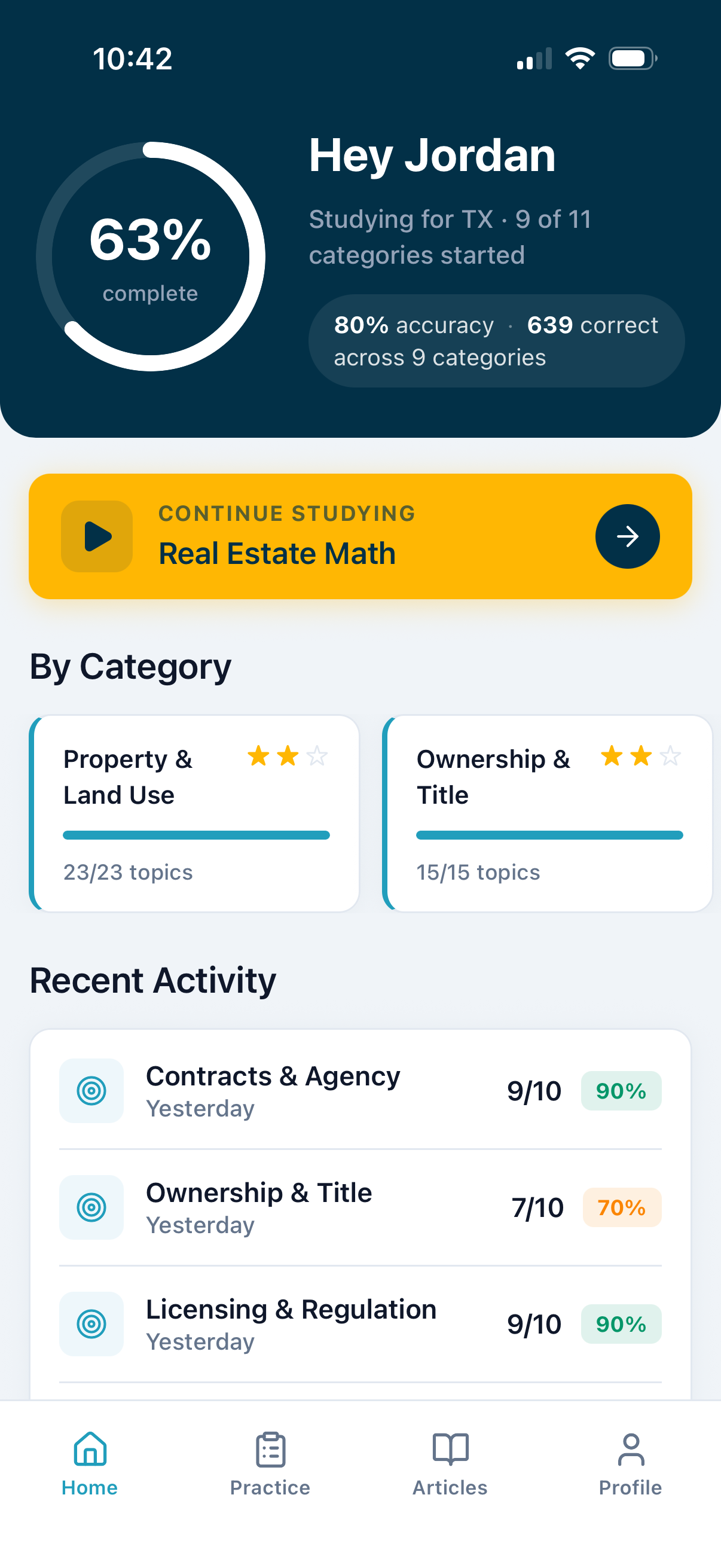
The RealReady app has all 1,015 questions covering both national real estate principles and Texas-specific law. The full app also includes:

  • Short articles that walk you through the why behind each topic
  • A missed-question drill mode
  • Detailed explanations on every question
  • Progress tracking with per-category accuracy

Unlike other real estate prep apps, we don't cut off access or charge a monthly subscription fee. It's a one-time $17.99, and it's yours forever.

About the exam

More about the Texas real estate exam

On the Texas real estate exam, the state section is where first-time candidates most often stumble, and because it's scored separately, a strong national score won't rescue it. That gap on the Texas section is why Texas-specific preparation matters more here than another round of national review.

The Texas section leans on the Real Estate License Act and TREC rules, the intermediary relationship Texas uses in place of dual agency, the promulgated contract forms a sales agent has to use rather than draft, the seller's disclosure notice, community property and Texas homestead protections, and special topics like the Deceptive Trade Practices Act and the Veterans Land Board. None of that looks like the material a candidate in a neighboring state studies. A generic real estate practice test won't cut it. You need Texas-specific practice questions.

FAQ

Texas real estate exam: your questions answered

How many questions are on the Texas real estate exam?

The Texas Sales Agent Real Estate Examination has 120 scored questions, split into an 80-question national portion and a 40-question Texas portion. Pearson VUE also mixes in unscored pretest items, 5 on the national portion and 10 on the Texas portion, that don't count toward your result. You get 240 minutes in total, 150 minutes for the national portion and 90 minutes for the Texas portion.

What's the passing score for the Texas real estate exam?

You need 70 percent on each portion, and the two are scored separately. That works out to 56 of 80 correct on the national portion and 28 of 40 on the Texas portion. You have to pass both to get licensed, so a high score on one portion doesn't make up for falling short on the other.

How much does the Texas real estate exam cost?

Pearson VUE charges $43 to sit the sales agent exam, paid by card when you make your reservation. The fee is the same whether you take both portions together or retake a single portion, and it is non-refundable. Sales agent is the entry-level real estate license Texas issues.

How long is the Texas real estate exam?

240 minutes in total, which is four hours. Pearson VUE gives you 150 minutes for the 80-question national portion and 90 minutes for the 40-question Texas portion. The exam ends automatically when your time expires, and you leave the test center with your official score in hand.

Who administers the Texas real estate exam?

The Texas Sales Agent Real Estate Examination is administered by Pearson VUE for the Texas Real Estate Commission (TREC). You register and schedule your exam date through Pearson VUE.

Is the Texas real estate exam hard?

Plenty of first-time candidates pass, but the exam earns its reputation and the Texas portion is where people stumble. The national portion is manageable for most candidates who actually studied. The state portion catches people off guard, because Texas's intermediary brokerage model, promulgated contract forms, and homestead and community property rules don't match what national prep material teaches. Honest practice on Texas-specific questions is usually the difference between passing the first time and paying to retake a portion.

What's on the Texas real estate exam?

The 80-question national portion covers general real estate principles like property characteristics and ownership, valuation and appraisal, contracts and agency, real estate practice, disclosures, financing and settlement, and real estate math. The 40-question Texas portion focuses on the duties and powers of the Texas Real Estate Commission, licensing and standards of conduct, agency and brokerage including the intermediary relationship, promulgated contracts and seller disclosure, and special topics like community property, homestead protections, the Deceptive Trade Practices Act, and the Veterans Land Board. The Texas material carries more weight than its share of questions suggests, since it's the part most candidates have never seen before.

What's the best way to prepare for the Texas real estate exam?

After you finish your 180 hours of qualifying real estate coursework, the highest-leverage move is grinding through Texas-specific practice questions with honest feedback on every miss. National practice tests help with the 80 national questions but won't catch you on Texas's intermediary rules, promulgated forms, and disclosure requirements. The RealReady app gives you the full Texas question bank, plus a missed-question mode and per-category progress tracking so you can drill your weak spots. Most users study 30 to 60 minutes a day for two to four weeks before sitting the exam.

Is RealReady free?

The 20 Texas practice questions on this page are free, no account or signup needed. Unlocking the rest of the Texas bank is a single in-app purchase you pay once and own, with no recurring charge and no time limit on access.

Does RealReady cover the Texas real estate exam?

Yes. RealReady has a dedicated Texas question bank built for the Texas real estate exam, covering the national principles every candidate sees plus the Texas law that trips people up, like the intermediary relationship Texas uses in place of dual agency, the promulgated contract forms, and Texas homestead protections.

Is RealReady a real estate license course?

No. RealReady is exam practice, not a pre-license course, so it doesn't count toward Texas's required pre-license education hours. Use it after or alongside your coursework to drill realistic practice questions and find your weak spots before exam day.