Nevada · Real estate exam prep

Nevada Real Estate Practice Test

20 free Nevada practice questions with no signup required. When you're ready for more, the full RealReady bank has 1,015 questions for the 2026 exam that cover both national principles and Nevada law.

Practice below

Practice

20 Nevada Real Estate Test Questions & Answers

Use this like a free Nevada real estate practice test: read the question, commit to an answer, then tap to reveal the correct answer and a plain-English explanation. The ones you miss tell you where to focus next.

Q1 of 20 Licensing & Regulation

A newly appointed Commissioner asks how many licensees sit on the Commission. What is the correct composition?

  1. Two licensees and three public members
  2. Three licensees and two public members
  3. Four licensees and one public member
  4. All five must be licensees
Show answer & explanation

Correct: D All five must be licensees

Under NRS 645.090, all five members of the Nevada Real Estate Commission must be experienced real estate professionals, a licensed broker for at least 3 years or a broker-salesperson for at least 5 years. Nevada does not seat public, non-licensee members, so the entire Commission is made up of industry licensees.

Q2 of 20 Licensing & Regulation

A licensed broker wants to work under another broker's supervision. Which license type allows this?

  1. Broker-salesperson license
  2. Provisional broker license
  3. Associate broker license
  4. Supervising broker license
Show answer & explanation

Correct: A Broker-salesperson license

A broker-salesperson holds a broker's license but chooses to work under another broker's supervision. This differs from an independent broker who operates their own firm and from a salesperson who has not yet obtained a broker's license.

Q3 of 20 Licensing & Regulation

A licensee is convicted of a crime involving fraud. Within how many days must they notify the Division?

  1. Within 60 days of the event
  2. Within 5 business days
  3. Within 10 days of the event
  4. Within 30 days of the event
Show answer & explanation

Correct: C Within 10 days of the event

Under NRS 645.615, a licensee must notify the Division in writing not more than 10 days after being convicted of, or pleading guilty, guilty but mentally ill, or nolo contendere to, a felony relating to the licensee's practice or any crime involving fraud, deceit, misrepresentation, or moral turpitude. The conviction must also be disclosed again when the licensee next applies for renewal. An ordinary misdemeanor involving none of these elements does not trigger the notice, but failing to report a covered conviction is itself grounds for discipline.

Q4 of 20 State Practice

A buyer hires a licensee for exclusive representation. What type of agency is this under Nevada law?

  1. Transaction broker with no duties
  2. Limited agent with dual duties
  3. Subagent of the listing broker
  4. Agent providing full representation
Show answer & explanation

Correct: D Agent providing full representation

Nevada defines a licensee's duties by statute rather than common law (NRS 645.251). An agent representing one party exclusively owes that client the duties of NRS 645.254 — one-year confidentiality, presenting all offers, seeking the client's price and terms, disclosing material facts, advising use of outside experts, and accounting — on top of the duties owed to all parties under NRS 645.252.

Q5 of 20 State Practice

When is a Nevada licensee required to obtain a signed Consent to Act form?

  1. Whenever a brokerage agreement is signed
  2. Before acting for more than one party to the transaction
  3. At the first meeting with a prospective buyer
  4. Before performing any acts for any new client
Show answer & explanation

Correct: B Before acting for more than one party to the transaction

The Consent to Act (NRED Form 524) is required only when a licensee acts for more than one party in the same transaction. NRS 645.252(1)(d) requires the licensee to disclose the multiple representation and obtain each party's written consent before continuing to act as an agent. Routine single-client relationships require the Duties Owed form, not a Consent to Act.

Q6 of 20 State Practice

A property owner asks a friend to list their home for sale and offers to pay a flat fee. The friend holds no real estate license. Which statement is correct?

  1. Only commercial sales require a license
  2. The friend cannot list property for pay
  3. Friends may always help sell property
  4. A flat fee exempts the licensing rule
Show answer & explanation

Correct: B The friend cannot list property for pay

Under NRS 645, listing, selling, or exchanging real property for compensation requires a real estate license. The relationship between the parties does not create an exemption. Flat-fee arrangements still constitute compensation triggering the licensing requirement.

Q7 of 20 State Practice

A salesperson closes a transaction without informing their broker. The Division later discovers the transaction contained errors. Who bears responsibility?

  1. The client who accepted the terms
  2. Only the salesperson who acted alone
  3. No one if the errors were unintentional
  4. The broker is responsible for licensee actions
Show answer & explanation

Correct: D The broker is responsible for licensee actions

In Nevada, the broker is responsible for all actions of their licensees. All transactions must go through the broker or be conducted with the broker's knowledge and consent. The broker's supervisory duty cannot be avoided by claiming ignorance of the transaction.

Q8 of 20 State Practice

A salesperson creates a social media ad for a listing that displays only the salesperson's name and photo. What is missing?

  1. The property's legal description
  2. The brokerage name and the agent's license number
  3. The broker's personal phone number
  4. The MLS number of the listing
Show answer & explanation

Correct: B The brokerage name and the agent's license number

Under NRS 645.315(1) and NAC 645.610, every advertisement must disclose the name of the brokerage with which the licensee is associated, and the licensee must include his or her license number in a conspicuous way. These rules apply to all media, including social media ads. MLS numbers, legal descriptions, and the broker's phone number are not required in advertising.

Q9 of 20 State Practice

A seller accepts a buyer's offer on Friday afternoon, and the broker holds the earnest money check. By when must the broker deposit the funds into the trust account?

  1. By the end of the next banking day
  2. Within 3 business days of receipt
  3. Before the end of the following week
  4. Within 5 business days of receipt
Show answer & explanation

Correct: A By the end of the next banking day

Under NRS 645.630(1)(k), once an offer is accepted, a broker must deposit any check or cash received as earnest money before the end of the next banking day — or deliver it to the escrow named in the contract — unless the purchase agreement provides otherwise. Separately, a licensee who receives a deposit must pay it over to the broker or the designated escrow company within 1 business day after receiving a fully executed contract (NAC 645.657). Holding trust funds beyond these deadlines violates NRS 645.

Q10 of 20 State Transactions

A Nevada licensee gives the Residential Disclosure Guide to their client. What must the licensee then obtain and retain?

  1. A signed acknowledgment of receipt from the client
  2. A notarized waiver of the client's inspection rights
  3. Written approval from the Real Estate Division
  4. The buyer's initialed copy of the SRPD form
Show answer & explanation

Correct: A A signed acknowledgment of receipt from the client

The Residential Disclosure Guide (Form 622) includes an acknowledgment page stating the client has received a copy, which the licensee has the client sign and retains in the transaction file. Per NRED, the licensee needs the signature of the party the licensee represents and any unrepresented party. No notarization, SRPD initials, or Division approval is involved.

Q11 of 20 State Transactions

Under NRS 116, how many days does an HOA have to provide the resale package after a request?

  1. 5 days
  2. 15 days
  3. 10 days
  4. 30 days
Show answer & explanation

Correct: C 10 days

Under NRS 116.4109, the association must furnish the resale documents and certificate within 10 calendar days after a written request from the unit's owner or the owner's agent, for inclusion in the resale package the seller must give the buyer. The package includes the CC&Rs, bylaws, rules, budget and financials with a reserve summary, an unpaid-assessment certificate, pending litigation, fee statements and, as of July 1, 2026, proof of the association's insurance.

Q12 of 20 State Transactions

Under Nevada law, what form must a listing agreement entered into on or after October 1, 2025 take?

  1. Email confirmation is sufficient
  2. It must be in writing
  3. It must be notarized to be valid
  4. Oral agreements are enforceable
Show answer & explanation

Correct: B It must be in writing

Assembly Bill 258 (2025) amended NRS 645.005 so that a brokerage agreement is a written contract between a client and a broker; oral contracts entered into on or after October 1, 2025 no longer qualify. Note that Nevada's Statute of Frauds (NRS 111.220) does not itself cover listing agreements — the writing requirement comes from the real estate license law, NRS chapter 645.

Q13 of 20 State Transactions

A Nevada licensee needs to add special terms to a purchase agreement. What is the licensee permitted to do?

  1. Modify pre-printed contract provisions
  2. Draft a custom addendum for the client
  3. Write a new clause and initial it
  4. Fill in the blanks on standard preprinted forms
Show answer & explanation

Correct: D Fill in the blanks on standard preprinted forms

Nevada licensees may complete standard preprinted forms — such as attorney-prepared association forms — by filling in the blanks (names, dates, price, property description). They may not draft original legal language, modify pre-printed provisions, or give legal advice; that is unauthorized practice of law, and custom addenda or clauses should be drafted by an attorney.

Q14 of 20 State Transactions

Nevada water law follows which legal doctrine?

  1. Reasonable use
  2. Correlative rights
  3. Riparian rights
  4. Prior appropriation
Show answer & explanation

Correct: D Prior appropriation

Nevada follows the prior appropriation doctrine — 'first in time, first in right.' Unlike riparian rights states where water rights attach to adjacent land, Nevada treats water rights as separate from land ownership. Water must be put to beneficial use and rights are obtained through the State Engineer.

Q15 of 20 Licensing & Regulation

Under which procedural framework does the Commission conduct disciplinary hearings?

  1. The Administrative Procedure Act
  2. The Commission's internal bylaws
  3. The Nevada Rules of Civil Procedure
  4. The Real Estate Settlement Act
Show answer & explanation

Correct: A The Administrative Procedure Act

Commission disciplinary proceedings are contested cases under Nevada's Administrative Procedure Act (NRS chapter 233B), and NRS 645.760 entitles a licensee to judicial review of an adverse decision in the manner provided by chapter 233B. Chapter 645 adds its own procedural rules: the Commission must hold the hearing within 90 days after the Administrator files the complaint and give the licensee at least 30 days' written notice (NRS 645.680). Together these ensure due process protections including notice, the right to be heard, and the right to present evidence.

Q16 of 20 Licensing & Regulation

Which additional permit allows a Nevada licensee to manage rental properties for owners?

  1. Residential management certificate
  2. Rental agency permit
  3. Property management permit
  4. Landlord services permit
Show answer & explanation

Correct: C Property management permit

Nevada requires a specific property management permit for licensees who manage rental properties on behalf of owners. This permit is in addition to the underlying real estate license and ensures the licensee has appropriate training for property management duties.

Q17 of 20 Licensing & Regulation

A salesperson is not currently associated with any broker. What is their license status?

  1. Suspended pending a Division hearing
  2. Inactive until associated with a broker
  3. Revoked after a 90-day grace period
  4. Active with limited practice rights
Show answer & explanation

Correct: B Inactive until associated with a broker

A salesperson or broker-salesperson without an active broker association holds an inactive license. They cannot conduct real estate activities until they associate with a licensed broker and update their status with the Division.

Q18 of 20 State Practice

A licensee represents both buyer and seller in the same transaction with written consent from both. What is their role?

  1. Transaction coordinator only
  2. Agent acting for both parties (Consent to Act)
  3. Unrepresented facilitator
  4. Subagent of each party's broker
Show answer & explanation

Correct: B Agent acting for both parties (Consent to Act)

Nevada statute does not use the terms 'dual agent' or 'limited agent.' NRS 645.252(1)(d) permits a licensee to act for more than one party after disclosing the conflict of interest and obtaining each party's written consent on the Division's Consent to Act form (Form 524). The consent must describe the transaction, acknowledge the adverse interests, and confirm it is given without coercion.

Q19 of 20 State Practice

A Nevada licensee proposes to represent both the seller and the buyer in the same transaction. What does the signed Consent to Act form establish?

  1. The geographic area of representation
  2. An employment agreement with both parties
  3. The commission rate to be paid
  4. Each party's written consent to the dual representation
Show answer & explanation

Correct: D Each party's written consent to the dual representation

Nevada permits a licensee to act for more than one party only after obtaining each party's written consent, and NRED Form 524 is that consent. The form states it 'does not constitute a contract for services nor an agreement to pay compensation,' so it sets no employment or commission terms — those belong in separate brokerage agreements.

Q20 of 20 State Practice

A licensed salesperson in Nevada negotiates a lease for a commercial tenant and receives payment directly from the tenant. What violation occurred?

  1. Only the tenant committed a violation
  2. Leasing does not require a license
  3. The salesperson must work under a broker
  4. Commercial leases are exempt from NRS 645
Show answer & explanation

Correct: C The salesperson must work under a broker

Nevada law requires all licensees to work under a supervising broker. Compensation must flow through the broker, not directly from clients. Leasing real property for compensation is an activity requiring licensure under NRS 645.

Want the rest of Nevada's 1,015-question bank?

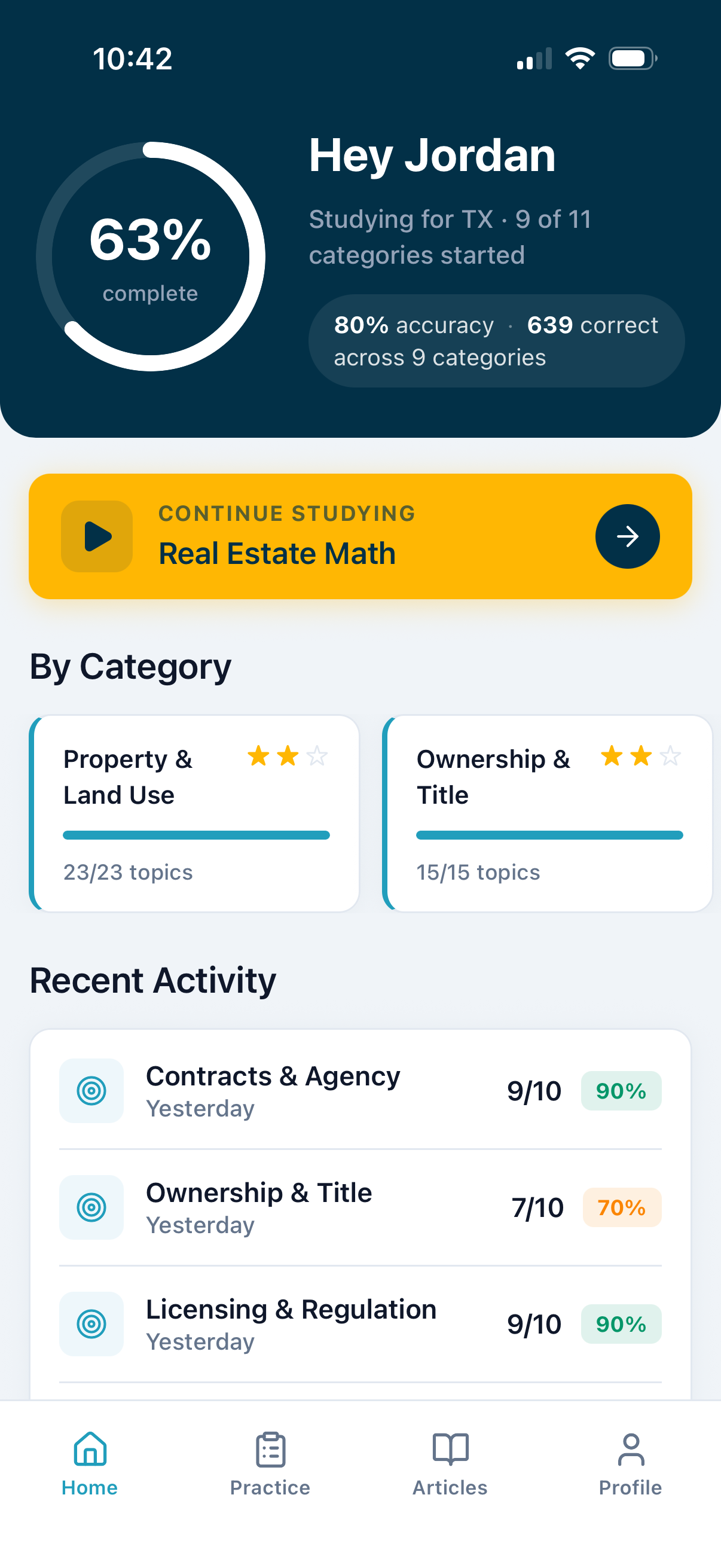
The RealReady app has all 1,015 questions covering both national real estate principles and Nevada-specific law. The full app also includes:

  • Short articles that walk you through the why behind each topic
  • A missed-question drill mode
  • Detailed explanations on every question
  • Progress tracking with per-category accuracy

Unlike other real estate prep apps, we don't cut off access or charge a monthly subscription fee. It's a one-time $17.99, and it's yours forever.

About the exam

More about the Nevada real estate exam

The Nevada real estate salesperson exam is a tougher test than most first-time candidates expect. The Nevada Real Estate Division, the state agency inside the Department of Business and Industry that licenses salespersons and brokers, scores the national and Nevada state-law portions separately, so a strong national score won't make up for a thin grasp of Nevada law. That is why Nevada-specific preparation matters as much as the national material.

Nevada tests its own rules in ways a national course never touches, from the duties a licensee owes under the Duties Owed by a Nevada Real Estate Licensee form, to the Consent to Act form that lets a brokerage represent both sides of a deal, the Seller's Real Property Disclosure required on residential homes, the resale package a seller owes a buyer in a common-interest community, Nevada's prior-appropriation water rights, and the disciplinary powers of the Real Estate Commission backed by the Education, Research and Recovery Fund. None of that looks like the material a candidate in a neighboring state studies. A generic real estate practice test won't cut it. You need Nevada-specific practice questions.

FAQ

Nevada real estate exam: your questions answered

How many questions are on the Nevada real estate exam?

The Nevada Real Estate Salesperson Examination has 120 scored multiple-choice questions, split into an 80-question general (national) portion and a 40-question Nevada state-law portion. Pearson VUE delivers both portions in one computer-based session and mixes in five to ten unscored pretest questions on each portion. The pretest questions look just like the scored ones and don't count toward your result.

What's the passing score for the Nevada real estate exam?

75 percent on each portion, and the two portions are scored separately. That works out to 60 of 80 on the general portion and 30 of 40 on the Nevada portion. If you pass one portion and fail the other, you only retake the portion you failed, as long as you pass both within twelve months. Miss that window and you start over with both portions.

How much does the Nevada real estate exam cost?

The examination fee is $100, paid to the Nevada Real Estate Division through its online licensing portal rather than to the testing company. One detail catches people off guard. A retake costs the same as the first attempt, so even when you only need to redo one of the two portions you still pay the full $100, which makes it worth walking in prepared for both halves. If you pass, the license application is a separate $140, which covers the $85 license fee, a $40 education and recovery fund fee, and a $15 technology fee.

How long is the Nevada real estate exam?

Four hours of seat time total. Pearson VUE allows two and a half hours (150 minutes) for the 80-question general portion and an hour and a half (90 minutes) for the 40-question Nevada portion, taken in one sitting. You get your official pass or fail score report before you leave. Pearson VUE runs test centers in Las Vegas, Reno, and Elko.

Who administers the Nevada real estate exam?

The Nevada Real Estate Salesperson Examination is administered by Pearson VUE for the Nevada Real Estate Division (NRED). You register and pay for the exam on the Division's online portal first, then schedule your exam date with Pearson VUE once your authorization-to-test email arrives, usually within two to three business days.

Is the Nevada real estate exam hard?

It's a serious test, and the part that trips people up is the 40-question Nevada portion. The general half covers the same principles taught everywhere, but the state questions reward candidates who actually studied Nevada license law, the duties a licensee owes under the agency disclosure rules, the consent-to-act form for representing both sides, the Seller's Real Property Disclosure, and how earnest money and trust accounts have to be handled. Most people who fail leaned too hard on national material and underprepared on Nevada law. Honest reps on Nevada-specific practice questions are the difference between a first-time pass and a $100 retake.

What's on the Nevada real estate exam?

The 80-question general portion covers real property characteristics and legal descriptions, forms of ownership and transfer of title, property value and appraisal, contracts and agency, the practice of real estate including fair housing, property disclosures and environmental issues, financing and settlement, and real estate math. The 40-question Nevada portion covers the duties and powers of the Real Estate Commission and Division, licensing rules, the activities that require a license, agency and the duties owed by a Nevada licensee, required disclosures such as the Seller's Real Property Disclosure and common-interest community resale packages, contracts along with the handling of earnest money and advance fees, record keeping, and special topics like timeshares, water rights, and solar. License practice and contracts are the two heaviest Nevada topics, so they are worth extra attention.

What's the best way to prepare for the Nevada real estate exam?

After you finish Nevada's required pre-license coursework, the highest-leverage move is grinding Nevada-specific practice questions with honest feedback on every miss. National principles you can pick up from any course, but the 40-question state portion rewards repetition on the license law, agency and the duties owed by a Nevada licensee, the required property disclosures, and trust account and earnest money handling. The RealReady app gives you the full Nevada question bank plus the national bank, detailed explanations, a missed-question drill mode, and per-category progress tracking so you can see exactly where you're weak. Most users study 30 to 60 minutes a day for two to four weeks before sitting the exam.

Is RealReady free?

The 20 Nevada practice questions on this page are free, no account or signup needed. Unlocking the rest of the Nevada bank is a single in-app purchase you pay once and own, with no recurring charge and no time limit on access.

Does RealReady cover the Nevada real estate exam?

Yes. RealReady has a dedicated Nevada question bank built for the Nevada real estate exam, covering the national principles every candidate sees plus the Nevada law that trips people up, like the Duties Owed by a Nevada Real Estate Licensee form, the Consent to Act form for representing both sides, and the Seller's Real Property Disclosure.

Is RealReady a real estate license course?

No. RealReady is exam practice, not a pre-license course, so it doesn't count toward Nevada's required pre-license education hours. Use it after or alongside your coursework to drill realistic practice questions and find your weak spots before exam day.