New Mexico · Real estate exam prep

New Mexico Real Estate Practice Test

20 free New Mexico practice questions with no signup required. When you're ready for more, the full RealReady bank has 1,035 questions for the 2026 exam that cover both national principles and New Mexico law.

Practice below

Practice

20 New Mexico Real Estate Test Questions & Answers

Use this like a free New Mexico real estate practice test: read the question, commit to an answer, then tap to reveal the correct answer and a plain-English explanation. The ones you miss tell you where to focus next.

Q1 of 20 Licensing & Regulation

Which action is NOT within NMREC's authority?

  1. Adopting rules for real estate practice
  2. Prosecuting criminal violations directly
  3. Suspending a broker's license
  4. Imposing civil penalties for unlicensed real estate activity
Show answer & explanation

Correct: B Prosecuting criminal violations directly

NMREC licenses, adopts rules, investigates, disciplines, and may impose civil penalties for unlicensed activity (NMSA 61-29-17.2). Criminal prosecution belongs to the courts: the attorney general or district attorney prosecutes violations upon application of the commission (NMSA 61-29-17). The commission itself never prosecutes crimes.

Q2 of 20 Licensing & Regulation

Which of the following is grounds for disciplinary action against a New Mexico broker?

  1. Charging a flat fee instead of a percentage
  2. Declining to list overpriced property
  3. Refusing to reduce a commission rate
  4. Commingling client funds with personal funds
Show answer & explanation

Correct: D Commingling client funds with personal funds

Commingling trust funds with personal or operating funds is a clear violation of the Real Estate License Law. Commission rates and listing decisions are business choices, not disciplinary matters.

Q3 of 20 Licensing & Regulation

New Mexico's licensing model differs from most states because it:

  1. Uses a three-tier license system
  2. Only licenses commercial brokers
  3. Has no separate salesperson license
  4. Requires a law degree for all licensees
Show answer & explanation

Correct: C Has no separate salesperson license

New Mexico uses a broker-only model. There is no salesperson license — entry-level licensees are called associate brokers and work under qualifying brokers.

Q4 of 20 Licensing & Regulation

Which of the following is required before an associate broker license can be activated?

  1. Passing a qualifying broker exam
  2. Obtaining E&O insurance coverage
  3. Registering a trade name with NMREC
  4. Completing two years of experience
Show answer & explanation

Correct: B Obtaining E&O insurance coverage

Before activation, associate brokers must obtain Errors and Omissions insurance and have the certificate on file with NMREC. Trade name registration is a qualifying broker requirement.

Q5 of 20 State Practice

A qualifying broker delegates all trust account management to an associate broker. If funds are mishandled, who bears responsibility?

  1. The associate broker exclusively
  2. Both brokers share responsibility equally
  3. The qualifying broker
  4. Neither broker if policies were in place
Show answer & explanation

Correct: C The qualifying broker

The qualifying broker is ultimately responsible for trust account management and all brokerage operations, regardless of delegation. Supervision duties cannot be fully delegated.

Q6 of 20 State Practice

The relationship between a qualifying broker and associate broker must be documented in:

  1. A notarized affidavit
  2. A verbal understanding only
  3. A written agreement
  4. An NMREC-filed registration form
Show answer & explanation

Correct: C A written agreement

16.61.16.9(J) NMAC requires the qualifying broker to execute and maintain written independent contractor agreements with affiliated brokers, while providing that no employer/employee relationship is required. The affiliation and its terms must be documented in a written agreement — verbal arrangements do not satisfy the rule (see also 16.61.17.8).

Q7 of 20 State Practice

In New Mexico, property management activities require:

  1. No license for residential properties
  2. A separate property management certificate
  3. A real estate broker's license
  4. Only a general business license
Show answer & explanation

Correct: C A real estate broker's license

Managing property for others for compensation is real estate brokerage activity under NMSA 1978 Section 61-29-2, so property management requires a broker's license and must run through a qualifying broker. Owners managing their own property — and the owner's own employees — are exempt (Section 61-29-2(C)).

Q8 of 20 State Practice

In New Mexico, a broker's duty of honesty and reasonable care applies to:

  1. Only the broker's client
  2. Only the buyer in a sale
  3. All parties in a transaction
  4. Only parties with a written agreement
Show answer & explanation

Correct: C All parties in a transaction

NM law requires brokers to treat ALL parties with honesty, reasonable care, and professional conduct — not just their clients. This is a universal duty regardless of representation.

Q9 of 20 State Practice

Under New Mexico rules, a broker must disclose the applicable broker duties to a party and obtain written acknowledgment:

  1. No later than the closing of the transaction
  2. At the earliest practicable time after first contact
  3. Before generating or presenting any document that could become an express written agreement
  4. Within 48 hours of the first substantive contact
Show answer & explanation

Correct: C Before generating or presenting any document that could become an express written agreement

NMSA 61-29-10.2 and 16.61.19.8 NMAC require brokers to disclose the applicable set of broker duties, and obtain written acknowledgment, prior to generating or presenting any written document that has the potential to become an express written agreement. For parties served by another broker, disclosure flows through that broker.

Q10 of 20 State Practice

A seller hires a broker to list and sell their home. The broker represents only the seller. This relationship is called:

  1. An exclusive seller agency
  2. A subagency
  3. A transaction broker relationship
  4. A dual agency
Show answer & explanation

Correct: A An exclusive seller agency

Under 16.61.19.9(B) NMAC, exclusive agency is an express written agreement in which a brokerage exclusively represents one party as agent; forms include seller agency, buyer agency, designated agency, and subagency. In New Mexico, agency arises only from an express written agreement (16.61.1.7 NMAC).

Q11 of 20 State Transactions

In New Mexico, residential property is assessed for tax purposes at what fraction of market value?

  1. One-quarter of market value
  2. Two-thirds of market value
  3. Full market value
  4. One-third of market value
Show answer & explanation

Correct: D One-third of market value

NM assesses both residential and non-residential property at one-third (33.33%) of market value. The county assessor determines market value, then calculates the assessed value.

Q12 of 20 State Transactions

Under NM's prior appropriation doctrine, who owns all water in the state?

  1. The public (the state)
  2. The county where water flows
  3. The property owner where water is located
  4. The federal government
Show answer & explanation

Correct: A The public (the state)

In New Mexico, all water belongs to the public (the state). Private parties acquire the right to use water, not ownership of the water itself.

Q13 of 20 State Transactions

The NM Human Rights Act protects all of the following classes EXCEPT:

  1. Gender identity
  2. Spousal affiliation
  3. Sexual orientation
  4. Marital status
Show answer & explanation

Correct: D Marital status

For housing, the NM Human Rights Act protects race, religion, color, national origin, ancestry, sex, sexual orientation, gender, gender identity, pregnancy or related conditions, spousal affiliation, physical or mental disability and military status (NMSA 28-1-7(G)). Marital status is not a listed class — 'spousal affiliation' replaced it in 2001.

Q14 of 20 State Transactions

A property is located within a Public Improvement District (PID). The owner's tax burden includes:

  1. Regular property taxes with no additional cost
  2. Regular property taxes plus PID assessments
  3. A one-time PID fee at purchase only
  4. Only PID assessments replacing property taxes
Show answer & explanation

Correct: B Regular property taxes plus PID assessments

PID assessments are in addition to regular property taxes. Property owners in PIDs pay both their normal property taxes and the special PID assessments for infrastructure improvements.

Q15 of 20 Licensing & Regulation

A brokerage keeps running misleading advertisements despite complaints. What is the License Law's mechanism for forcing the practice to stop?

  1. A criminal arrest warrant issued by the commission
  2. A cease and desist order issued directly by NMREC
  3. An automatic license forfeiture without a hearing
  4. A court injunction sought by the attorney general or district attorney on the commission's application
Show answer & explanation

Correct: D A court injunction sought by the attorney general or district attorney on the commission's application

NMREC has no cease-and-desist authority. Under NMSA 61-29-17(B), the attorney general or district attorney may, upon application of the commission, sue in the state's name to enjoin violations or prosecute them. License discipline is also available through Uniform Licensing Act proceedings.

Q16 of 20 Licensing & Regulation

A broker fails to disclose to a buyer that they personally own the property being sold. This is an example of:

  1. Acceptable dual agency practice
  2. An undisclosed conflict of interest
  3. A permissible transaction brokerage
  4. An exempt owner sale transaction
Show answer & explanation

Correct: B An undisclosed conflict of interest

Broker duties under 16.61.19 NMAC require written disclosure of any potential conflict of interest, including any material personal, family, or business interest the broker has in the transaction. Violating a commission rule is a ground for discipline under NMSA 61-29-12(A)(10), and concealing a personal interest also demonstrates bad faith under 61-29-12(A)(11).

Q17 of 20 Licensing & Regulation

In New Mexico, what is the entry-level real estate license called?

  1. Salesperson
  2. Associate broker
  3. Sales associate
  4. Licensed agent
Show answer & explanation

Correct: B Associate broker

In NM's broker-only model, the entry-level license is called associate broker. There is no salesperson designation. The supervisory level is qualifying broker.

Q18 of 20 Licensing & Regulation

To upgrade to a qualifying broker who will supervise other brokers, an associate broker must have how many years of active experience?

  1. 5 years with no time restriction
  2. 4 years within the prior 5 years
  3. 3 years within the prior 7 years
  4. 2 years within the prior 5 years
Show answer & explanation

Correct: B 4 years within the prior 5 years

A qualifying broker who will supervise or manage other brokers needs at least four years of active associate broker experience in the 60 months before applying; a non-supervising qualifying broker needs only two. Candidates must also document 100 points of qualifying transactional experience (16.61.3.10 NMAC).

Q19 of 20 State Practice

Which of the following is a qualifying broker REQUIRED to do under NMREC rules?

  1. Review and approve every contract an associate broker prepares
  2. Review and approve advertising drafts not prepared by the brokerage
  3. Sign all contracts on behalf of associate brokers
  4. Attend every closing for a newly licensed associate broker
Show answer & explanation

Correct: B Review and approve advertising drafts not prepared by the brokerage

Advertising drafts not prepared by the brokerage must go to the qualifying broker for review and approval (16.61.16.9(I) NMAC). Contract review is discretionary — the QB may require review of transaction documents (16.61.16.9(H)(8)). Closings are attended by the associate broker or an experienced substitute, not the QB (16.61.16.9(H)(7)).

Q20 of 20 State Practice

For an associate broker to qualify as an independent contractor, which factor must be present?

  1. Compensation based on production, not hours
  2. A minimum of 3 years experience
  3. A fixed monthly salary with bonuses
  4. An office provided by the qualifying broker
Show answer & explanation

Correct: A Compensation based on production, not hours

IC status requires compensation tied to production (commissions), not hours worked. Other IC factors include a written agreement, broker not controlling work methods, and AB paying own taxes.

Want the rest of New Mexico's 1,035-question bank?

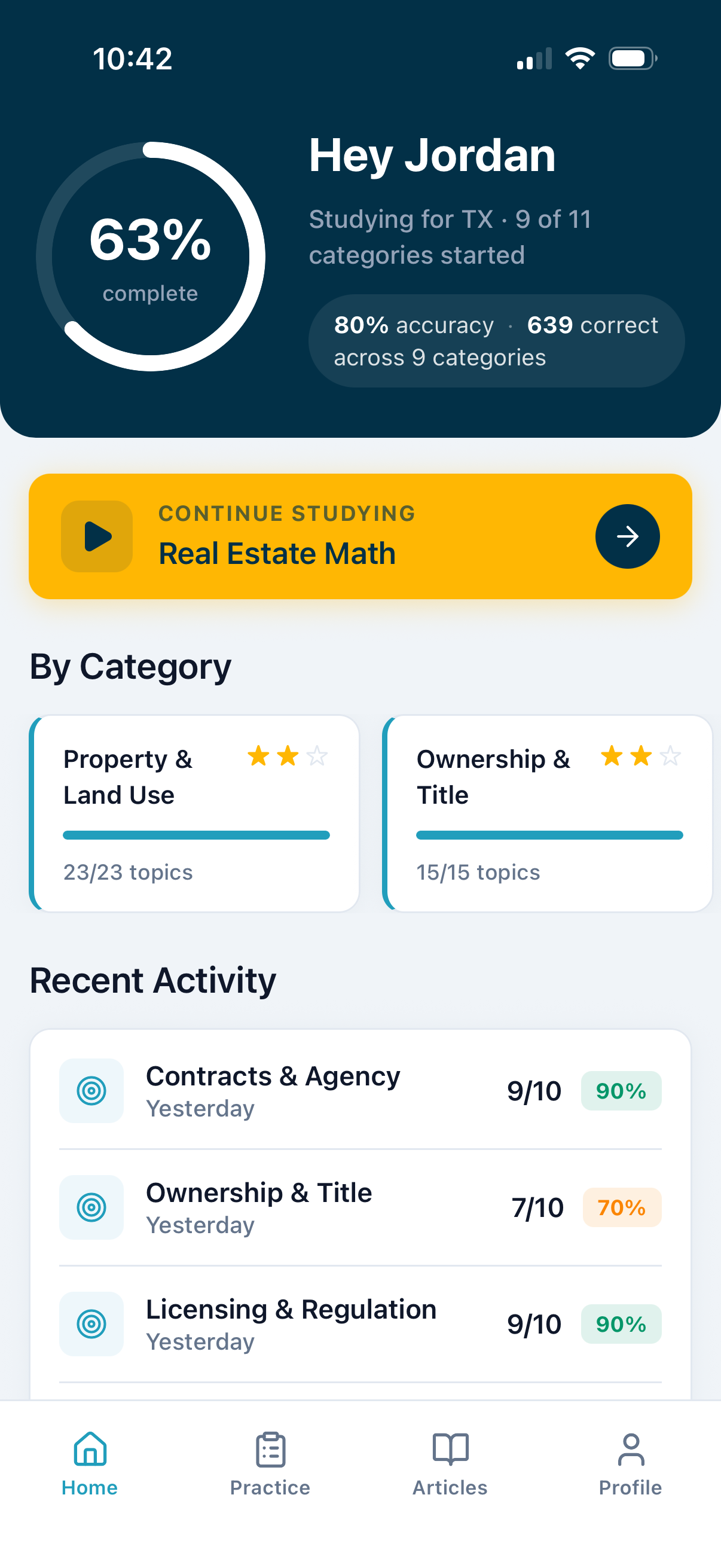
The RealReady app has all 1,035 questions covering both national real estate principles and New Mexico-specific law. The full app also includes:

  • Short articles that walk you through the why behind each topic
  • A missed-question drill mode
  • Detailed explanations on every question
  • Progress tracking with per-category accuracy

Unlike other real estate prep apps, we don't cut off access or charge a monthly subscription fee. It's a one-time $17.99, and it's yours forever.

About the exam

More about the New Mexico real estate exam

New Mexico scores its national and 50-question state-law portions separately, so a strong national score won't rescue a thin grasp of New Mexico law. The exam is set by the New Mexico Real Estate Commission (NMREC), and New Mexico uses the word "broker" for what most other states call a salesperson license, so the very first license you earn is an associate broker license and the exam covers full broker scope from day one. That is why New Mexico-specific preparation matters as much as the national material.

New Mexico tests its own rules in ways a national course never touches, from the mandatory written broker duties every licensee owes to every party in a transaction, to the brokerage relationship choices of exclusive agency, dual agency, and transaction broker, the qualifying broker who supervises every associate broker in an office, the community property rules that decide how married couples take title, prior-appropriation water rights, the required Public Improvement District and estimated property tax disclosures, and the New Mexico Human Rights Act with its broader list of protected classes. None of that looks like the material a candidate in a neighboring state studies. A generic real estate practice test won't cut it. You need New Mexico-specific practice questions.

FAQ

New Mexico real estate exam: your questions answered

How many questions are on the New Mexico real estate broker exam?

The New Mexico Real Estate Broker Examination has 125 scored multiple-choice questions, split into a 75-question national portion and a 50-question New Mexico state-law portion. PSI also mixes in five to ten unscored pretest questions on each portion that look identical to the scored ones, so you should answer everything.

What's the passing score for the New Mexico real estate broker exam?

You need a score of 75 percent on each portion, and the national and state portions are scored separately. If you pass one portion and fail the other, you only retake the portion you failed, but you have to pass both within 90 calendar days of your first attempt or you start over with both halves.

How much does the New Mexico real estate broker exam cost?

The PSI examination fee is $95 per attempt, paid to the testing company when you schedule your seat. That single fee covers the exam whether you sit for one portion or both. After you pass, the associate broker license application fee paid to the New Mexico Real Estate Commission is $270.

How long is the New Mexico real estate broker exam?

Three hours of seat time total. PSI allows two hours for the 75-question national portion and one hour for the 50-question New Mexico portion, taken in one sitting. You get your official pass or fail score report before you leave the test center.

Who administers the New Mexico real estate exam?

The New Mexico Real Estate Broker Examination is administered by PSI for the New Mexico Real Estate Commission (NMREC). You register and schedule your exam date through PSI.

Is the New Mexico real estate broker exam hard?

Yes, more than most candidates expect. New Mexico is one of a smaller group of states where the entry-level license is the broker license, so the exam tests full broker scope from the start, including the brokerage relationships, the written broker duties disclosure, trust accounts, and the qualifying broker supervision structure rather than just salesperson basics. The 50-question state portion is dense with license law and rule, and a single missed concept on something like the broker duties owed to every party or a required disclosure can pull you under the 75 percent line. Honest practice on New Mexico-specific questions, not generic national content, is what gets people across the line on the first try.

What's on the New Mexico real estate broker exam?

The 75-question national portion covers property ownership and land use, valuation and market analysis, financing, general principles of agency, mandated disclosures, contracts, transfer of title, the practice of real estate, and real estate math. The 50-question New Mexico portion covers the Real Estate Commission's structure and disciplinary powers, the license law and Commission rules under 16.61 NMAC, the mandatory broker duties and brokerage relationships, required disclosures including stigmatized property and Public Improvement Districts, community property and how married couples take title, prior-appropriation water rights, trust accounts and earnest money, and the New Mexico Human Rights Act. New Mexico license law and brokerage relationships carry the heaviest weight on the state portion.

What's the best way to prepare for the New Mexico real estate broker exam?

After you finish your 90-hour broker pre-licensing coursework, the highest-leverage move is grinding New Mexico-specific practice questions with honest feedback on every miss. National principles you can pick up from any course, but the 50-question state portion rewards repetition on the license law, the written broker duties, the brokerage relationship choices, trust account handling, and New Mexico's community property and water rights rules. The RealReady app gives you the full New Mexico question bank plus the national bank, detailed explanations, a missed-question drill mode, and per-category progress tracking so you can see exactly where you're weak. Most users study 30 to 60 minutes a day for two to four weeks before sitting the exam.

Is RealReady free?

The 20 New Mexico practice questions on this page are free, no account or signup needed. Unlocking the rest of the New Mexico bank is a single in-app purchase you pay once and own, with no recurring charge and no time limit on access.

Does RealReady cover the New Mexico real estate exam?

Yes. RealReady has a dedicated New Mexico question bank built for the New Mexico real estate exam, covering the national principles every candidate sees plus the New Mexico law that trips people up, like the mandatory written broker duties, the qualifying broker supervision structure, and the New Mexico Human Rights Act protected classes.

Is RealReady a real estate license course?

No. RealReady is exam practice, not a pre-license course, so it doesn't count toward New Mexico's required pre-license education hours. Use it after or alongside your coursework to drill realistic practice questions and find your weak spots before exam day.