Illinois · Real estate exam prep

Illinois Real Estate Practice Test

Practice Illinois real estate questions free below. RealReady has 1,055 questions in the bank covering both national real estate principles and Illinois state law. Pay $17.99 once and own it forever. No subscription like the other prep services.

The Illinois real estate broker exam is one of the toughest in the country. PSI delivers it for the Illinois Department of Financial and Professional Regulation (IDFPR) as a 140-question test split into a 100-question national portion and a 40-question Illinois state-law portion, with 150 minutes allowed for the national portion and 90 minutes for the state portion. You need at least 75 percent on each section, scored separately, so Illinois-specific prep matters as much as the national material.

State-specific prep matters more here than almost anywhere else. Illinois abolished the salesperson tier in 2011 and made "Broker" the entry license under the Real Estate License Act of 2000 (225 ILCS 454), so every new licensee operates under a sponsoring broker and the law uses designated agency as the default. Add the Residential Real Property Disclosure Act and its statutory form, the Radon Awareness Act disclosure rule that does not exist in most states, the Illinois Human Rights Act with its expanded protected classes, the Predatory Lending Database Program in Cook, Kane, Peoria, and Will counties, and the Real Estate Recovery Fund administered by IDFPR's Real Estate Administration and Disciplinary Board, and you see why an Indiana or Missouri prep tool will not catch what Illinois tests. None of that looks like the material a candidate in a neighboring state studies. A generic real estate practice test won't cut it. You need Illinois-specific practice questions.

Below are 20 free Illinois real estate test questions and answers from RealReady's full Illinois bank. Each tests a specific topic with the correct answer and a plain-English explanation under the card. Read each one, commit to an answer, then reveal. Treat it like a real IDFPR practice test, and the ones you miss show you what to focus on next.

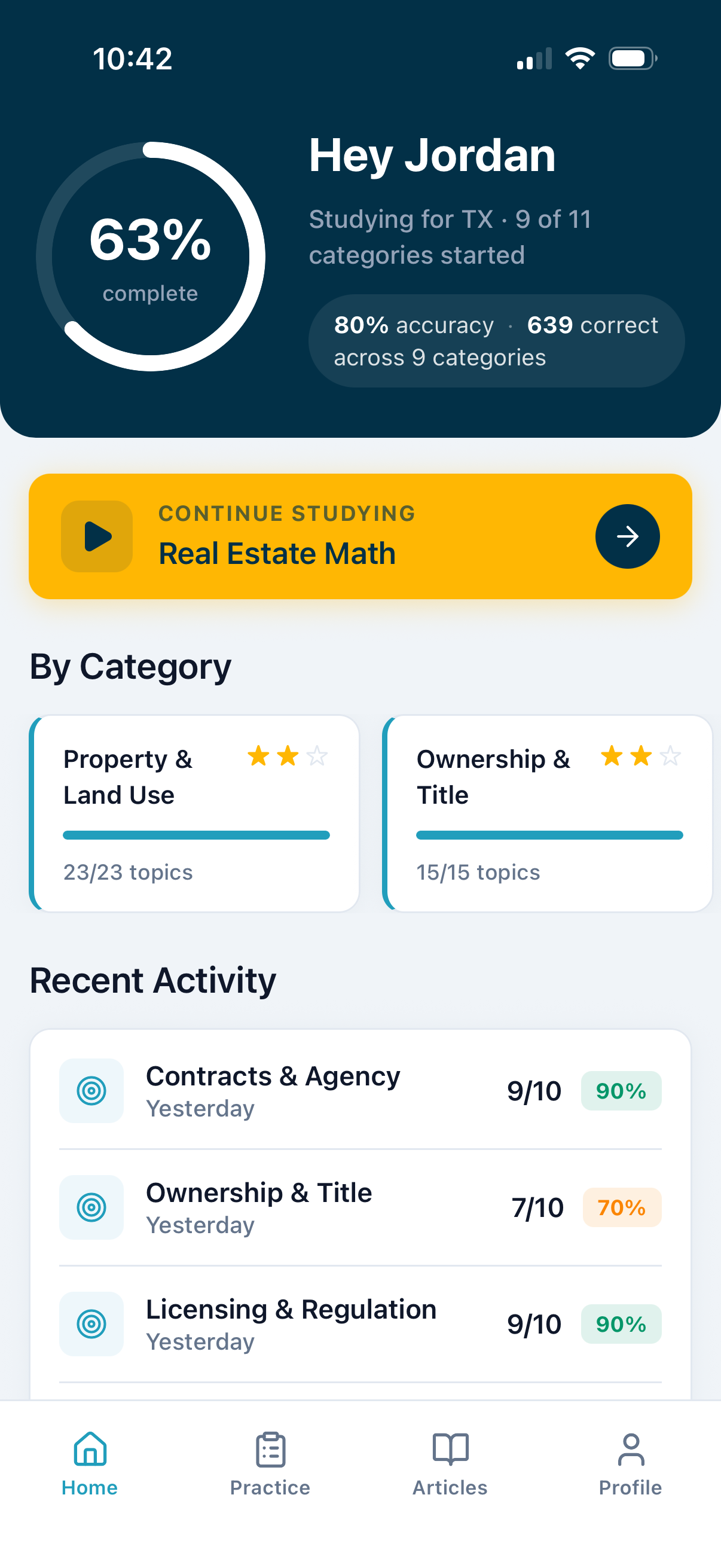
Get the RealReady app on iPhone, iPad, or Android for the rest of the Illinois question bank. The full app includes short articles that walk you through the why behind each topic, detailed explanations on every question, a missed-question drill mode, and progress tracking that shows your per-category accuracy.

Practice

20 Illinois Real Estate Test Questions & Answers

Use this like a free Illinois real estate practice test: read the question, commit to an answer, then tap to reveal the correct answer and a plain-English explanation. The ones you miss tell you where to focus next.

Q1 of 20 Licensing & Regulation

Which state agency is responsible for regulating real estate licensees in Illinois?

  1. IDFPR
  2. Office of the Attorney General
  3. Illinois Real Estate Commission
  4. Department of Commerce
Show answer & explanation

Correct: A IDFPR

The Illinois Department of Financial and Professional Regulation (IDFPR) is the state agency that regulates real estate licensees. Illinois does not have a standalone real estate commission. The Department of Commerce and the Attorney General's office serve different functions.

Q2 of 20 Licensing & Regulation

What is the passing threshold for the Illinois broker licensing examination?

  1. 75% on each section, 140 questions total
  2. 75% overall on a single 120-question format
  3. 70% overall on a combined 100-question exam
  4. 80% on each section of a 150-question exam
Show answer & explanation

Correct: A 75% on each section, 140 questions total

The Illinois broker exam consists of 140 questions, and candidates must achieve at least 75% on each section. A passing score on one section does not offset a failing score on another.

Q3 of 20 Licensing & Regulation

A broker changes sponsoring managing brokers. Who must notify IDFPR of the change?

  1. Only the departing managing broker
  2. Both old and new managing brokers
  3. Only the new sponsoring managing broker
  4. Only the broker who is changing sponsors
Show answer & explanation

Correct: B Both old and new managing brokers

When an Illinois broker changes sponsoring managing brokers, both the departing and receiving managing brokers must notify IDFPR. This dual notification ensures accurate records of which managing broker currently supervises each licensee.

Q4 of 20 Licensing & Regulation

A broker deposits a client's earnest money into the brokerage's general operating account. Which violation has the broker committed?

  1. Commingling trust funds with personal funds
  2. Failing to deliver a signed agency disclosure
  3. Inducing a party to break an existing contract
  4. Practicing real estate without an active license
Show answer & explanation

Correct: A Commingling trust funds with personal funds

Placing client funds into a general operating account constitutes commingling, which is mixing trust money with the broker's own funds. Illinois law requires earnest money and other trust funds to be held in a separate escrow or trust account.

Q5 of 20 State Practice

In a transaction where Broker A lists a property and Broker B from the same firm brings a buyer, the managing broker designates each to represent their respective client. What type of agency relationship exists?

  1. Dual agency with written consent
  2. Transaction brokerage for both parties
  3. Designated agency
  4. Single agency with shared duties
Show answer & explanation

Correct: C Designated agency

Illinois uses designated agency as its default model. The managing broker designates specific brokers to represent the buyer and seller separately, allowing each designated agent to owe full fiduciary duties to their client.

Q6 of 20 State Practice

A broker meets a buyer at an open house and begins discussing the buyer's property needs. When must the broker provide a written agency disclosure?

  1. Before the closing date
  2. At first substantive contact
  3. When a purchase offer is submitted
  4. After showing the first property
Show answer & explanation

Correct: B At first substantive contact

Illinois law requires written agency disclosure at the point of first substantive contact with a consumer. This means the disclosure must occur when the broker begins discussing specific property needs or financial details, not at a later stage such as offer submission or closing.

Q7 of 20 State Practice

A sponsored broker publishes a social media ad without the managing broker's review. Under Illinois law, who bears regulatory responsibility for that advertisement?

  1. The brokerage's marketing department
  2. The managing broker of the brokerage
  3. The sponsored broker who created the ad
  4. IDFPR as the licensing authority
Show answer & explanation

Correct: B The managing broker of the brokerage

Illinois law holds the managing broker responsible for all licensed activities of sponsored brokers, including advertising. The managing broker must review and approve all advertising before publication.

Q8 of 20 State Practice

A sponsored licensee receives a $5,000 earnest money check after a buyer's offer is accepted on Thursday. By when must the check be deposited into the trust account?

  1. Within 24 hours of the offer being written
  2. No later than the next business day, Friday
  3. By the following Monday at close of business
  4. Within 3 business days of receipt
Show answer & explanation

Correct: B No later than the next business day, Friday

Illinois requires that trust funds be deposited no later than the next business day after contract acceptance. Since the offer was accepted on Thursday, the deposit deadline is Friday.

Q9 of 20 State Practice

A seller asks her listing broker to pay a portion of the commission directly to the seller's unlicensed friend who introduced the buyer. How should the broker respond?

  1. Agree if the friend signs a disclosure form first
  2. Refuse because unlicensed persons cannot be paid
  3. Pay the friend through the closing attorney instead
  4. Agree as long as the total amount is under $500
Show answer & explanation

Correct: B Refuse because unlicensed persons cannot be paid

Illinois law prohibits sharing real estate compensation with unlicensed individuals. Regardless of the amount or method of payment, only persons holding an active real estate license may receive compensation for brokerage activities.

Q10 of 20 State Transactions

A buyer and seller both sign a residential purchase contract on Monday. When does the five-business-day attorney review period begin?

  1. Tuesday, the day after both parties sign
  2. Monday, the day the contract is signed
  3. Five calendar days from the listing date
  4. The following Monday after a weekend pause
Show answer & explanation

Correct: A Tuesday, the day after both parties sign

In Illinois, the attorney review period begins the day after both parties have signed the contract. Since both signed on Monday, the five-business-day clock starts on Tuesday.

Q11 of 20 State Transactions

A seller lists a three-unit residential building in Cook County. The seller's agent asks whether a disclosure report is required. Under the Residential Real Property Disclosure Act, which statement is correct?

  1. The seller must provide the disclosure report
  2. Only single-family homes require disclosure
  3. The agent completes the report for the seller
  4. Properties with more than two units are exempt
Show answer & explanation

Correct: A The seller must provide the disclosure report

The Illinois Residential Real Property Disclosure Act (765 ILCS 77) applies to residential property of one to four units. A three-unit building falls within that range, so the seller must provide the Residential Real Property Disclosure Report.

Q12 of 20 State Transactions

Two unrelated business partners purchase an investment property in Illinois. They do not specify the form of ownership in the deed. How is title presumed to be held?

  1. Tenancy in common with no right of survivorship
  2. Joint tenancy with right of survivorship
  3. Community property with equal shares
  4. Tenancy by the entirety with creditor protection
Show answer & explanation

Correct: A Tenancy in common with no right of survivorship

In Illinois, when unrelated parties take title without specifying ownership type, the default presumption is tenancy in common. Each owner holds an undivided interest that passes to their heirs at death, not to the other co-owner.

Q13 of 20 State Transactions

A property sells for $250,000 in DuPage County. What is the Illinois state transfer tax owed?

  1. $1,250 in state transfer tax
  2. $500 in state transfer tax
  3. $250 in state transfer tax
  4. $125 in state transfer tax
Show answer & explanation

Correct: C $250 in state transfer tax

The Illinois state transfer tax rate is $0.50 per $500 of value, which equals $1.00 per $1,000. For a $250,000 sale: $250,000 / $500 = 500 increments x $0.50 = $250. The $500 distractor confuses the rate with $1.00 per $500, and $125 confuses the county rate.

Q14 of 20 State Transactions

A home in DuPage County has a fair market value of $300,000. What is the property's equalized assessed value (EAV)?

  1. $150,000
  2. $100,000
  3. $199,900
  4. $75,000 EAV
Show answer & explanation

Correct: B $100,000

In most Illinois counties outside Cook County, property is assessed at 33.33% of fair market value. $300,000 x 0.3333 = $100,000 EAV. Cook County uses different assessment ratios for different property classes.

Q15 of 20 State Transactions

A Chicago landlord refuses to rent to a prospective tenant because she receives housing choice vouchers. Under Illinois law, what violation has occurred?

  1. A local ordinance violation but not a state violation
  2. A federal Fair Housing Act violation only
  3. No violation because vouchers are voluntary to accept
  4. Source of income discrimination under state law
Show answer & explanation

Correct: D Source of income discrimination under state law

Illinois prohibits source of income discrimination, which includes refusing to rent to tenants who use housing vouchers. This protection goes beyond the federal Fair Housing Act, which does not include source of income as a protected class.

Q16 of 20 Licensing & Regulation

A managing broker disputes a licensing decision made by IDFPR staff. Who has final authority on this decision?

  1. The Division of Professional Regulation director
  2. The Governor of Illinois
  3. The Real Estate Advisory Council
  4. The Secretary of IDFPR
Show answer & explanation

Correct: D The Secretary of IDFPR

The Secretary of IDFPR holds final authority on licensing decisions. While the Division of Professional Regulation handles day-to-day processing, disputed or significant decisions ultimately rest with the Secretary. The Governor appoints the Secretary but does not make individual licensing decisions.

Q17 of 20 Licensing & Regulation

Sandra holds an Illinois leasing agent license. A property owner asks her to help negotiate the sale of a commercial building. How should Sandra respond?

  1. Handle the sale for properties she currently leases
  2. Proceed only if her managing broker gives written approval
  3. Assist if the building contains fewer than four units
  4. Decline, as leasing agents cannot negotiate sales
Show answer & explanation

Correct: D Decline, as leasing agents cannot negotiate sales

An Illinois leasing agent license is limited to residential leasing activities only. Leasing agents cannot negotiate sales, handle trust funds, or engage in commercial transactions. Sandra would need a broker license to perform those activities.

Q18 of 20 Licensing & Regulation

An Illinois broker moves to a new address but waits 60 days to notify IDFPR. Has the broker complied with state requirements?

  1. Yes, address changes only apply at renewal
  2. No, changes must be reported within 14 days
  3. No, changes must be reported within 24 hours
  4. Yes, 60 days is within the allowed timeframe
Show answer & explanation

Correct: B No, changes must be reported within 14 days

Illinois Administrative Code Section 1450.150(a)(1)(B) requires licensees to inform the Division of any change of address within 14 days of the change. Waiting 60 days exceeds this deadline and constitutes a violation. The separate 24-hour rule in Section 1450.150(c) applies only to changes in office location for managing brokers, not to a licensee's individual address.

Q19 of 20 Licensing & Regulation

Which practice is prohibited under the Illinois Real Estate License Act?

  1. Charging a flat fee instead of a percentage
  2. Acting as a dual agent without informed written consent from all clients
  3. Using a net listing arrangement
  4. Holding an open house without the seller present
Show answer & explanation

Correct: B Acting as a dual agent without informed written consent from all clients

Section 15-45 of the Real Estate License Act of 2000 (225 ILCS 454/15-45) requires informed written consent from all clients before a licensee may act as a dual agent, and acting without that consent is grounds for discipline under Section 20-20. Net listings, while widely discouraged and excluded from most MLS systems, are not explicitly banned by Illinois statute. Fee structure and open-house arrangements are business choices, not licensing violations.

Q20 of 20 State Practice

Under designated agency in Illinois, what role does the managing broker play when two sponsored brokers in the firm represent opposing parties?

  1. Mediator who negotiates terms between the parties
  2. Advocate for the party who listed the property first
  3. Neutral supervisor who does not advocate for either party
  4. Dual agent representing both buyer and seller equally
Show answer & explanation

Correct: C Neutral supervisor who does not advocate for either party

In designated agency, the managing broker serves as a neutral supervisor. The managing broker oversees the transaction but does not advocate for either party, ensuring that each designated agent can fulfill fiduciary duties independently.

Want the rest of Illinois's 1,055-question bank?

The RealReady app has all 1,055 questions covering both national real estate principles and Illinois-specific law. The full app also includes:

  • Short articles that walk you through the why behind each topic
  • A missed-question drill mode
  • Detailed explanations on every question
  • Progress tracking with per-category accuracy

Unlike other real estate prep apps, we don't cut off access or charge a monthly subscription fee. Once you buy, it's yours forever.

FAQ

Illinois real estate exam — questions answered

How many questions are on the Illinois real estate exam?

The Illinois Real Estate Broker Examination has 140 scored multiple-choice questions, split into a 100-question national portion and a 40-question Illinois state-law portion. PSI also includes a small number of unscored pretest questions that look identical to the scored ones, and the time spent on those does not count against you.

What's the passing score for the Illinois real estate exam?

You need at least a 75 scaled score on each section, scored separately. That works out to passing both the 100-question national portion and the 40-question state portion independently. If you pass one section and fail the other, you only have to retake the section you failed, and you have one year from your eligibility date to pass both portions.

How much does the Illinois real estate exam cost?

The PSI examination fee is $58 per attempt, paid when you schedule the test with PSI. After you pass, the initial broker license fee is paid to IDFPR with your application. Illinois lets you attempt the exam up to four times within the one-year eligibility window before you have to repeat the 75-hour pre-license coursework.

How long is the Illinois real estate exam?

240 minutes of testing time. The national portion is allotted 150 minutes for 100 questions and the state portion is 90 minutes for 40 questions, taken back-to-back at a PSI testing center. PSI runs Illinois sites in Aurora, Bloomington, Carbondale, Chicago, Lombard, Marion, Peoria, River Forest, Rockford, Springfield, and a few other locations, plus a Milwaukee site that serves northern Illinois candidates. You receive an on-screen pass or fail notification before you leave.

Is the Illinois real estate exam hard?

The 75 percent cutoff on each section makes Illinois one of the stricter states, and the state portion is where most first-time candidates lose ground. The national portion is the same content you'd find on any PSI real estate exam, but the 40 Illinois questions cover narrow topics like the Real Estate License Act of 2000, the sponsoring broker relationship, designated agency, IDFPR enforcement procedures, the Residential Real Property Disclosure Act form, the Radon Awareness Act, the Illinois Human Rights Act, and the Predatory Lending Database Program. Honest practice on an Illinois-specific practice exam is the difference between passing on the first try and retaking the $58 exam.

What's on the Illinois real estate exam?

The 100-question national portion covers property ownership, land-use controls, valuation and market analysis, financing, contracts, agency, property disclosures, transfer of title, the general practice of real estate, and real estate math, in proportions set by PSI's content outline. The 40-question Illinois state portion covers IDFPR licensing requirements and the Real Estate Administration and Disciplinary Board, the Real Estate License Act of 2000 and Title 68 Part 1450 administrative rules, Illinois agency law (sponsoring broker, designated agency, written brokerage agreements, dual agency consent), Illinois disclosure rules (Residential Real Property Disclosure Act, Radon Awareness Act, lead paint), Illinois Human Rights Act fair housing, escrow account handling, advertising, unlicensed assistant rules, and the Real Estate Recovery Fund.

What's the best way to prepare for the Illinois real estate exam?

After finishing your 75-hour pre-license coursework at an IDFPR-approved school (60 hours of broker pre-license topics plus 15 hours of applied real estate principles), the highest-leverage thing you can do is grind through Illinois-specific practice questions with honest feedback on every miss. Generic real estate practice tests will help with national principles but won't catch you on Illinois's unique rules, especially the sponsoring broker structure, the designated agency default, and the Illinois-only disclosure laws. The RealReady app gives you the full bank of Illinois questions plus the national bank, with progress tracking and a missed-question mode so you can drill what you're weak on.