Rhode Island · Real estate exam prep

Rhode Island Real Estate Practice Test

20 free Rhode Island practice questions with no signup required. When you're ready for more, the full RealReady bank has 995 questions for the 2026 exam that cover both national principles and Rhode Island law.

Practice below

Practice

20 Rhode Island Real Estate Test Questions & Answers

Use this like a free Rhode Island real estate practice test: read the question, commit to an answer, then tap to reveal the correct answer and a plain-English explanation. The ones you miss tell you where to focus next.

Q1 of 20 Licensing & Regulation

Which division within DBR regulates real estate licensees in Rhode Island?

  1. Division of Professional Regulation
  2. Division of Commercial Licensing
  3. Division of Business Oversight
  4. Division of Real Estate Services
Show answer & explanation

Correct: B Division of Commercial Licensing

The DBR Division of Commercial Licensing is responsible for regulating real estate licensees in Rhode Island. This division handles license applications, renewals, and enforcement actions.

Q2 of 20 Licensing & Regulation

A salesperson leaves Broker A and joins Broker B. What must the salesperson do regarding DBR?

  1. Wait 30 days before practicing
  2. Retake the licensing exam
  3. Notify DBR of the broker change
  4. Complete 6 additional CE hours
Show answer & explanation

Correct: C Notify DBR of the broker change

Rhode Island licensees must notify DBR when changing brokers. This ensures that DBR records accurately reflect which broker is supervising each salesperson at all times.

Q3 of 20 Licensing & Regulation

Is Errors and Omissions insurance optional or mandatory for Rhode Island real estate licensees?

  1. Required only for firms
  2. Optional but recommended
  3. Mandatory for all licensees
  4. Required only for brokers
Show answer & explanation

Correct: C Mandatory for all licensees

Rhode Island requires all real estate licensees to maintain Errors and Omissions insurance as a condition of holding an active license. Failure to maintain coverage is grounds for discipline.

Q4 of 20 State Practice

When must a Rhode Island licensee provide the Mandatory Real Estate Relationship Disclosure (MRED) form?

  1. At the earliest practical opportunity
  2. Within 48 hours of the first contact
  3. At the time an offer is written up
  4. Before closing and not any sooner
Show answer & explanation

Correct: A At the earliest practical opportunity

Rhode Island requires the MRED form to be presented at the earliest practical opportunity so consumers understand the agency relationship before substantive discussions begin.

Q5 of 20 State Practice

Under Rhode Island law, all salespersons must conduct business through whom?

  1. A licensed attorney
  2. The state real estate commission
  3. Any managing associate
  4. A licensed broker
Show answer & explanation

Correct: D A licensed broker

Rhode Island requires all salespersons to work under and conduct all business through a licensed broker. Salespersons cannot operate independently or under an unlicensed entity.

Q6 of 20 State Practice

Where must a Rhode Island brokerage maintain its escrow account?

  1. A nationally chartered bank in any state
  2. The Rhode Island state treasurer's office
  3. A federally insured bank in Rhode Island
  4. Any bank located in the United States
Show answer & explanation

Correct: C A federally insured bank in Rhode Island

Rhode Island requires each firm to maintain a separate escrow account at a federally insured institution located within Rhode Island. Out-of-state banks are not permitted for escrow accounts.

Q7 of 20 State Practice

A Rhode Island agent posts a property listing on social media without including any brokerage name. What violation has occurred?

  1. Advertising without MLS approval
  2. Failing to disclose agency
  3. Publishing a prohibited blind ad
  4. Violating fair housing rules
Show answer & explanation

Correct: C Publishing a prohibited blind ad

All advertising in Rhode Island must include the name of the licensed brokerage firm exactly as it appears on the license. An ad without broker identification is a blind ad and is prohibited, regardless of whether it appears online or in print.

Q8 of 20 State Practice

A seller verbally agrees to give Broker Adams exclusive rights to sell her home. Is this listing enforceable?

  1. Yes, if witnessed by a third party
  2. No, listings must be in writing
  3. Only if the commission is under 5%
  4. Yes, verbal agreements are binding
Show answer & explanation

Correct: B No, listings must be in writing

Under the Statute of Frauds, listing agreements in Rhode Island must be in writing to be enforceable. A verbal agreement to list property, regardless of the terms, cannot be enforced in court.

Q9 of 20 State Practice

A seller asks Agent Park what the 'standard' commission rate is in Rhode Island. How should Agent Park respond?

  1. Rates are freely negotiable
  2. The standard rate is 6%
  3. The MLS determines rates
  4. The state caps rates at 7%
Show answer & explanation

Correct: A Rates are freely negotiable

Commission rates in Rhode Island are freely negotiable between the parties. There is no standard, fixed, or state-mandated rate. Agents should never imply that a particular rate is standard, as this could constitute price-fixing.

Q10 of 20 State Transactions

A landlord in Rhode Island refuses to rent to a tenant because they plan to pay with a Section 8 voucher. Is this lawful?

  1. Only if the unit has fewer than 4 units
  2. Yes, landlords may choose payment methods
  3. Only if the voucher amount is below market rent
  4. No, lawful source of income is protected
Show answer & explanation

Correct: D No, lawful source of income is protected

Rhode Island's Fair Housing Practices Act (RIGL §34-37-1) protects tenants from discrimination based on lawful source of income, which includes Section 8 housing vouchers. Landlords cannot refuse tenancy solely because a tenant uses government assistance to pay rent.

Q11 of 20 State Transactions

A tenant rents an unfurnished apartment in Providence for $1,500 per month. What is the maximum security deposit the landlord may collect?

  1. $750
  2. $2,250
  3. $3,000
  4. $1,500
Show answer & explanation

Correct: D $1,500

Rhode Island limits security deposits to one month's rent for unfurnished units. Since the monthly rent is $1,500, the maximum deposit is $1,500.

Q12 of 20 State Transactions

A seller is listing a single-family home in Warwick. When must the seller provide the Real Estate Sales Disclosure Form?

  1. Within 10 days after the offer is accepted
  2. Prior to signing the transfer agreement
  3. At the closing table
  4. Only if the buyer requests it in writing
Show answer & explanation

Correct: B Prior to signing the transfer agreement

Under RIGL 5-20.8, the seller must provide the written disclosure form prior to signing the transfer agreement. This ensures buyers have material information before committing to the purchase.

Q13 of 20 State Transactions

Under the Cesspool Act of 2007, when a property with a cesspool is sold, how long does the new owner have to replace it?

  1. 24 months from the date of sale
  2. 12 months from the date of sale
  3. Before the closing can occur
  4. 6 months from the date of sale
Show answer & explanation

Correct: B 12 months from the date of sale

The Cesspool Act of 2007 (RIGL 23-19.15) requires that when a property with a cesspool is transferred, the cesspool must be removed and replaced with an OWTS or connected to public sewer within 12 months of the sale date.

Q14 of 20 State Transactions

A condo owner requests a resale certificate from their association. How many days does the association have to provide it?

  1. 30 days
  2. 10 days
  3. 15 days
  4. 5 days
Show answer & explanation

Correct: B 10 days

Under RIGL 34-36.1, a condominium association must furnish a resale certificate within 10 days of a unit owner's request. This certificate discloses key financial and legal information needed for the transaction.

Q15 of 20 Licensing & Regulation

A broker is found guilty of commingling client funds after a formal hearing. What is the maximum penalty DBR can impose per violation?

  1. Up to $5,000
  2. Up to $1,000
  3. Up to $10,000
  4. Up to $2,000
Show answer & explanation

Correct: D Up to $2,000

DBR can impose penalties up to $2,000 per violation after a hearing. In addition to fines, DBR may also suspend or revoke the broker's license or place the licensee on probation.

Q16 of 20 Licensing & Regulation

Effective June 2025, an agent holds both an MLO and RE license. What restriction applies when both roles overlap in a single transaction?

  1. Must choose which license to surrender
  2. Must disclose but can collect both fees
  3. Must have broker approval for dual pay
  4. Cannot collect compensation for both roles
Show answer & explanation

Correct: D Cannot collect compensation for both roles

Rhode Island's dual licensing prohibition effective June 2025 prevents a person holding both MLO and RE licenses from being compensated for both roles in the same transaction. This prevents conflicts of interest.

Q17 of 20 Licensing & Regulation

An individual licensee is sued for a negligent misrepresentation. What is the maximum E&O coverage available per claim?

  1. $150,000 per claim
  2. $25,000 per claim
  3. $50,000 per claim
  4. $100,000 per claim
Show answer & explanation

Correct: C $50,000 per claim

Individual Rhode Island licensees must carry E&O insurance with minimum coverage of $50,000 per claim and $150,000 in the aggregate. These are the required minimums for individual coverage.

Q18 of 20 State Practice

A buyer contacts a licensee wanting to tour properties immediately. Under the NAR settlement rules effective August 2024, what must occur first?

  1. The MLS listing must be verified
  2. The seller must consent to the showing
  3. A buyer representation agreement is signed
  4. The buyer must first obtain mortgage preapproval
Show answer & explanation

Correct: C A buyer representation agreement is signed

As of August 2024 per the NAR settlement, a buyer representation agreement must be signed before a licensee can tour properties with a buyer. This applies in Rhode Island and nationwide.

Q19 of 20 State Practice

A salesperson negotiates a transaction outside the scope of their broker's authorization. Who may be held liable?

  1. The broker for the salesperson's actions
  2. The title company that processed it
  3. Only the salesperson personally
  4. The buyer for not verifying authority
Show answer & explanation

Correct: A The broker for the salesperson's actions

In Rhode Island, the broker is liable for actions of supervised salespersons within the scope of employment. Even unauthorized actions can create broker liability if they appear to fall within normal duties.

Q20 of 20 State Practice

How must a Rhode Island brokerage's escrow account be identified on bank records?

  1. Labeled Trust Account or Escrow Account
  2. Listed under the broker's full personal name only
  3. Identified only by the assigned bank account number
  4. Marked as an operating account for the full firm
Show answer & explanation

Correct: A Labeled Trust Account or Escrow Account

Rhode Island requires the escrow account to be designated as 'Trust Account' or 'Escrow Account' on bank records, deposit tickets, checks, and statements. This ensures clear identification of client funds.

Want the rest of Rhode Island's 995-question bank?

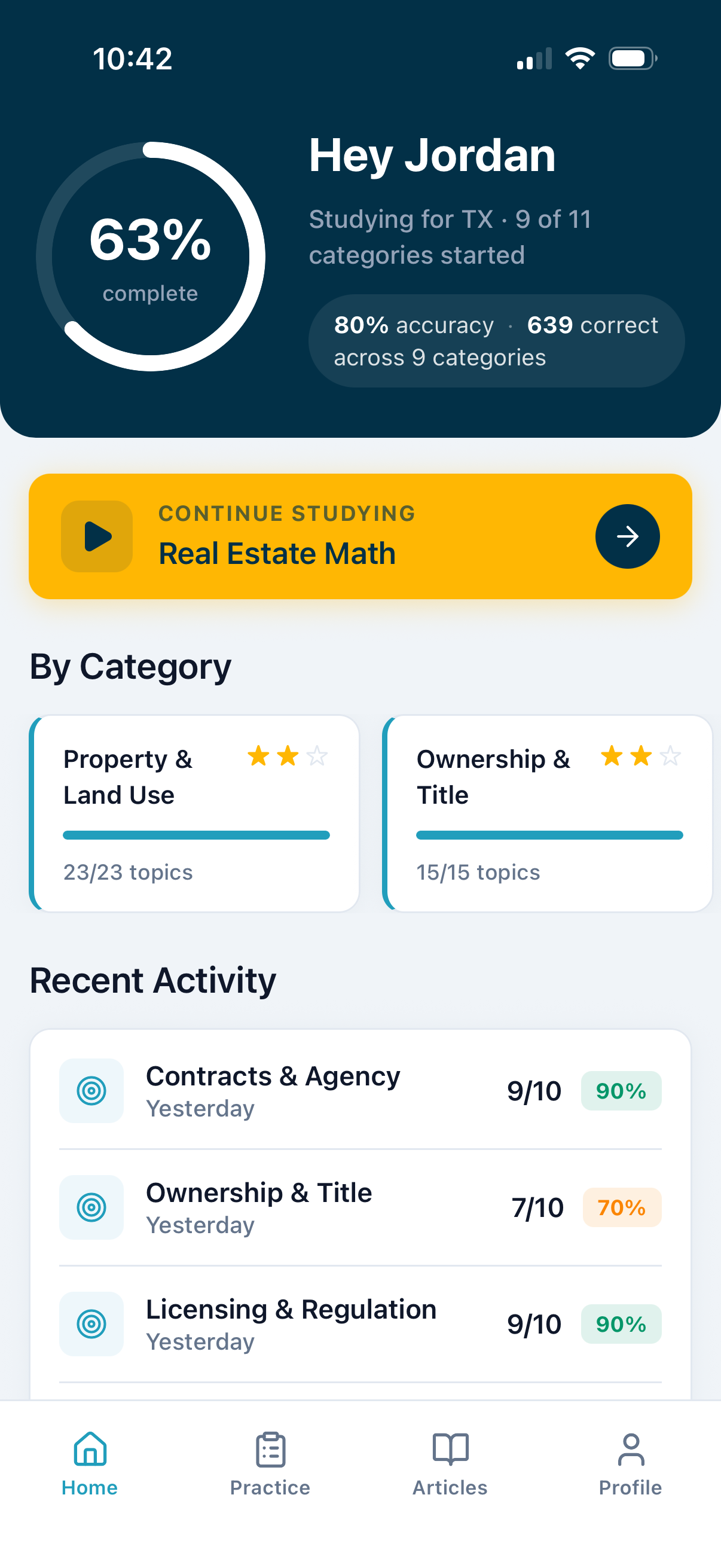
The RealReady app has all 995 questions covering both national real estate principles and Rhode Island-specific law. The full app also includes:

  • Short articles that walk you through the why behind each topic
  • A missed-question drill mode
  • Detailed explanations on every question
  • Progress tracking with per-category accuracy

Unlike other real estate prep apps, we don't cut off access or charge a monthly subscription fee. It's a one-time $17.99, and it's yours forever.

About the exam

More about the Rhode Island real estate exam

The Rhode Island real estate salesperson exam is tougher than most candidates expect. The Department of Business Regulation splits it into a separate national portion and a Rhode Island portion that you have to pass on its own. Almost half of that state portion drills the statutory duties governing how Rhode Island licensees advertise, handle client money, and disclose conflicts, which makes Rhode Island-specific study the difference between passing and retaking.

Rhode Island threads its own rules through the exam, the mandatory residential sales disclosure, onsite wastewater and cesspool disclosures, the lead hazard mitigation law, mandatory agency disclosure in residential transactions, non-resident seller withholding, and the Real Estate Recovery Account that backs consumer claims. None of that looks like the material a candidate in a neighboring state studies. A generic real estate practice test won't cut it. You need Rhode Island-specific practice questions.

FAQ

Rhode Island real estate exam: your questions answered

How many questions are on the Rhode Island real estate exam?

The Rhode Island salesperson exam has 130 scored questions, an 80-question national portion and a 50-question Rhode Island state portion. Pearson VUE delivers them as two separate exams, and each also mixes in a handful of unscored pretest questions that don't count toward your score. You get two and a half hours for the national part and ninety minutes for the Rhode Island part.

What's the passing score for the Rhode Island real estate exam?

You need a scaled score of 70 on each portion, and the two are scored independently, so a strong national score does not rescue a failing Rhode Island law score. Rhode Island reports a scaled score from 0 to 100 rather than a raw percentage, so there's no curve and every question matters. If you miss one portion, you retake only that portion within the one-year window.

How much does the Rhode Island real estate exam cost?

The exam fee is $103 total, $53 for the national portion and $50 for the Rhode Island state portion, each paid to Pearson VUE when you reserve that part. If you pass both and apply, the Department of Business Regulation charges a $140 license fee plus a $25 Real Estate Recovery Account fee, and a Rhode Island salesperson license runs two years before renewal.

How long is the Rhode Island real estate exam?

You get two and a half hours for the 80-question national portion and ninety minutes for the 50-question Rhode Island portion, so 240 minutes of testing in all if you take both on the same day. Pearson VUE runs the exam at a test center in East Providence and several nearby Massachusetts locations, and you leave with your official score report in hand.

Who administers the Rhode Island real estate exam?

The Rhode Island Real Estate Salesperson Examination is administered by Pearson VUE for the Rhode Island Department of Business Regulation (DBR), Division of Commercial Licensing. You register and schedule your exam date through Pearson VUE.

Is the Rhode Island real estate exam hard?

It's hard enough that plenty of first-time candidates don't clear both portions on the first try. The questions aren't written to trick you. They test whether you actually understand Rhode Island real estate law alongside national principles. Most people who struggle underestimated the state portion, where nearly half the questions cover the statutory duties of licensees and the rest cover Rhode Island disclosure rules, fair housing, and landlord-tenant law. Honest work on a Rhode Island-specific practice test is what separates a first-try pass from a costly retake.

What's on the Rhode Island real estate exam?

The 130-question exam splits in two. The 80-question national portion covers property ownership and land use, valuation and appraisal, contracts and agency, financing and settlement, property disclosures and environmental issues, real estate practice, and math. The 50-question Rhode Island portion leans hard on the statutory duties that govern licensee activity, about 48 percent of it, with another 36 percent on Rhode Island topics like the Fair Housing Practice Act, the Residential Landlord and Tenant Act, lead and wastewater disclosures, condominium sales, and non-resident seller withholding. Licensing requirements and the powers of the Department of Business Regulation round out the rest.

What's the best way to prepare for the Rhode Island real estate exam?

After finishing your 45-hour Rhode Island pre-license course, the highest-leverage thing you can do is grind through Rhode Island-specific practice questions with honest feedback on every miss. Generic real estate practice tests help with national principles but won't catch you on Rhode Island's disclosure rules, agency law, and licensee duties. The RealReady app gives you the full bank of Rhode Island questions, plus progress tracking and a missed-question mode so you can drill what you're weak on. Most users study 30 to 60 minutes a day for two to four weeks before sitting the exam.

Is RealReady free?

The 20 Rhode Island practice questions on this page are free, no account or signup needed. Unlocking the rest of the Rhode Island bank is a single in-app purchase you pay once and own, with no recurring charge and no time limit on access.

Does RealReady cover the Rhode Island real estate exam?

Yes. RealReady has a dedicated Rhode Island question bank built for the Rhode Island real estate exam, covering the national principles every candidate sees plus the Rhode Island law that trips people up, like the mandatory residential sales disclosure, the lead hazard mitigation law, and the Real Estate Recovery Account.

Is RealReady a real estate license course?

No. RealReady is exam practice, not a pre-license course, so it doesn't count toward Rhode Island's required pre-license education hours. Use it after or alongside your coursework to drill realistic practice questions and find your weak spots before exam day.