Maryland · Real estate exam prep

Maryland Real Estate Practice Test

20 free Maryland practice questions with no signup required. When you're ready for more, the full RealReady bank has 1,055 questions for the 2026 exam that cover both national principles and Maryland law.

Practice below

Practice

20 Maryland Real Estate Test Questions & Answers

Use this like a free Maryland real estate practice test: read the question, commit to an answer, then tap to reveal the correct answer and a plain-English explanation. The ones you miss tell you where to focus next.

Q1 of 20 Licensing & Regulation

A newly appointed MREC member asks which state department oversees Commission operations. What is the correct answer?

  1. Department of Commerce
  2. Department of Housing
  3. Office of the Attorney General
  4. Department of Labor
Show answer & explanation

Correct: D Department of Labor

The Maryland Real Estate Commission operates under the Department of Labor. This organizational placement connects real estate regulation to the state's broader workforce oversight framework.

Q2 of 20 Licensing & Regulation

What is the primary purpose of Maryland's Real Estate Guaranty Fund?

  1. Provide grants to first-time homebuyers
  2. Fund continuing education for licensees
  3. Pay legal fees for disciplinary hearings
  4. Compensate consumers for actual monetary losses
Show answer & explanation

Correct: D Compensate consumers for actual monetary losses

The Guaranty Fund exists to compensate consumers who suffer actual monetary losses due to violations committed by licensed real estate professionals. It serves as a financial safety net when licensees cannot pay.

Q3 of 20 Licensing & Regulation

Which activity requires a Maryland real estate license?

  1. A government employee appraising public land
  2. Listing property for sale for compensation
  3. An attorney handling a real estate closing
  4. An owner selling their own property
Show answer & explanation

Correct: B Listing property for sale for compensation

Listing, selling, buying, exchanging, or leasing real property for compensation requires a license. Owners selling their own property, attorneys acting within scope, and government employees in official capacity are exempt.

Q4 of 20 Licensing & Regulation

A salesperson's affiliation with her broker ends. What does Maryland law require regarding notice to the Commission?

  1. The salesperson must notify the Commission within 10 days
  2. The broker must immediately notify the Commission in writing
  3. The broker must notify the Commission within 30 days
  4. The broker holds the salesperson's license until she finds a new broker
Show answer & explanation

Correct: B The broker must immediately notify the Commission in writing

Under BOP §17-320, when a salesperson's or associate broker's affiliation ends, the broker must immediately mail notice of the termination to the licensee, submit written notice to the Commission, and return the license certificate to the Commission. Maryland has no 10-day notification window.

Q5 of 20 State Practice

By when must a Maryland licensee give the 'Understanding Whom Real Estate Agents Represent' disclosure to an unrepresented buyer or seller?

  1. When a purchase contract is signed
  2. Within 48 hours of initial phone contact
  3. Not later than the first scheduled face-to-face contact
  4. At the time of property settlement
Show answer & explanation

Correct: C Not later than the first scheduled face-to-face contact

BOP §17-530 requires the written disclosure not later than the first scheduled face-to-face contact. It is owed to parties the licensee does NOT represent — for example, a seller's agent gives it to an unrepresented buyer — and is not required for a party who already has a written brokerage agreement with a broker.

Q6 of 20 State Practice

Under Maryland law, when is dual agency permitted?

  1. Only in commercial transactions
  2. When both parties give informed written consent
  3. When the listing agent obtains seller approval
  4. When the broker verbally informs both parties
Show answer & explanation

Correct: B When both parties give informed written consent

Maryland permits dual agency only with the informed written consent of both parties, documented on the Consent for Dual Agency form (BOP §17-530.1). The dual agent is the broker or a designated branch office manager — not the individual agents — and a party who signed earlier must affirm consent for the specific property and buyer before an offer is presented or accepted.

Q7 of 20 State Practice

Which type of listing agreement is most commonly used in Maryland?

  1. Exclusive right to sell
  2. Net listing
  3. Open listing
  4. Exclusive agency
Show answer & explanation

Correct: A Exclusive right to sell

The exclusive right to sell listing is the most commonly used listing agreement in Maryland. It guarantees the broker a commission regardless of who procures the buyer, providing the strongest protection for the listing broker.

Q8 of 20 State Practice

Within how many business days must earnest money be deposited into a trust account after contract acceptance in Maryland?

  1. 7 business days
  2. 3 business days
  3. 10 business days
  4. 5 business days
Show answer & explanation

Correct: A 7 business days

BOP §17-502(b) requires a broker to deposit trust money promptly, and not more than 7 business days after acceptance of the contract of sale by both parties, in an account kept separate from the broker's own funds and used solely for trust money. Under §17-503 the depository must be a financial institution located in Maryland whose deposits are insured.

Q9 of 20 State Practice

A Maryland listing agent receives a low offer while the seller is waiting on a stronger offer expected tomorrow. What must the agent do?

  1. Hold the offer until the better one arrives
  2. Present the low offer promptly to the seller
  3. Reject the offer on the seller's behalf
  4. Inform the buyer the seller is not interested
Show answer & explanation

Correct: B Present the low offer promptly to the seller

Maryland law requires agents to promptly present ALL offers to the seller unless the seller has provided written instructions to the contrary. An agent cannot withhold or delay presenting any offer, regardless of the amount or timing.

Q10 of 20 State Practice

Which protected class is recognized under Maryland fair housing law but NOT under federal fair housing law?

  1. Familial status
  2. Source of income
  3. National origin
  4. Disability
Show answer & explanation

Correct: B Source of income

Maryland extends fair housing protections beyond federal law to include marital status, sexual orientation, gender identity, source of income, and (since October 2024) military status. Source of income protection means landlords and sellers cannot refuse to deal with someone based on their use of housing vouchers or other lawful income sources.

Q11 of 20 State Transactions

Under Maryland's Statute of Frauds, which element is required for a real estate contract to be enforceable?

  1. Filed with the county clerk
  2. Notarized by a public notary
  3. Witnessed by two individuals
  4. Written and signed by the parties
Show answer & explanation

Correct: D Written and signed by the parties

Maryland's Statute of Frauds requires real estate contracts to be in writing and signed by the parties to be enforceable. Notarization, filing, and witnessing are not required for contract enforceability.

Q12 of 20 State Transactions

Which Maryland agency is responsible for assessing property values for tax purposes?

  1. County Tax Collector
  2. Maryland Real Estate Commission
  3. SDAT
  4. Department of Housing
Show answer & explanation

Correct: C SDAT

The State Department of Assessments and Taxation (SDAT) is responsible for assessing property values in Maryland. Each of the 23 counties and Baltimore City then applies their own tax rate to the assessed value.

Q13 of 20 State Transactions

Under Maryland's current law (effective October 2024), what is the maximum security deposit a landlord may collect?

  1. No statutory limit
  2. Two months' rent
  3. One month's rent
  4. Three months' rent
Show answer & explanation

Correct: C One month's rent

Under the Renters' Rights and Stabilization Act (RRSA) effective October 2024, Maryland limits security deposits to one month's rent. The previous limit was two months' rent. A narrow exception allows up to two months' rent only when the tenant has qualified for utility assistance through the Department of Human Services, the lease requires utility payments to be made directly to the landlord, and both parties agree in writing (RP §8-203(b)).

Q14 of 20 State Transactions

What type of foreclosure process does Maryland use?

  1. Strict foreclosure without sale
  2. Administrative foreclosure
  3. Judicial foreclosure through courts
  4. Non-judicial power of sale
Show answer & explanation

Correct: D Non-judicial power of sale

Maryland's primary foreclosure method is non-judicial power of sale under Real Property §7-105, exercised through the deed of trust's power-of-sale clause. The lender files an Order to Docket and the court ratifies the sale, so the process is sometimes called 'quasi-judicial', but it does not require a full judicial foreclosure lawsuit.

Q15 of 20 State Transactions

What is ground rent in Baltimore's historical real estate practice?

  1. A tax on vacant lots
  2. A fee for street maintenance
  3. A lease of the land beneath improvements
  4. A surcharge on rental properties
Show answer & explanation

Correct: C A lease of the land beneath improvements

Ground rent is a historical Baltimore practice where the property owner owns the improvements but leases the land from a ground rent holder. Typical annual amounts range from $50 to $150.

Q16 of 20 Licensing & Regulation

The MREC discovers that an unlicensed individual has been collecting fees for selling homes. Besides referring the matter for criminal prosecution, what may the Commission itself impose?

  1. A cease and desist order
  2. A jail sentence of up to 1 year
  3. A civil penalty of up to $5,000 for a first violation
  4. Nothing — only the courts may act against unlicensed activity
Show answer & explanation

Correct: C A civil penalty of up to $5,000 for a first violation

Under Maryland law the MREC may impose a civil penalty of up to $5,000 for a first unlicensed-activity violation, rising to $15,000 for a second and $25,000 for subsequent violations (BOP §17-613). Unlicensed practice is also a criminal misdemeanor, but only a court can impose jail time, and Maryland's Brokers Act gives the Commission no cease and desist power.

Q17 of 20 Licensing & Regulation

A consumer lost $30,000 due to a licensee's misrepresentation. How does she seek compensation from the Guaranty Fund?

  1. Get written approval from the licensee's broker
  2. Sue the Guaranty Fund in circuit court
  3. Obtain a final court judgment against the licensee first
  4. File a claim directly with the MREC
Show answer & explanation

Correct: D File a claim directly with the MREC

Under BOP §17-404, a Guaranty Fund claim is submitted directly to the Commission, which decides the claim through an administrative hearing process (most contested cases are referred to the Office of Administrative Hearings). Maryland does not require the claimant to first win a court judgment against the licensee.

Q18 of 20 Licensing & Regulation

A retired teacher helps her neighbor sell a house and accepts a $2,000 thank-you payment. Does she need a license?

  1. No, the payment was a gift not a commission
  2. Yes, she performed licensed activity for compensation
  3. Only if she advertised her services publicly
  4. No, helping a neighbor is always exempt
Show answer & explanation

Correct: B Yes, she performed licensed activity for compensation

Any person who assists in selling real property for compensation must hold a license. The nature of the payment or the relationship to the seller does not create an exemption.

Q19 of 20 Licensing & Regulation

A licensee wants to transfer her license to a new broker. What approval is needed?

  1. No approval needed if she notifies within 10 days
  2. Only written consent from both brokers
  3. Approval from the Department of Labor
  4. Her license must be reissued by the Commission under the new broker
Show answer & explanation

Correct: D Her license must be reissued by the Commission under the new broker

A transfer is processed through the Commission: the licensee applies (via MREC's electronic licensing) with the new broker's commitment, and she may not provide brokerage services until her license is issued under the new broker. BOP §17-320 requires the former broker to notify the Commission and return the license certificate when the affiliation ends.

Q20 of 20 State Practice

A listing agent schedules a Saturday showing with an unrepresented buyer but does not present the agency disclosure form until the buyer writes an offer a week later. What violation occurred?

  1. No violation occurred because the buyer eventually received the form
  2. The agent should have mailed the form within 48 hours of the first call
  3. Disclosure was not made by the first scheduled face-to-face contact
  4. Phone conversations exempt agents from the disclosure requirement
Show answer & explanation

Correct: C Disclosure was not made by the first scheduled face-to-face contact

Under BOP §17-530, a seller's agent must make the written agency disclosure to an unrepresented buyer not later than the first scheduled face-to-face contact — here, the Saturday showing. Waiting until the offer was written misses the statutory deadline.

Want the rest of Maryland's 1,055-question bank?

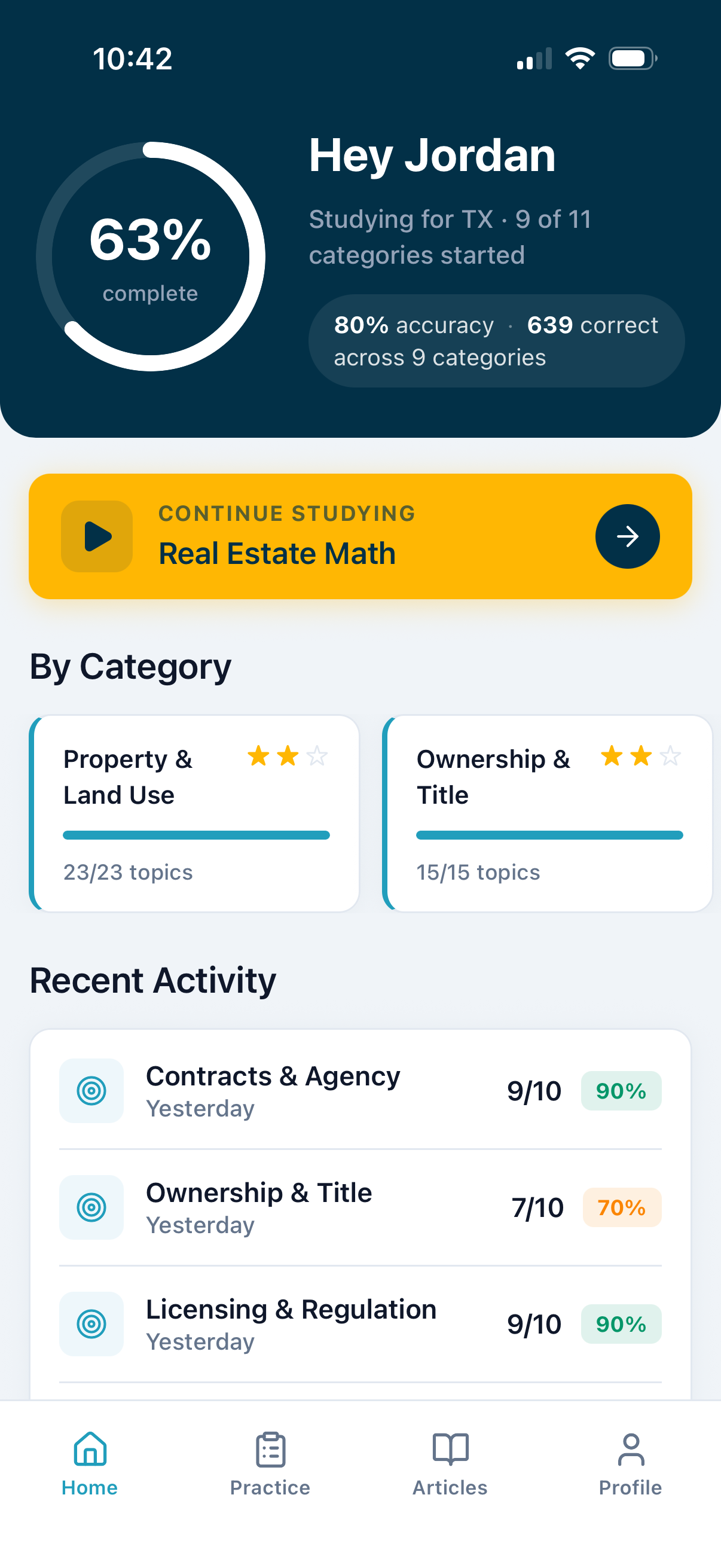
The RealReady app has all 1,055 questions covering both national real estate principles and Maryland-specific law. The full app also includes:

  • Short articles that walk you through the why behind each topic
  • A missed-question drill mode
  • Detailed explanations on every question
  • Progress tracking with per-category accuracy

Unlike other real estate prep apps, we don't cut off access or charge a monthly subscription fee. It's a one-time $17.99, and it's yours forever.

About the exam

More about the Maryland real estate exam

Maryland grades its state-law portion separately and runs harder than average; prep-industry figures put first-time pass rates in the 50-60% range. A strong national score won't carry a weak state score, so Maryland-specific preparation matters as much as the national material.

Maryland has its own Real Estate Guaranty Fund, mandatory MREC brokerage disclosure timing, a one-month-rent security deposit cap under the 2024 Renters' Rights and Stabilization Act, Section 8 source-of-income protection on top of federal fair housing, power-of-sale foreclosure with mandatory 45-day pre-file Notice of Intent and court ratification, the State Department of Assessments and Taxation valuation system, and Baltimore's historical ground rent. None of that looks like the material a candidate in a neighboring state studies. A generic real estate practice test won't cut it. You need Maryland-specific practice questions.

FAQ

Maryland real estate exam: your questions answered

How many questions are on the Maryland real estate exam?

The Maryland Real Estate Salesperson Examination has 110 scored multiple-choice questions split into two portions: 80 on national real estate principles and 30 on Maryland law. The state portion also includes up to 10 unscored pretest questions PSI uses to evaluate future items. You have 90 minutes on the national portion and 30 minutes on the state portion.

What's the passing score for the Maryland real estate exam?

70% on each portion, scored separately. You need at least 56 of 80 national questions and 21 of 30 state questions correct. Failing either side means you retake only the side you failed, not the whole exam.

How much does the Maryland real estate exam cost?

The PSI examination fee is $44 per attempt, paid directly to PSI when you schedule. If you pass, MREC's original salesperson license fee is $98, which includes a $20 payment into the state Real Estate Guaranty Fund. License renewal is $78 every two years.

How long is the Maryland real estate exam?

Two hours total, broken into a 90-minute national portion and a 30-minute Maryland portion. PSI delivers it by computer at testing centers in Baltimore, College Park, Crofton, Hagerstown, and Lanham, plus Brainseed Testing Services. You'll see whether you passed each portion before you leave.

Who administers the Maryland real estate exam?

The Maryland Real Estate Salesperson Examination is administered by PSI for the Maryland Real Estate Commission (MREC). You register and schedule your exam date through PSI.

Is the Maryland real estate exam hard?

PSI doesn't publish a Maryland-specific first-time pass rate, but national prep-industry data puts state real estate salesperson pass rates in the 50-60% range on the first attempt, and Maryland is harder than average because the state portion is graded separately. Most people who fail aren't lazy; they underestimated the Maryland material (MREC structure, Guaranty Fund, the brokerage disclosure form, Maryland's source-of-income fair housing rules, security deposit limits) and over-prepared on national principles. Honest practice on a Maryland-specific practice exam is the difference between passing on the first try and paying for another $44 retake.

What's on the Maryland real estate exam?

The 80-question national portion covers seven content areas: property ownership and land use controls, laws of agency and fiduciary duty, valuation and market analysis, financing, contracts, transfer of title, and general practice including mandated disclosures and real estate math. The 30-question Maryland portion covers six areas: Duties and Powers of the Real Estate Commission (4 questions), Licensing Requirements (4), Brokerage Relationships (7), Supervision (5), Business Conduct (6), and Ethics (4). The state portion leans heavily on Title 17 of the Business Occupations and Professions Article, MREC regulations (COMAR Title 09 Subtitle 11), and Maryland-specific consumer-protection statutes.

What's the best way to prepare for the Maryland real estate exam?

After finishing your 60-hour MREC-approved pre-license course, the highest-leverage thing you can do is grind through Maryland-specific practice questions with honest feedback on every miss. Generic real estate practice tests will help with national principles but won't catch you on Maryland's unique rules: the Guaranty Fund cap, brokerage disclosure timing, the one-month-rent security deposit cap (effective October 2024), Section 8 source-of-income protection, power-of-sale foreclosure procedures, and Baltimore ground rent. The RealReady app gives you the full bank of Maryland questions, plus progress tracking and a missed-question mode so you can drill what you're weak on. Most users study 30-60 minutes a day for 2-4 weeks before sitting the PSI exam.

Is RealReady free?

The 20 Maryland practice questions on this page are free, no account or signup needed. Unlocking the rest of the Maryland bank is a single in-app purchase you pay once and own, with no recurring charge and no time limit on access.

Does RealReady cover the Maryland real estate exam?

Yes. RealReady has a dedicated Maryland question bank built for the Maryland real estate exam, covering the national principles every candidate sees plus the Maryland law that trips people up, like the Maryland Real Estate Guaranty Fund, the one-month-rent security deposit cap under the Renters' Rights and Stabilization Act, and power-of-sale foreclosure with its 45-day Notice of Intent.

Is RealReady a real estate license course?

No. RealReady is exam practice, not a pre-license course, so it doesn't count toward Maryland's required pre-license education hours. Use it after or alongside your coursework to drill realistic practice questions and find your weak spots before exam day.