New Jersey · Real estate exam prep

New Jersey Real Estate Practice Test

20 free New Jersey practice questions with no signup required. When you're ready for more, the full RealReady bank has 1,120 questions for the 2026 exam that cover both national principles and New Jersey law.

Practice below

Practice

20 New Jersey Real Estate Test Questions & Answers

Use this like a free New Jersey real estate practice test: read the question, commit to an answer, then tap to reveal the correct answer and a plain-English explanation. The ones you miss tell you where to focus next.

Q1 of 20 Licensing & Regulation

Within which state department does the New Jersey Real Estate Commission (NJREC) operate?

  1. Department of Law and Public Safety
  2. Department of Community Affairs
  3. Department of Banking and Insurance
  4. Department of Consumer Affairs
Show answer & explanation

Correct: C Department of Banking and Insurance

NJREC operates within the New Jersey Department of Banking and Insurance (DOBI). The Department of Consumer Affairs handles other professional licensing but not real estate. The Department of Community Affairs deals with housing policy, not licensee regulation.

Q2 of 20 Licensing & Regulation

What distinguishes a broker-salesperson from a broker in New Jersey?

  1. A broker-salesperson cannot list properties
  2. A broker-salesperson works under another broker
  3. A broker-salesperson holds a salesperson license
  4. A broker-salesperson has fewer education hours
Show answer & explanation

Correct: B A broker-salesperson works under another broker

A broker-salesperson holds a broker license but chooses to work under another broker rather than operating independently. Both have the same education requirements. A broker-salesperson can perform all broker functions but does so under supervision of another broker.

Q3 of 20 Licensing & Regulation

What triggers an NJREC investigation into a licensee's conduct?

  1. Only a court order from a judge
  2. A consumer complaint or Commission initiative
  3. Only a complaint from another licensee
  4. A request from the local police department
Show answer & explanation

Correct: B A consumer complaint or Commission initiative

NJREC can initiate investigations based on consumer complaints or on its own initiative. The Commission does not need a court order or a complaint from another licensee to begin an investigation. Police departments do not direct NJREC investigations.

Q4 of 20 Licensing & Regulation

What is the primary purpose of the New Jersey Real Estate Guaranty Fund?

  1. Provide down payment assistance to buyers
  2. Insure brokers against transaction lawsuits
  3. Fund NJREC annual operating expenses
  4. Compensate the public for licensee misconduct losses
Show answer & explanation

Correct: D Compensate the public for licensee misconduct losses

The Guaranty Fund exists to compensate members of the public who suffer financial losses due to the misconduct of licensed real estate professionals. It does not insure brokers, fund agency operations, or provide buyer assistance programs.

Q5 of 20 State Practice

When must a New Jersey licensee first disclose their agency role to a consumer?

  1. When a purchase offer is submitted
  2. At the time of contract signing
  3. At first contact with the consumer
  4. Before the closing date is set
Show answer & explanation

Correct: C At first contact with the consumer

New Jersey law requires agency disclosure at first contact with the consumer. Waiting until an offer or contract signing would be too late, as meaningful discussions may have already occurred without the consumer understanding the agent's role.

Q6 of 20 State Practice

Under New Jersey law, who bears full responsibility for a salesperson's professional conduct?

  1. The New Jersey Real Estate Commission
  2. The employing broker
  3. The salesperson alone
  4. The managing associate broker
Show answer & explanation

Correct: B The employing broker

The employing broker has full responsibility for all salespersons under their supervision. This includes ensuring compliance with all regulations and laws. NJREC oversees licensing but does not bear responsibility for individual salesperson conduct.

Q7 of 20 State Practice

Where must a New Jersey broker maintain their trust or escrow account?

  1. At the broker's personal bank of choice
  2. At any federally insured bank nationwide
  3. At the NJREC headquarters office
  4. At a New Jersey banking institution
Show answer & explanation

Correct: D At a New Jersey banking institution

New Jersey requires brokers to maintain trust/escrow accounts at a New Jersey banking institution. An out-of-state bank, even if federally insured, does not satisfy this requirement. NJREC does not hold broker funds.

Q8 of 20 State Practice

What must appear in all New Jersey real estate advertising?

  1. The MLS listing identification number
  2. The property's assessed tax value
  3. The name of the licensed broker or firm
  4. The salesperson's personal phone number
Show answer & explanation

Correct: C The name of the licensed broker or firm

All real estate advertising in New Jersey must include the name of the licensed broker or firm as it appears on the license. While a salesperson's name may appear, the broker's name must be prominent. Tax values and MLS numbers are not required elements.

Q9 of 20 State Practice

Under the CPEA effective August 2024, which parties must complete a Seller's Property Condition Disclosure Statement in New Jersey?

  1. Only sellers of properties built before 1978
  2. Only individual homeowner sellers
  3. Sellers of commercial property exclusively
  4. All sellers of residential property
Show answer & explanation

Correct: D All sellers of residential property

The Real Estate Consumer Protection Enhancement Act (CPEA), effective August 1, 2024, requires ALL sellers of residential property to complete the disclosure statement. This includes banks, estate administrators, and other entities without exception.

Q10 of 20 State Practice

Which protected class is recognized under New Jersey's LAD but NOT under the federal Fair Housing Act?

  1. Familial status
  2. Source of income
  3. Disability or handicap
  4. Race and color
Show answer & explanation

Correct: B Source of income

New Jersey's Law Against Discrimination adds several classes beyond federal protections, including source of income. This means landlords cannot refuse Section 8 voucher holders solely because of their payment source.

Q11 of 20 State Transactions

How many business days does the attorney review period last in a New Jersey real estate contract?

  1. Ten business days
  2. Five business days
  3. Three business days
  4. Seven calendar days
Show answer & explanation

Correct: C Three business days

New Jersey real estate contracts include a distinctive 3-business-day attorney review period. During this time, either party's attorney can review, modify, or void the contract entirely.

Q12 of 20 State Transactions

In New Jersey, who typically conducts the real estate closing?

  1. The county recorder's office staff
  2. A licensed escrow officer exclusively
  3. Attorneys for the buyer and seller
  4. The listing broker handles all closings
Show answer & explanation

Correct: C Attorneys for the buyer and seller

New Jersey does not legally require an attorney at closing, but of the parties listed, the buyer's and seller's attorneys are who conduct a closing when one is used. Attorney-conducted closings are customary in northern New Jersey, while title or settlement companies commonly handle them in the southern part of the state. A listing broker, an escrow officer, and the county recorder's staff do not conduct New Jersey closings.

Q13 of 20 State Transactions

What is the general Realty Transfer Fee rate in New Jersey for sales up to $150,000?

  1. $5.00 per $500 of consideration
  2. $1.00 per $500 of consideration
  3. $2.00 per $500 of consideration
  4. $3.75 per $500 of consideration
Show answer & explanation

Correct: C $2.00 per $500 of consideration

The NJ Realty Transfer Fee is calculated at $2.00 per $500 of consideration, which equals 0.4%, for sales up to $150,000. Higher graduated rates apply for sales exceeding that threshold.

Q14 of 20 State Transactions

What type of eviction state is New Jersey classified as?

  1. A notice-only eviction state
  2. An at-will eviction state
  3. A just cause eviction state
  4. A no-fault eviction state
Show answer & explanation

Correct: C A just cause eviction state

New Jersey is a just cause eviction state under the Anti-Eviction Act. Landlords may only remove tenants for specific enumerated reasons, providing strong tenant protections compared to at-will eviction states.

Q15 of 20 State Transactions

How do Pinelands development regulations differ from standard municipal zoning in New Jersey?

  1. The county assumes all zoning authority
  2. A separate commission controls development there
  3. Only agricultural use is permitted in the area
  4. Federal wilderness rules override state law
Show answer & explanation

Correct: B A separate commission controls development there

The Pinelands Commission, created by the Pinelands Protection Act, exercises development control that supersedes standard municipal zoning within the Pinelands area. Federal wilderness designation does not apply. Agricultural use is not the only permitted use, and the county does not take over zoning authority.

Q16 of 20 State Transactions

What constitutional obligation does the Mount Laurel doctrine impose on NJ municipalities?

  1. Offer tax abatements to all new residents
  2. Eliminate all single-family zoning districts
  3. Build public housing on municipal land
  4. Provide realistic opportunity for affordable housing
Show answer & explanation

Correct: D Provide realistic opportunity for affordable housing

The Mount Laurel doctrine, from the landmark NJ Supreme Court decisions, requires every municipality to provide a realistic opportunity for its fair share of affordable housing. This obligation is rooted in the NJ Constitution.

Q17 of 20 Licensing & Regulation

Which group does NJREC have authority to license and regulate?

  1. Brokers, salespersons, and instructors
  2. All real estate service providers
  3. Brokers and salespersons only
  4. Brokers, appraisers, and inspectors
Show answer & explanation

Correct: A Brokers, salespersons, and instructors

NJREC licenses and regulates brokers, salespersons, and real estate instructors. Appraisers are regulated by a separate board. Home inspectors fall under different oversight, not NJREC jurisdiction.

Q18 of 20 Licensing & Regulation

A salesperson wants to operate her own brokerage. What license must she obtain?

  1. Sole proprietor permit from DOBI
  2. Broker license
  3. Broker-salesperson license
  4. An upgraded salesperson license
Show answer & explanation

Correct: B Broker license

To operate an independent brokerage, an individual must hold a broker license. A broker-salesperson still works under another broker. There is no separate sole proprietor permit or upgraded salesperson license category in New Jersey.

Q19 of 20 Licensing & Regulation

During a routine audit, NJREC discovers a broker's trust account is short $5,000. What authority does the Commission have?

  1. Immediately revoke the broker's license
  2. Order the bank to freeze the account
  3. Investigate and initiate formal proceedings
  4. Arrest the broker for theft
Show answer & explanation

Correct: C Investigate and initiate formal proceedings

NJREC has authority to investigate trust account irregularities and initiate formal disciplinary proceedings. Immediate revocation without a hearing would violate due process. The Commission cannot order banks to freeze accounts or arrest anyone; arrests require law enforcement action.

Q20 of 20 Licensing & Regulation

A salesperson contributes $10 to the Guaranty Fund. How much does a broker contribute?

  1. $100
  2. $20
  3. $50
  4. $10
Show answer & explanation

Correct: B $20

Brokers contribute $20 per licensing period to the Guaranty Fund, while salespersons contribute $10. The higher broker contribution reflects the broker's greater responsibility in real estate transactions. These amounts are set by statute and included in the overall license fee.

Want the rest of New Jersey's 1,120-question bank?

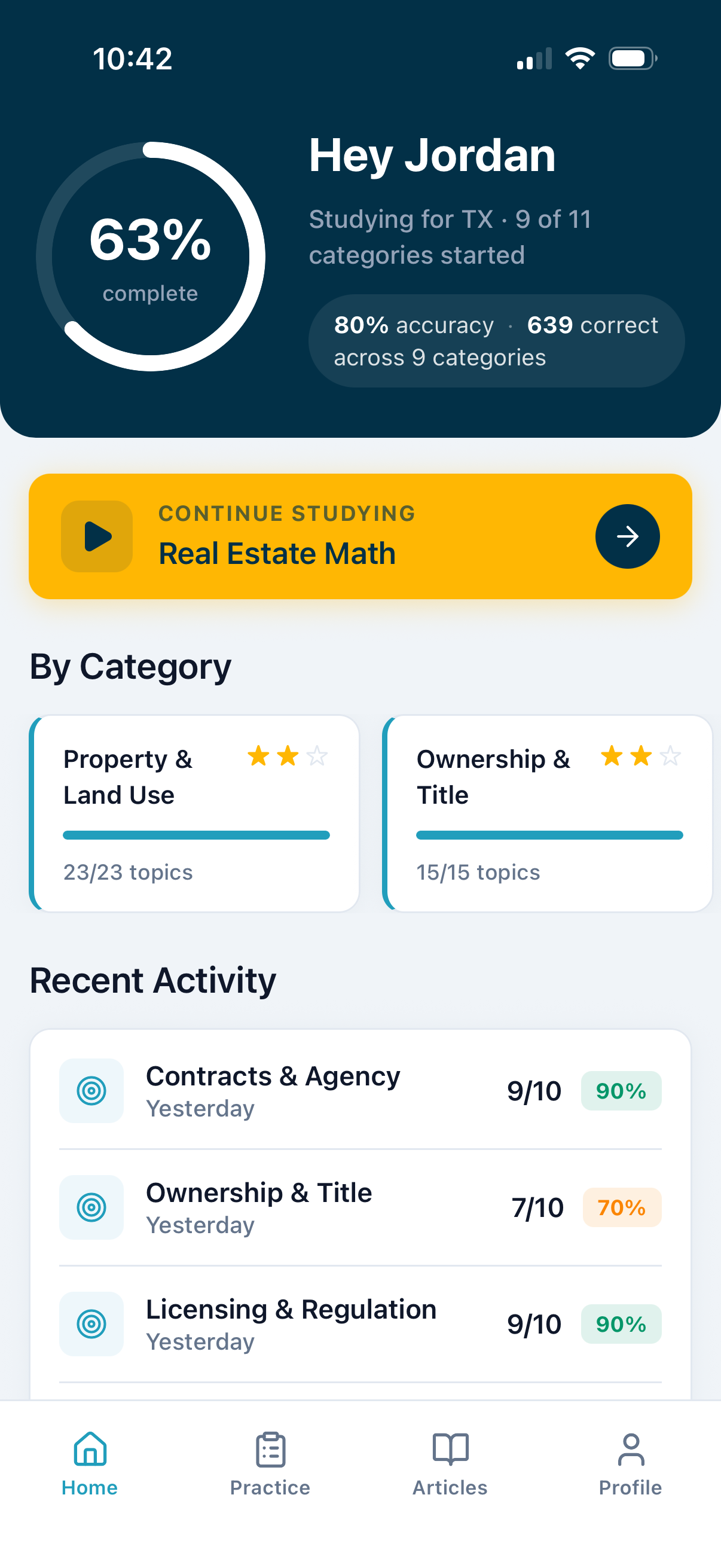
The RealReady app has all 1,120 questions covering both national real estate principles and New Jersey-specific law. The full app also includes:

  • Short articles that walk you through the why behind each topic
  • A missed-question drill mode
  • Detailed explanations on every question
  • Progress tracking with per-category accuracy

Unlike other real estate prep apps, we don't cut off access or charge a monthly subscription fee. It's a one-time $17.99, and it's yours forever.

About the exam

More about the New Jersey real estate exam

New Jersey's first-time pass rate runs low, and most candidates who fall short underestimated the 30-question state portion. New Jersey grades the salesperson exam as a single combined result rather than scoring each portion on its own, so the state questions are folded into the one score that decides everything. That makes New Jersey-specific material the difference between passing and retaking.

New Jersey piles on the NJREC's licensing and disciplinary powers, the Real Estate Guaranty Fund, the Consumer Fraud Act, the Law Against Discrimination with its broader list of protected classes, the Real Estate Sales Full Disclosure Act and the Real Estate Time Share Act, the Consumer Information Statement that governs how agents disclose whose interests they represent, and the three-business-day attorney-review clause that every residential contract a licensee prepares has to carry. None of that looks like the material a candidate in a neighboring state studies. A generic real estate practice test won't cut it. You need New Jersey-specific practice questions.

FAQ

New Jersey real estate exam: your questions answered

How many questions are on the New Jersey real estate exam?

The New Jersey Real Estate Salesperson Examination has 110 scored multiple-choice questions. PSI builds it from an 80-question national portion and a 30-question New Jersey portion, and you may also see a handful of unscored pretest items mixed in. The questions are intermixed in a single sitting rather than given as two separate tests.

What's the passing score for the New Jersey real estate exam?

70%, which is 77 of the 110 scored questions correct. New Jersey grades the salesperson exam as one combined score across the national and state questions, so unlike the broker exam there is no separate per-portion bar to clear. PSI tells you whether you passed before you leave the test center.

How much does the New Jersey real estate exam cost?

The salesperson examination fee is $45 per attempt, paid to PSI when you schedule. You can sit it at one of PSI's New Jersey test centers or through online proctoring. That fee is separate from the license fee you'll pay the New Jersey Real Estate Commission after you pass.

How long is the New Jersey real estate exam?

Four hours total for the salesperson exam. That single block covers all 110 questions, the 80 national and the 30 New Jersey, and you find out whether you passed before you leave the test center.

Who administers the New Jersey real estate exam?

The New Jersey Real Estate Salesperson Examination is administered by PSI for the New Jersey Real Estate Commission (NJREC). You register and schedule your exam date through PSI.

Is the New Jersey real estate exam hard?

New Jersey's first-time pass rate runs low, and most candidates who fail underestimate the state portion. The 80 national questions are the same shared content candidates see everywhere, and a decent prep course gets you there. The 30 New Jersey questions are where people lose. You are tested on the NJREC's powers and the Real Estate Guaranty Fund, the Consumer Fraud Act and the Law Against Discrimination, the Real Estate Sales Full Disclosure Act and the Time Share Act, the Consumer Information Statement on agency, and the three-business-day attorney-review clause that every residential contract has to carry. Honest practice on New Jersey-specific material is the difference between passing on your first $45 attempt and retaking.

What's on the New Jersey real estate exam?

The 80-question national portion covers property ownership and land use, valuation and market analysis, financing and mortgages, agency and fiduciary duties, contracts, transfer of title, leasing and property management, fair housing, and real estate math. The 30-question New Jersey portion tests the Real Estate Commission's duties and powers, the statutes and rules governing licensee conduct under Title 45 and N.J.A.C. 11:5, the Real Estate Guaranty Fund, the New Jersey Real Estate Sales Full Disclosure Act, the New Jersey Law Against Discrimination, the New Jersey Real Estate Time Share Act, the Consumer Information Statement that sets out the agency relationships a licensee can offer, and New Jersey practice rules on advertising, trust accounts, commissions, and the attorney-review clause.

What's the best way to prepare for the New Jersey real estate exam?

After you finish your 75-hour pre-license course, the highest-leverage thing you can do is grind through New Jersey-specific practice questions with honest feedback on every miss. National practice tests will help you on the 80 national questions but will not catch you on the Guaranty Fund, the Consumer Fraud Act, the Law Against Discrimination, the Full Disclosure Act, or the Consumer Information Statement. The RealReady app gives you the full New Jersey question bank plus the shared national bank, a missed-question drill mode, and per-category progress tracking so you can see exactly where the state portion is leaking points. Most users study 30 to 60 minutes a day for 2 to 4 weeks before sitting the PSI exam.

Is RealReady free?

The 20 New Jersey practice questions on this page are free, no account or signup needed. Unlocking the rest of the New Jersey bank is a single in-app purchase you pay once and own, with no recurring charge and no time limit on access.

Does RealReady cover the New Jersey real estate exam?

Yes. RealReady has a dedicated New Jersey question bank built for the New Jersey real estate exam, covering the national principles every candidate sees plus the New Jersey law that trips people up, like the Real Estate Guaranty Fund, the Consumer Information Statement, and the attorney-review clause.

Is RealReady a real estate license course?

No. RealReady is exam practice, not a pre-license course, so it doesn't count toward New Jersey's required pre-license education hours. Use it after or alongside your coursework to drill realistic practice questions and find your weak spots before exam day.