How many questions are on the Hawaii real estate exam?
The Hawaii Real Estate Salesperson Examination has 130 scored multiple-choice questions. 80 are on the uniform portion covering national real estate principles, and 50 are on the Hawaii state portion covering HRS Chapter 467 licensing law, Hawaii agency rules, and state-specific topics like the Bureau of Conveyances, HARPTA, and the State Land Use Districts. PSI also embeds five to ten unscored pretest items that aren't identified during the test and don't count toward your score.
What's the passing score for the Hawaii real estate exam?
You need at least 70% on each portion, scored independently. That works out to 56 of 80 correct on the uniform portion and 35 of 50 correct on the Hawaii state portion. If you pass one portion and fail the other, you only have to retake the part you failed, as long as you do so within two years of your first attempt.
How much does the Hawaii real estate exam cost?
The PSI examination fee is $61 per attempt, whether you sit the full combo exam or only one portion as a retake. After you pass, the initial salesperson license application is filed with the Hawaii Real Estate Commission through DCCA, and Hawaii salesperson licenses run on a two-year cycle that ends on December 31 of every even-numbered year.
How long is the Hawaii real estate exam?
Four hours (240 minutes) total for the full salesperson exam, taken as a single sitting. The time is split into 150 minutes for the 80 uniform questions and 90 minutes for the 50 Hawaii state questions. PSI offers it at testing centers on Oahu, Maui, Kauai, and the Big Island, with online proctoring available for candidates who prefer to test from home.
Who administers the Hawaii real estate exam?
The Hawaii Real Estate Salesperson Examination is administered by PSI for the Hawaii Real Estate Commission. You register and schedule your exam date through PSI.
Is the Hawaii real estate exam hard?
The state portion is what trips most candidates up. The 80-question uniform section is the same national content you'd see on any PSI real estate exam, but Hawaii's 50 state questions are dense and unforgiving. The Bureau of Conveyances versus Land Court recording rules, leasehold property quirks, HARPTA's 7.25% nonresident seller withholding, the General Excise Tax on commissions and gross rents, condominium and time share registration requirements, and the four State Land Use Districts catch candidates who only drilled mainland practice questions. Honest practice on a Hawaii-specific practice exam is the difference between passing on the first try and paying another $61 for a retake.
What's on the Hawaii real estate exam?
The 80-question uniform portion covers property ownership (6 items), land use controls and regulations (5), valuation and market analysis (8), financing (7), laws of agency (10), mandated disclosures (7), contracts (10), transfer of title (4), practice of real estate (12), real estate calculations (7), and specialty areas (4). The 50-question Hawaii state portion is weighted toward professional practices and conduct (14 items, including office management, trust accounts, advertising, HRS Chapter 467 licensing law, and grounds for disciplinary action), ascertaining and disclosing material facts (8, including Bureau of Conveyances and Land Court, HARPTA and GET, and the Seller Disclosure Law), types of ownership (6, including condominiums, cooperatives, time sharing plans, and land trusts), contracts and addenda (6), title and conveyances (4), financing (4), escrow and closing (3), property management under the Residential Landlord-Tenant Code (3), and land utilization (2, including State Land Use Districts and Special Management Areas).
What's the best way to prepare for the Hawaii real estate exam?
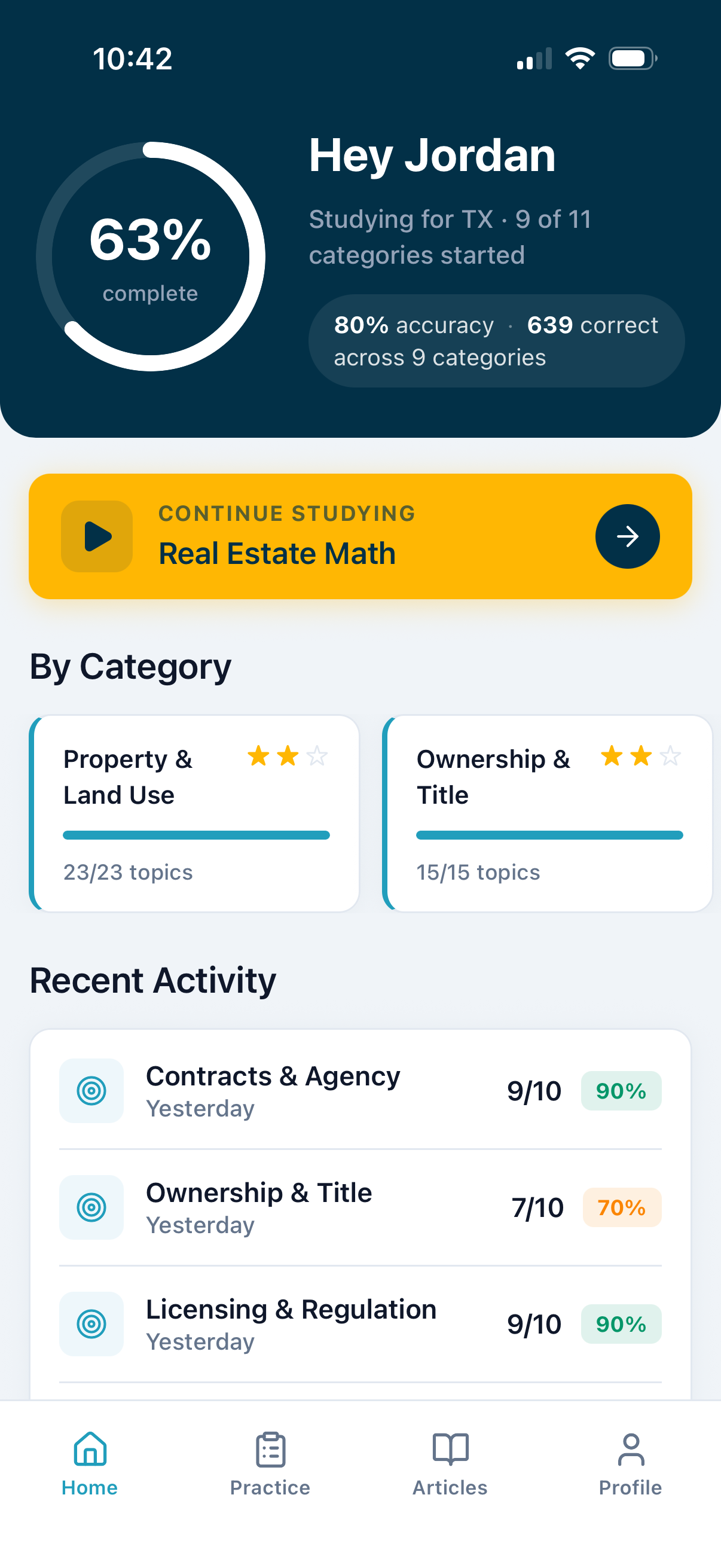
After finishing your 60-hour Hawaii prelicense course, the highest-leverage thing you can do is grind through Hawaii-specific practice questions with honest feedback on every miss. The uniform portion isn't hard to prepare for if you've used any national prep tool, but the state portion is where Hawaii-specific question banks earn their keep. The RealReady app gives you the full bank of Hawaii questions, plus progress tracking and a missed-question mode so you can drill what you're weak on. Most users study 30-60 minutes a day for 2-4 weeks before sitting the exam.
Is RealReady free?
The 20 Hawaii practice questions on this page are free, no account or signup needed. Unlocking the rest of the Hawaii bank is a single in-app purchase you pay once and own, with no recurring charge and no time limit on access.
Does RealReady cover the Hawaii real estate exam?
Yes. RealReady has a dedicated Hawaii question bank built for the Hawaii real estate exam, covering the national principles every candidate sees plus the Hawaii law that trips people up, like the Bureau of Conveyances and Land Court recording system, HARPTA withholding on nonresident sellers, and the Seller Disclosure Law under HRS Chapter 508D.
Is RealReady a real estate license course?
No. RealReady is exam practice, not a pre-license course, so it doesn't count toward Hawaii's required pre-license education hours. Use it after or alongside your coursework to drill realistic practice questions and find your weak spots before exam day.