How many questions are on the Wisconsin real estate exam?
The Wisconsin real estate salesperson exam has 140 scored multiple-choice questions, plus a handful of unscored pretest items mixed in that don't count toward your result. The Department of Safety and Professional Services gives it as one combined test through Pearson VUE, so there's no separate national portion to clear.
What's the passing score for the Wisconsin real estate exam?
You need a score of 75 to pass. Wisconsin reports your result as a scaled score on a 0 to 100 scale rather than a raw percentage, so a 75 reflects how your performance compares across different exam versions, not simply 75% of the questions correct. You find out whether you passed before you leave the test center.
How much does the Wisconsin real estate exam cost?
The examination fee is $65, paid to Pearson VUE when you reserve your seat. The fee is the same on every attempt, so if you have to retake the exam you pay $65 again. Payment is due at reservation and isn't accepted at the test center.
How long is the Wisconsin real estate exam?
You get four hours, which is 240 minutes, for the 140-question salesperson exam. That's generous compared with many states, so most candidates have time to read carefully and review the questions they flagged before the clock runs out.
Who administers the Wisconsin real estate exam?
The Wisconsin Real Estate Salesperson Examination is administered by Pearson VUE for the Wisconsin Department of Safety and Professional Services (DSPS). You register and schedule your exam date through Pearson VUE.
Is the Wisconsin real estate exam hard?
It's challenging, and the Wisconsin-specific material is where most people lose points. Candidates often handle national topics like financing and valuation well, then get tripped up by Wisconsin's approved forms, agency-disclosure rules, and trust-account requirements. Focused practice on Wisconsin law is what separates first-time passers from retakes.
What's on the Wisconsin real estate salesperson exam?
The 140-question exam blends national real estate principles with Wisconsin law across ten areas. Agency is the largest at about 32 questions, followed by contract law and Wisconsin's WB approved forms at about 22, valuing and financing property at about 20, ownership and transfer of property at about 14, business ethics at about 14, and disclosures at about 13. The rest is split among land use controls, fair housing, federal antitrust law, and a miscellaneous group that covers trust accounts, fee splitting, and rental practices.
What's the best way to prepare for the Wisconsin real estate exam?
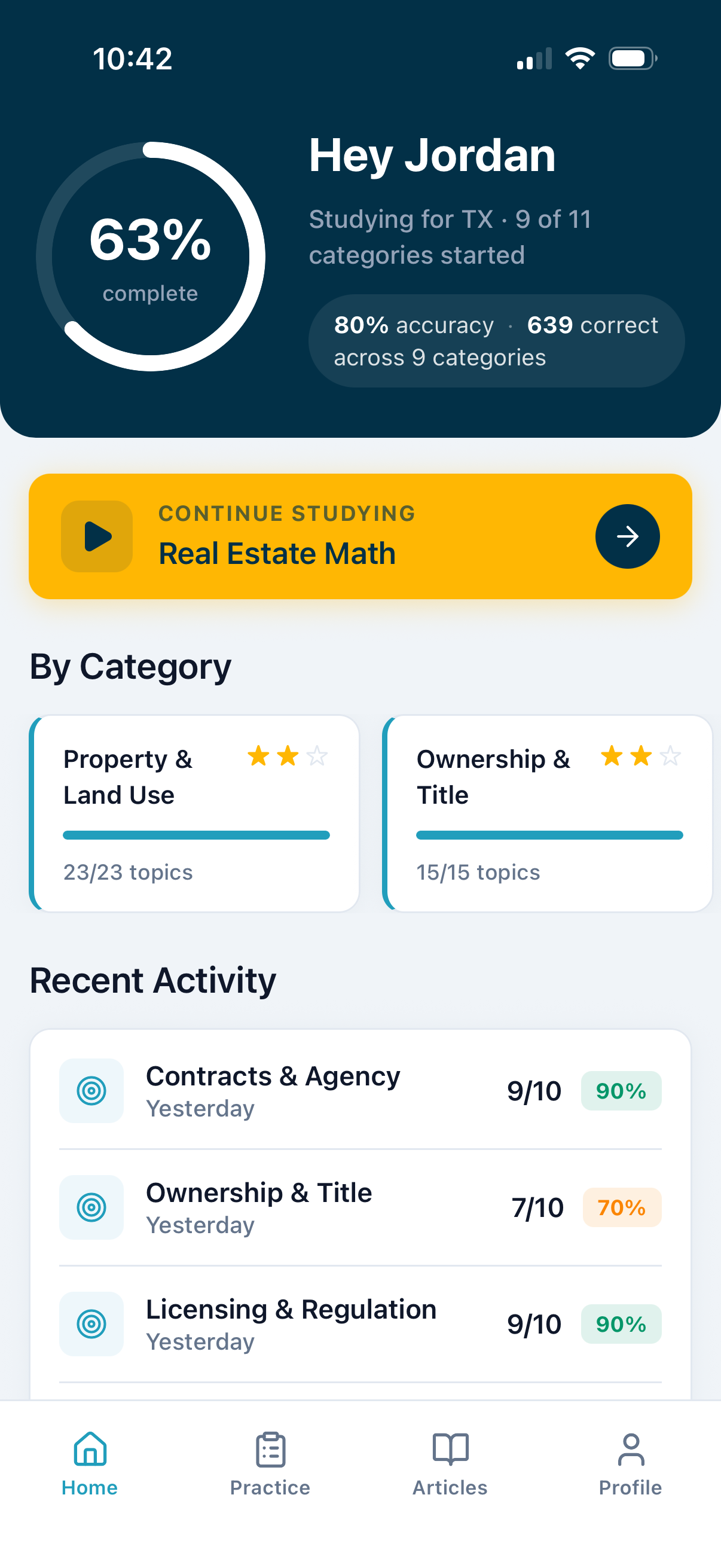
After you finish your pre-license coursework, the highest-leverage thing you can do is drill Wisconsin-specific practice questions and review the explanation on every miss. Generic national practice tests help with principles but won't catch you on Wisconsin's forms and statutes. The RealReady app gives you the full Wisconsin question bank, plus a missed-question mode and per-category progress tracking so you can target your weak spots. Most users study 30 to 60 minutes a day for a few weeks before sitting the exam.
Is RealReady free?
The 20 Wisconsin practice questions on this page are free, no account or signup needed. Unlocking the rest of the Wisconsin bank is a single in-app purchase you pay once and own, with no recurring charge and no time limit on access.
Does RealReady cover the Wisconsin real estate exam?
Yes. RealReady has a dedicated Wisconsin question bank built for the Wisconsin real estate exam, covering the national principles every candidate sees plus the Wisconsin law that trips people up, like the WB-11 Residential Offer to Purchase and other WB approved forms, the powers of the Real Estate Examining Board, and the real estate condition report.
Is RealReady a real estate license course?
No. RealReady is exam practice, not a pre-license course, so it doesn't count toward Wisconsin's required pre-license education hours. Use it after or alongside your coursework to drill realistic practice questions and find your weak spots before exam day.