Oregon · Real estate exam prep

Oregon Real Estate Practice Test

20 free Oregon practice questions with no signup required. When you're ready for more, the full RealReady bank has 1,085 questions for the 2026 exam that cover both national principles and Oregon law.

Practice below

Practice

20 Oregon Real Estate Test Questions & Answers

Use this like a free Oregon real estate practice test: read the question, commit to an answer, then tap to reveal the correct answer and a plain-English explanation. The ones you miss tell you where to focus next.

Q1 of 20 Licensing & Regulation

Who heads the Oregon Real Estate Agency (OREA)?

  1. The Real Estate Commissioner
  2. The Attorney General
  3. A five-member commission
  4. The Governor directly
Show answer & explanation

Correct: A The Real Estate Commissioner

OREA is headed by the Real Estate Commissioner, who is appointed by the Governor. Unlike most states that use a commission structure, Oregon uses a single-administrator model.

Q2 of 20 Licensing & Regulation

Under ORS 696.301, which action constitutes a licensing violation in Oregon?

  1. Charging a commission below the average rate
  2. Advertising property at market value
  3. Commingling client funds with personal funds
  4. Declining to represent a buyer
Show answer & explanation

Correct: C Commingling client funds with personal funds

Commingling client funds with personal or business funds is a specific violation under ORS 696.301. Oregon law requires that client trust funds be maintained separately. Declining a client or setting competitive commission rates are lawful activities.

Q3 of 20 Licensing & Regulation

A buyer's broker receives a bonus check directly from a home builder at closing. Is this permissible under Oregon law?

  1. Yes, if the amount is disclosed at closing
  2. Yes, if all parties provide written consent
  3. Only with the principal broker's verbal approval
  4. No, compensation must go through the principal broker
Show answer & explanation

Correct: D No, compensation must go through the principal broker

Oregon law requires that all compensation to brokers be paid through their principal broker. A broker cannot receive compensation directly from any party other than their own principal broker.

Q4 of 20 Licensing & Regulation

A broker receives a signed counteroffer on Friday afternoon. By when must the broker transmit this document to the principal broker?

  1. Within 24 hours of receipt
  2. Within 3 banking days of receipt
  3. Within 5 banking days of receipt
  4. By the next business day
Show answer & explanation

Correct: B Within 3 banking days of receipt

Oregon requires all transaction documents to be transmitted to the principal broker within 3 banking days of the broker's receipt. This applies to counteroffers, offers, amendments, and all other transaction-related writings.

Q5 of 20 State Practice

A broker represents only the seller in a transaction. What type of agency relationship exists?

  1. Buyer's agent relationship
  2. Disclosed limited agency
  3. Facilitator relationship
  4. Seller's agent relationship
Show answer & explanation

Correct: D Seller's agent relationship

When a broker represents only the seller, the relationship is a seller's agency. The broker owes fiduciary duties exclusively to the seller while still owing statutory duties to all parties in the transaction.

Q6 of 20 State Practice

A broker posts a property listing on social media but omits the brokerage's registered business name. What violation has occurred?

  1. Acceptable if the MLS number appears
  2. Only a violation on print media
  3. No violation if posted personally
  4. The ad is a prohibited blind ad
Show answer & explanation

Correct: D The ad is a prohibited blind ad

All real estate advertising in Oregon must include the registered business name (RBN) of the brokerage. This requirement applies equally to internet and social media advertising. An ad without the RBN is considered a blind ad and is prohibited.

Q7 of 20 State Practice

Who bears ultimate responsibility for all trust account activity in an Oregon brokerage?

  1. The office manager
  2. The principal broker
  3. Each individual broker
  4. The listing broker
Show answer & explanation

Correct: B The principal broker

In Oregon, the principal broker (or managing principal broker) is responsible for establishing, maintaining, and overseeing all trust account activity. Individual brokers handle client funds but the PB bears ultimate accountability.

Q8 of 20 State Practice

A seller owns a duplex and receives a written offer from a buyer. What must the seller deliver to the buyer?

  1. A completed property disclosure statement
  2. A professional home inspection report
  3. A municipal certificate of occupancy
  4. A preliminary title insurance commitment
Show answer & explanation

Correct: A A completed property disclosure statement

Under ORS 105.462-105.490, sellers of residential properties with 1-4 units must deliver a completed Seller's Property Disclosure Statement to each buyer who makes a written offer.

Q9 of 20 State Practice

A property management agreement in Oregon must include which material term under ORS 696?

  1. Only the monthly management fee amount
  2. Scope of authority, compensation, and duration
  3. The tenant's preferred lease renewal date
  4. A guarantee of minimum rental income
Show answer & explanation

Correct: B Scope of authority, compensation, and duration

Under ORS 696 and OREA rules, property management agreements must be in writing and include material terms such as scope of authority, compensation, duration, and termination provisions. A fee alone is insufficient, and guarantees of income or tenant preferences are not required terms.

Q10 of 20 State Practice

Which protected class does Oregon fair housing law cover that federal law does NOT?

  1. National origin
  2. Source of income
  3. Familial status
  4. Race
Show answer & explanation

Correct: B Source of income

ORS 659A.421 adds source of income as a protected class, which is not covered under the federal Fair Housing Act. Race, familial status, and national origin are all federally protected classes.

Q11 of 20 State Transactions

A tenant has lived in an Oregon rental unit for 14 months. Under SB 608, what must the landlord have to terminate the tenancy?

  1. Permission from the local housing authority
  2. No special reason after 30-day notice
  3. Just cause for termination
  4. Written approval from the tenant
Show answer & explanation

Correct: C Just cause for termination

Under SB 608 (2019), after 12 months of occupancy, landlords must have 'just cause' to terminate a tenancy. This applies to both at-fault and no-fault terminations.

Q12 of 20 State Transactions

In an Oregon trust deed, what role does the borrower hold?

  1. Mortgagee
  2. Beneficiary
  3. Grantor
  4. Trustee
Show answer & explanation

Correct: C Grantor

In Oregon's trust deed structure, the borrower is the grantor who conveys bare legal title to the trustee. The lender is the beneficiary, and the trustee is a neutral third party.

Q13 of 20 State Transactions

Which legislation established Oregon's statewide land use planning program?

  1. Measure 37 (2004)
  2. Senate Bill 458 (1981)
  3. Senate Bill 100 (1973)
  4. House Bill 2001 (1969)
Show answer & explanation

Correct: C Senate Bill 100 (1973)

Senate Bill 100, passed in 1973, created one of the most comprehensive land use planning systems in the United States. It required all Oregon cities and counties to adopt comprehensive plans consistent with statewide planning goals.

Q14 of 20 State Transactions

Oregon has no state sales tax. What is the primary source of local government revenue?

  1. Municipal sales surcharges
  2. Excise taxes on goods
  3. Property taxes
  4. State income tax
Show answer & explanation

Correct: C Property taxes

Because Oregon has no state sales tax, property taxes serve as the primary revenue source for local governments, funding schools and government operations.

Q15 of 20 State Transactions

Two farmers both claim water from the same creek during a drought. Farmer A's water right was established in 1952 and Farmer B's in 1978. Who receives water first?

  1. Farmer B, as the downstream user
  2. Both receive equal shares
  3. Farmer A, as the senior appropriator
  4. Neither, until OWRD allocates shares
Show answer & explanation

Correct: C Farmer A, as the senior appropriator

Oregon follows the prior appropriation doctrine: first in time, first in right. Farmer A holds the senior right (1952 priority date) and must be fully satisfied before Farmer B receives any water during shortage.

Q16 of 20 State Transactions

A developer plans to divide a 20-acre parcel into six lots. Under ORS 92, what does this constitute?

  1. A planned unit development
  2. A partition
  3. A lot line adjustment
  4. A subdivision
Show answer & explanation

Correct: D A subdivision

Under ORS 92.010-92.990, a subdivision is a division of land into four or more lots. Dividing into six lots meets this threshold. A partition applies only when dividing into two or three parcels.

Q17 of 20 Licensing & Regulation

How is the Oregon Real Estate Commissioner selected?

  1. Elected by licensed brokers
  2. Appointed by the legislature
  3. Appointed by the Governor
  4. Selected by OREA staff
Show answer & explanation

Correct: C Appointed by the Governor

The Real Estate Commissioner is appointed by the Governor. The Commissioner has powers including rulemaking, licensing, investigation, and disciplinary action over real estate licensees.

Q18 of 20 Licensing & Regulation

A broker tells a buyer that a property has no known defects, knowing the foundation has cracks. What violation has occurred under ORS 696.301?

  1. Fraud or misrepresentation
  2. Failure to maintain continuing education
  3. Commingling of funds
  4. Acting without a license
Show answer & explanation

Correct: A Fraud or misrepresentation

Knowingly making false statements about material property conditions constitutes fraud or misrepresentation under ORS 696.301. This is distinct from commingling, which involves mixing client and personal funds. The broker holds an active license, so unlicensed activity does not apply.

Q19 of 20 Licensing & Regulation

A broker left Brokerage A and joined Brokerage B. A commission from a transaction she started at Brokerage A is now due. Who may pay her?

  1. The seller directly
  2. Her former principal broker at Brokerage A
  3. Either principal broker at her choice
  4. Her new principal broker at Brokerage B
Show answer & explanation

Correct: B Her former principal broker at Brokerage A

Oregon allows a former principal broker to pay compensation for transactions that began during the broker's employment at that brokerage. The new principal broker at Brokerage B was not involved in the original transaction.

Q20 of 20 Licensing & Regulation

Which documents must an Oregon broker transmit to their principal broker after receiving them?

  1. Only disclosure forms
  2. Only signed contracts
  3. All transaction-related writings
  4. Only offers and counteroffers
Show answer & explanation

Correct: C All transaction-related writings

Oregon law requires brokers to transmit all transaction-related writings to their principal broker. This includes offers, counteroffers, amendments, contracts, disclosures, and any other documents connected to the transaction.

Want the rest of Oregon's 1,085-question bank?

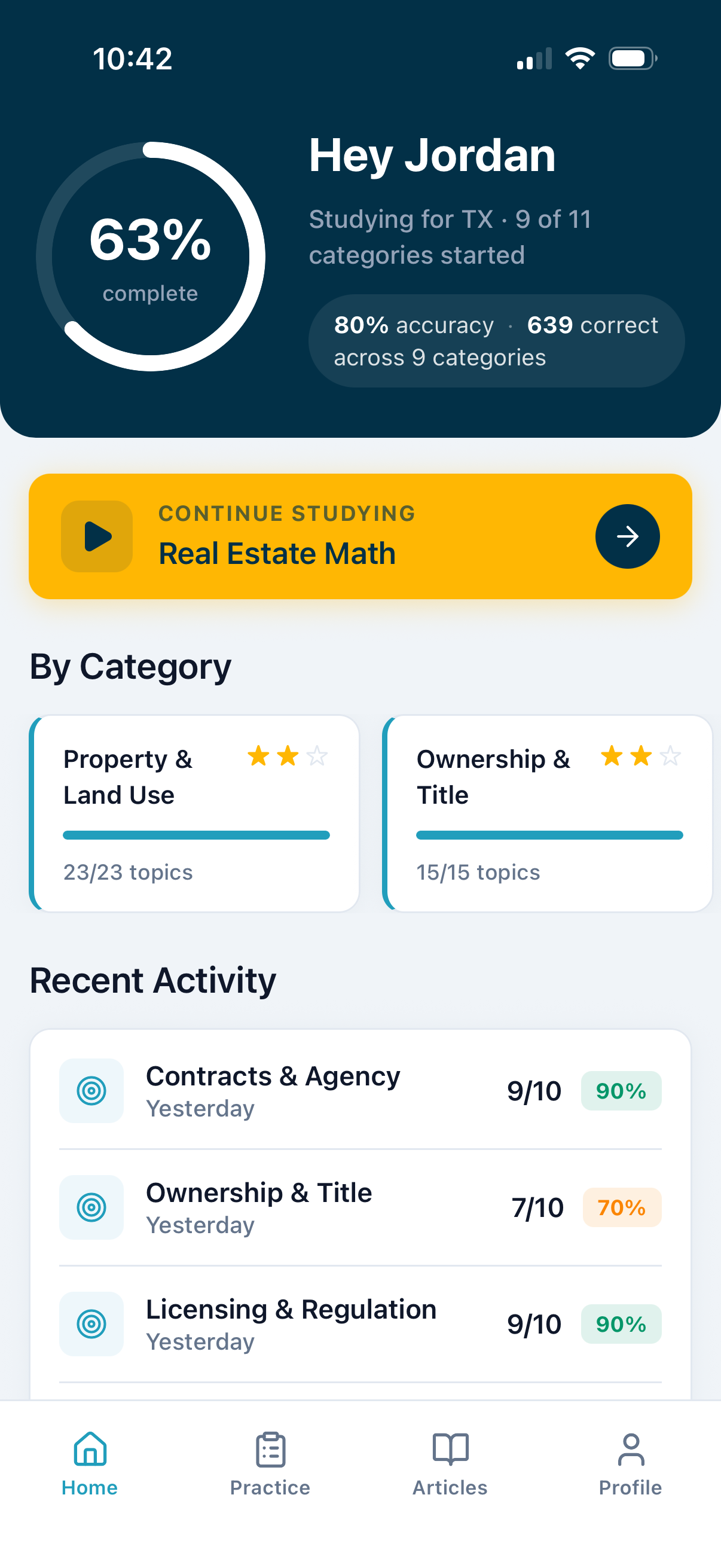
The RealReady app has all 1,085 questions covering both national real estate principles and Oregon-specific law. The full app also includes:

  • Short articles that walk you through the why behind each topic
  • A missed-question drill mode
  • Detailed explanations on every question
  • Progress tracking with per-category accuracy

Unlike other real estate prep apps, we don't cut off access or charge a monthly subscription fee. It's a one-time $17.99, and it's yours forever.

About the exam

More about the Oregon real estate exam

Oregon scores its national and Oregon-law portions separately, and the Oregon-law half is where national prep leaves you exposed. Oregon has no salesperson license, so the entry-level credential is the broker license, regulated by the Oregon Real Estate Agency, the agency most people call OREA. A strong national score does nothing to rescue a thin grasp of Oregon law, which is why Oregon-specific preparation carries as much weight here as the national material.

Oregon tests its own rules in ways a national course never touches, from the disclosed limited agency model that replaces the buyer-and-seller agency labels used elsewhere, to the Oregon real estate license law in ORS 696 and the agency's administrative rules in OAR chapter 863, the statewide land use planning system with its urban growth boundaries, the Oregon Trust Deed Act and its non-judicial foreclosure process, the Residential Landlord and Tenant Act with the statewide rent control Oregon enacted in 2019, water rights under prior appropriation, the construction lien law, and the seller's property disclosure statement with its rules on stigmatized property. None of that looks like the material a candidate in a neighboring state studies. A generic real estate practice test won't cut it. You need Oregon-specific practice questions.

FAQ

Oregon real estate exam: your questions answered

How many questions are on the Oregon real estate exam?

The Oregon broker licensing exam has 130 scored questions, split into an 80-question national portion and a 50-question Oregon state-law portion. PSI delivers them as two separate exams and mixes in a handful of unscored experimental questions that look just like the scored ones and do not count toward your result.

What's the passing score for the Oregon real estate exam?

You need 75 percent on each portion, scored separately. The national and Oregon portions are graded on their own, so passing one does not offset failing the other. If you clear one portion and miss the other, you only retake the portion you failed, as long as you finish both within 12 months.

How much does the Oregon real estate exam cost?

PSI charges $75 to sit the exam, and that fee covers your scheduled attempt. The fee is non-refundable and non-transferable, and it stays valid for one year. Passing the exam is separate from the $300 application fee you pay the Oregon Real Estate Agency to issue your broker license.

How long is the Oregon real estate exam?

Three hours and 15 minutes of testing in total, though the two portions are separate exams. PSI allows two hours for the 80-question national portion and 75 minutes for the 50-question Oregon portion. You can sit them at a PSI test center or through remote online proctoring, and you leave with an official pass or fail score report.

Who administers the Oregon real estate exam?

The Oregon Real Estate Broker License Examination is administered by PSI for the Oregon Real Estate Agency (OREA). You register and schedule your exam date through PSI.

Is the Oregon real estate exam hard?

It is a serious test, and the part that catches people off guard is the 50-question Oregon portion. The national half covers the same principles taught in every state, but the Oregon questions reward candidates who actually studied disclosed limited agency, the ORS 696 license law and OAR chapter 863 rules, the state's land use system, and Oregon's disclosure and trust deed rules. Most people who struggle leaned too heavily on national material and underprepared on Oregon law. Honest reps on Oregon-specific practice questions are the difference between a first-time pass and a retake.

What's on the Oregon real estate exam?

The 80-question national portion covers property ownership and land use, valuation and market analysis, financing, the general principles of agency, contracts, transfer of title, the practice of real estate, property disclosures, and real estate math, with contracts and agency carrying the most weight. The 50-question Oregon portion is built around license law and disciplinary measures, handling client funds, agency law and rules, the regulation of broker activities, document handling and recordkeeping, property management, and a large block of Oregon real estate statutes covering land use, water rights, trust deeds, construction liens, and the property disclosure law. The Oregon statutes block and the regulation of broker activities together make up more than half the state portion, so they are worth extra attention.

What's the best way to prepare for the Oregon real estate exam?

After you finish your required Oregon broker pre-license coursework, the highest-leverage move is grinding Oregon-specific practice questions with honest feedback on every miss. National principles you can pick up from any course, but the 50-question Oregon portion rewards repetition on disclosed limited agency, OREA's powers and the license law, the land use and trust deed rules, and client trust account requirements. The RealReady app gives you the full Oregon question bank plus the national bank, detailed explanations, a missed-question drill mode, and per-category progress tracking so you can see exactly where you are weak.

Is RealReady free?

The 20 Oregon practice questions on this page are free, no account or signup needed. Unlocking the rest of the Oregon bank is a single in-app purchase you pay once and own, with no recurring charge and no time limit on access.

Does RealReady cover the Oregon real estate exam?

Yes. RealReady has a dedicated Oregon question bank built for the Oregon real estate exam, covering the national principles every candidate sees plus the Oregon law that trips people up, like the disclosed limited agency model, the Oregon Trust Deed Act and its non-judicial foreclosure, and the Residential Landlord and Tenant Act with statewide rent control.

Is RealReady a real estate license course?

No. RealReady is exam practice, not a pre-license course, so it doesn't count toward Oregon's required pre-license education hours. Use it after or alongside your coursework to drill realistic practice questions and find your weak spots before exam day.