Pennsylvania · Real estate exam prep

Pennsylvania Real Estate Practice Test

20 free Pennsylvania practice questions with no signup required. When you're ready for more, the full RealReady bank has 1,085 questions for the 2026 exam that cover both national principles and Pennsylvania law.

Practice below

Practice

20 Pennsylvania Real Estate Test Questions & Answers

Use this like a free Pennsylvania real estate practice test: read the question, commit to an answer, then tap to reveal the correct answer and a plain-English explanation. The ones you miss tell you where to focus next.

Q1 of 20 Licensing & Regulation

How many licensed real estate brokers serve on the Pennsylvania Real Estate Commission?

  1. 9 brokers
  2. 7 brokers
  3. 5 brokers
  4. 3 brokers
Show answer & explanation

Correct: C 5 brokers

PREC has 11 members total, including 5 licensed real estate brokers who must each have at least 10 years of licensure at appointment. The remaining seats go to 3 public members, 1 cemetery broker, and 2 ex officio members.

Q2 of 20 Licensing & Regulation

Who may file a complaint with the Pennsylvania Real Estate Commission against a licensee?

  1. Only licensed agents
  2. Only consumers in a transaction
  3. Any person
  4. Only the employing broker
Show answer & explanation

Correct: C Any person

Anyone can file a complaint with PREC against a licensee. There is no requirement that the complainant be a party to a transaction or hold a license.

Q3 of 20 Licensing & Regulation

The Pennsylvania Real Estate Recovery Fund compensates consumers who have been harmed by a licensee's:

  1. Failure to meet sales goals
  2. Fraudulent or deceptive conduct
  3. Honest mistake in a transaction
  4. Negligent marketing errors
Show answer & explanation

Correct: B Fraudulent or deceptive conduct

The Recovery Fund compensates members of the public harmed by a licensee's fraudulent, deceptive, or dishonest conduct. It does not cover honest mistakes, negligence, or poor performance.

Q4 of 20 Licensing & Regulation

A newly licensed salesperson has not yet found an employing broker. The salesperson's license status is:

  1. Suspended pending employment
  2. Inactive
  3. Active but restricted
  4. Automatically cancelled
Show answer & explanation

Correct: B Inactive

A PA salesperson license is inactive without an employing broker. The licensee cannot perform any licensed activities until they are associated with a licensed broker.

Q5 of 20 Licensing & Regulation

A wholesaler enters a contract with a homeowner. Under Act 52, the homeowner may cancel the contract within:

  1. 10 business days of signing
  2. 15 days of signing only
  3. 30 days or before conveyance
  4. 7 days of signing only
Show answer & explanation

Correct: C 30 days or before conveyance

Act 52 gives sellers the right to cancel a wholesale contract until the sooner of midnight on the 30th day after execution or conveyance of the property. Wholesalers cannot cause sellers to waive this right.

Q6 of 20 State Practice

A licensee must provide the Consumer Notice form at what point in a conversation with a consumer?

  1. Before the closing date
  2. At first substantive contact
  3. When a written offer is prepared
  4. At the first open house visit
Show answer & explanation

Correct: B At first substantive contact

The Consumer Notice (Form CN) must be provided at first substantive contact, defined as any discussion beyond objective property facts like dimensions, list price, age, or zoning.

Q7 of 20 State Practice

Regardless of agency relationship, all Pennsylvania licensees must provide which duty to every party?

  1. Confidentiality of all information
  2. Full fiduciary loyalty
  3. Obedience to all instructions
  4. Honest and fair dealing
Show answer & explanation

Correct: D Honest and fair dealing

Honest and fair dealing is owed to ALL parties in a transaction, regardless of agency. Loyalty, confidentiality, and obedience are fiduciary duties owed only to clients (principals).

Q8 of 20 State Practice

In Pennsylvania, real estate commission rates are:

  1. Fixed at 6% for residential sales
  2. Set by PREC regulation
  3. Standardized by the local MLS
  4. Freely negotiable between parties
Show answer & explanation

Correct: D Freely negotiable between parties

Commission rates in Pennsylvania are freely negotiable. There are no fixed or standardized rates set by law, regulation, or any industry organization. Any agreement on rates is between the parties.

Q9 of 20 State Practice

Every real estate advertisement in Pennsylvania must include the employing broker's:

  1. Name and PREC registration number
  2. Name only, phone number optional
  3. License number and email address
  4. Business name AND telephone number
Show answer & explanation

Correct: D Business name AND telephone number

PA requires every advertisement to include the employing broker's business name AND telephone number. Both must be equal in size to the agent's name and number in the advertisement.

Q10 of 20 State Practice

A broker receives an earnest money deposit on Wednesday afternoon. By when must it be deposited into escrow?

  1. End of business Friday
  2. End of business Thursday
  3. Within 3 business days
  4. Within 24 hours
Show answer & explanation

Correct: B End of business Thursday

Pennsylvania requires brokers to deposit funds into escrow by the end of the next business day following receipt. Received Wednesday → deposited by end of business Thursday.

Q11 of 20 State Practice

Which of the following is a prohibited activity under RELRA?

  1. Advertising on social media
  2. Charging a flat-fee commission
  3. Representing both a buyer and seller with consent
  4. Guaranteeing future profits from real estate
Show answer & explanation

Correct: D Guaranteeing future profits from real estate

Guaranteeing future profits from real estate investment is specifically prohibited under RELRA. Flat fees are legal, disclosed dual agency is permitted, and social media advertising is allowed when compliant.

Q12 of 20 State Transactions

The Seller's Property Disclosure Statement in Pennsylvania applies to residential properties with:

  1. 1 to 4 dwelling units
  2. 1 to 2 dwelling units
  3. Only single-family homes
  4. All residential properties
Show answer & explanation

Correct: A 1 to 4 dwelling units

Pennsylvania's Seller Disclosure Law (68 Pa.C.S. §§ 7301-7315) applies to residential property with 1 to 4 units. Larger residential buildings and commercial properties are not covered.

Q13 of 20 State Transactions

Housing discrimination complaints under Pennsylvania law are investigated by the:

  1. PA Department of Housing
  2. PA Real Estate Commission (PREC)
  3. PA Attorney General's Office
  4. PA Human Relations Commission (PHRC)
Show answer & explanation

Correct: D PA Human Relations Commission (PHRC)

The Pennsylvania Human Relations Commission (PHRC) is the state agency responsible for investigating fair housing complaints under the Pennsylvania Human Relations Act.

Q14 of 20 State Transactions

The most widely used residential purchase contract in Pennsylvania is published by:

  1. Pearson VUE testing company
  2. PA Real Estate Commission (PREC)
  3. PA Bar Association (PBA)
  4. PA Association of Realtors (PAR)
Show answer & explanation

Correct: D PA Association of Realtors (PAR)

The PAR Standard Agreement of Sale (Form ASR) is the most commonly used residential purchase contract for 1-4 unit properties in Pennsylvania. It is published by the Pennsylvania Association of Realtors.

Q15 of 20 State Transactions

Under Pennsylvania's Timeshare Act, a purchaser may rescind a timeshare contract within:

  1. 15 days of execution
  2. 3 days of execution
  3. 10 days of execution
  4. 7 days of execution
Show answer & explanation

Correct: D 7 days of execution

The PA Timeshare Act (68 Pa.C.S. §§ 4401-4414) grants purchasers a 7-day rescission period from the date of contract execution. No penalty may be imposed for exercising this right.

Q16 of 20 State Transactions

During the first year of a tenancy in Pennsylvania, the maximum security deposit a landlord can collect is:

  1. First and last month's rent
  2. 1 month's rent
  3. 3 months' rent
  4. 2 months' rent
Show answer & explanation

Correct: D 2 months' rent

During the first year of tenancy, the landlord may collect a maximum security deposit of 2 months' rent. This decreases to 1 month's rent starting in the second year.

Q17 of 20 State Transactions

The Pennsylvania state realty transfer tax rate is:

  1. 1% of the sale price
  2. 2% of the sale price
  3. 1.5% of the sale price
  4. 0.5% of the sale price
Show answer & explanation

Correct: A 1% of the sale price

The state transfer tax is 1%. Local municipalities and school districts typically add another 1%, bringing the standard total to 2%. Philadelphia has a higher local rate.

Q18 of 20 Licensing & Regulation

What is the maximum civil penalty PREC may impose per violation of the Real Estate Licensing and Registration Act?

  1. $5,000 per violation
  2. $1,000 per violation
  3. $2,500 per violation
  4. $500 per violation
Show answer & explanation

Correct: B $1,000 per violation

Under RELRA, PREC can levy civil penalties up to $1,000 per violation. This is in addition to other disciplinary actions like license suspension or revocation.

Q19 of 20 Licensing & Regulation

After investigating a complaint, PREC determines that violations occurred. Which is NOT a possible outcome of the investigation?

  1. Formal charges filed
  2. No further action taken
  3. Immediate license revocation
  4. Consent agreement offered
Show answer & explanation

Correct: C Immediate license revocation

Investigation outcomes are no action, consent agreement, or formal charges. License revocation can only occur after a formal hearing process, not as an immediate investigation result.

Q20 of 20 Licensing & Regulation

Before applying to the Recovery Fund, a claimant must first obtain what?

  1. Written confirmation from the broker
  2. A police report of the fraud
  3. A PREC disciplinary order
  4. A court judgment against the licensee
Show answer & explanation

Correct: D A court judgment against the licensee

A claimant must first obtain a court judgment against the licensee before seeking payment from the Recovery Fund. The judgment must be less than 1 year old with all appeals exhausted.

Want the rest of Pennsylvania's 1,085-question bank?

The RealReady app has all 1,085 questions covering both national real estate principles and Pennsylvania-specific law. The full app also includes:

  • Short articles that walk you through the why behind each topic
  • A missed-question drill mode
  • Detailed explanations on every question
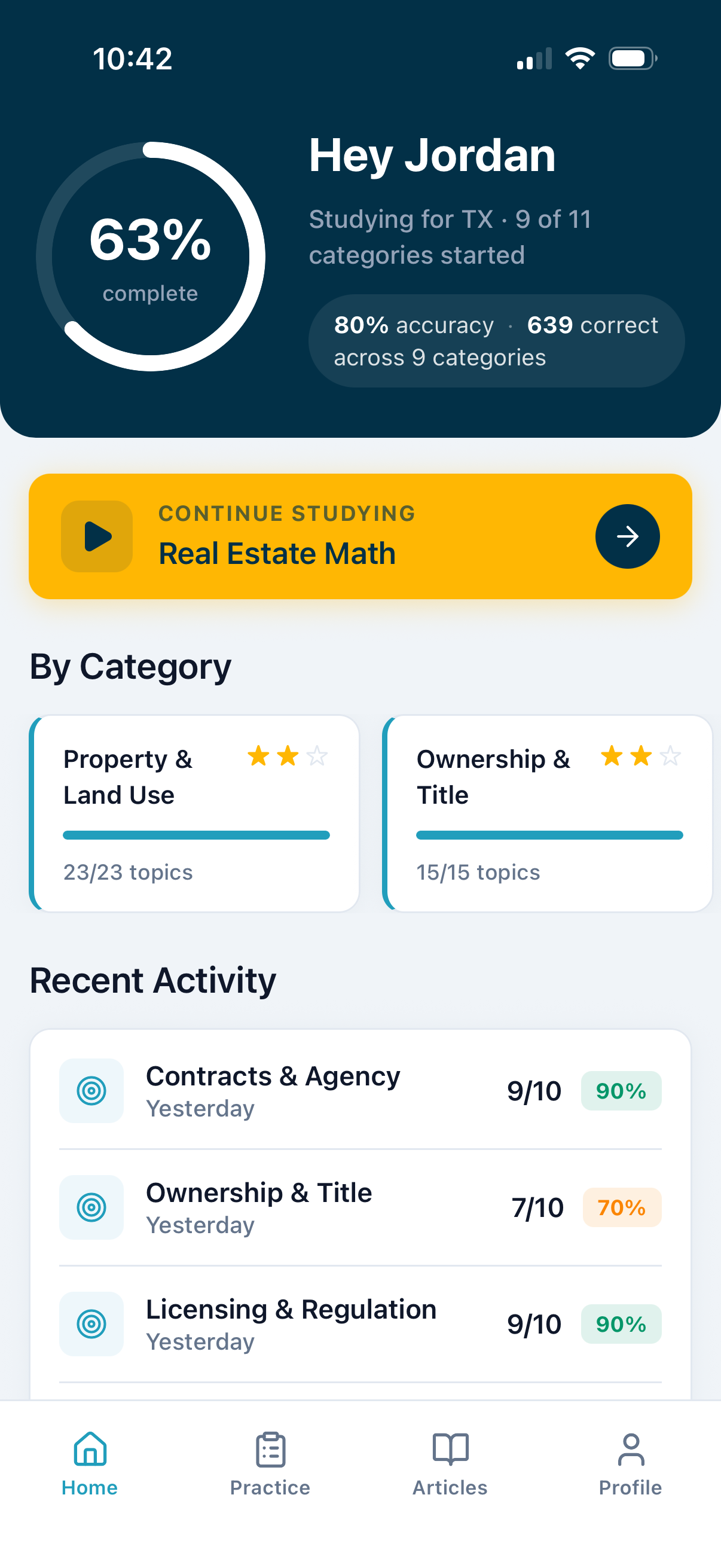
  • Progress tracking with per-category accuracy

Unlike other real estate prep apps, we don't cut off access or charge a monthly subscription fee. It's a one-time $17.99, and it's yours forever.

About the exam

More about the Pennsylvania real estate exam

Pennsylvania scores its national and state-law portions separately, so a strong national score does nothing for you if the state half sinks you. That makes Pennsylvania-specific prep matter as much as the national material.

Pennsylvania tests its own rules in ways a national course never touches. Pennsylvania's Real Estate Licensing and Registration Act, the Consumer Notice and agency disclosure rules, the Real Estate Recovery Fund, the Real Estate Seller Disclosure Law, the Pennsylvania Human Relations Act, and the Commission's rules on advertising, escrow accounts, and prohibited conduct all show up on the state portion. None of that looks like the material a candidate in a neighboring state studies. A generic real estate practice test won't cut it. You need Pennsylvania-specific practice questions.

FAQ

Pennsylvania real estate exam: your questions answered

How many questions are on the Pennsylvania real estate exam?

The Pennsylvania salesperson exam has 120 scored questions split into two parts, an 80-question national portion and a 40-question Pennsylvania state portion. Pearson VUE administers both for the Pennsylvania Real Estate Commission, and the two sections are scored separately. A handful of unscored pretest questions are mixed in that don't count toward your result.

What's the passing score for the Pennsylvania real estate exam?

You need 75% on each portion, scored separately. That works out to 60 of 80 correct on the national section and 30 of 40 correct on the Pennsylvania state section. If you pass one part and fail the other, you only retake the part you failed, so every question on your practice test matters.

How much does the Pennsylvania real estate exam cost?

The combined salesperson exam fee is $52 when you schedule the national and state portions together on the same order, which earns Pearson VUE's combination discount. Booked on separate orders they run $52 for the national part and $49 for the state part. Exam fees are non-refundable and non-transferable.

How long is the Pennsylvania real estate exam?

Three and a half hours total. You get 150 minutes for the 80-question national portion and 60 minutes for the 40-question Pennsylvania state portion. The two sections can be scheduled back to back or on different days within your authorization period.

Who administers the Pennsylvania real estate exam?

The Pennsylvania Real Estate Salesperson Licensing Examination is administered by Pearson VUE for the Pennsylvania Real Estate Commission. You register and schedule your exam date through Pearson VUE.

Is the Pennsylvania real estate exam hard?

It has a reputation as one of the harder state exams, and the two-portion format is a big part of why. You have to clear 75% on both the national and the Pennsylvania law sections, and a strong national score won't rescue a weak state score. Most people who fail underestimated the Pennsylvania-specific material, the Real Estate Licensing and Registration Act, the Commission's rules, agency disclosure, the Recovery Fund, and the Seller Disclosure Law, and leaned too heavily on national principles. Honest practice on Pennsylvania-specific questions is the difference between passing on the first try and paying to retake a portion.

What's on the Pennsylvania real estate exam?

The 80-question national portion covers real property characteristics, ownership and transfer of title, valuation and appraisal, contracts and agency, real estate practice, property disclosures and environmental issues, financing and settlement, and real estate math. The 40-question Pennsylvania portion is weighted toward the rules that govern licensee activity (advertising, broker-salesperson relations, escrow accounts, and prohibited conduct), agency and disclosure, licensure, the Real Estate Commission and Recovery Fund, and miscellaneous topics like property disclosures, the Pennsylvania Human Relations Act, and condominium and planned-community law.

What's the best way to prepare for the Pennsylvania real estate exam?

After you finish your 75-hour pre-license coursework, the highest-leverage thing you can do is grind through Pennsylvania-specific practice questions with honest feedback on every miss. Generic real estate practice tests help with the national portion but won't catch you on Pennsylvania's licensing law, agency rules, and disclosure requirements. The RealReady app gives you the full Pennsylvania question bank, plus progress tracking and a missed-question mode so you can drill your weak spots. Most users study 30 to 60 minutes a day for a few weeks before sitting the exam.

Is RealReady free?

The 20 Pennsylvania practice questions on this page are free, no account or signup needed. Unlocking the rest of the Pennsylvania bank is a single in-app purchase you pay once and own, with no recurring charge and no time limit on access.

Does RealReady cover the Pennsylvania real estate exam?

Yes. RealReady has a dedicated Pennsylvania question bank built for the Pennsylvania real estate exam, covering the national principles every candidate sees plus the Pennsylvania law that trips people up, like the Real Estate Licensing and Registration Act, the Consumer Notice and agency disclosure rules, and the Real Estate Recovery Fund.

Is RealReady a real estate license course?

No. RealReady is exam practice, not a pre-license course, so it doesn't count toward Pennsylvania's required pre-license education hours. Use it after or alongside your coursework to drill realistic practice questions and find your weak spots before exam day.