South Carolina · Real estate exam prep

South Carolina Real Estate Practice Test

20 free South Carolina practice questions with no signup required. When you're ready for more, the full RealReady bank has 1,051 questions for the 2026 exam that cover both national principles and South Carolina law.

Practice below

Practice

20 South Carolina Real Estate Test Questions & Answers

Use this like a free South Carolina real estate practice test: read the question, commit to an answer, then tap to reveal the correct answer and a plain-English explanation. The ones you miss tell you where to focus next.

Q1 of 20 Licensing & Regulation

How many total members serve on the South Carolina Real Estate Commission?

  1. 9 members
  2. 7 members
  3. 12 members
  4. 10 members
Show answer & explanation

Correct: D 10 members

The SCREC has 10 members: 7 elected from congressional districts, 1 at-large elected by the other commissioners, and 2 public members appointed by the Governor with Senate consent.

Q2 of 20 Licensing & Regulation

An SC licensee changes brokerage firms. What must the licensee do?

  1. Notify the Commission of the change
  2. Nothing if still in the same county
  3. Wait until the next renewal to update
  4. Have the new BIC notify the Commission
Show answer & explanation

Correct: A Notify the Commission of the change

Licensees must report changes in name, address, or brokerage firm to the Commission. This is the licensee's responsibility, not the BIC's, and must be done promptly — not at renewal.

Q3 of 20 Licensing & Regulation

Under Section 40-57-710, which action is grounds for discipline by the SCREC?

  1. Refusing to reduce a commission rate
  2. Advertising a property at its listed price
  3. Guaranteeing profits on a real estate investment
  4. Presenting a low offer from a qualified buyer
Show answer & explanation

Correct: C Guaranteeing profits on a real estate investment

Guaranteeing profits on real estate investments is explicitly listed as grounds for discipline. Licensees cannot make promises about future investment returns.

Q4 of 20 State Practice

In South Carolina, which types of brokerage relationships are recognized by law?

  1. Single, dual, designated, and transaction broker
  2. Only single agency and dual agency
  3. Buyer agency and seller agency only
  4. Single, dual, and facilitator only
Show answer & explanation

Correct: A Single, dual, designated, and transaction broker

SC recognizes four types of brokerage relationships: single agency, disclosed dual agency, designated agency, and transaction brokerage. A party may also choose to be a customer with no representation.

Q5 of 20 State Practice

Under SC law, a BIC's supervisory authority over affiliated licensees can be delegated to:

  1. No one — BIC authority cannot be delegated
  2. A senior associate with 5+ years experience
  3. Any licensed broker within the firm
  4. An office manager with a PM license
Show answer & explanation

Correct: A No one — BIC authority cannot be delegated

The BIC role is personal and cannot be delegated to another licensee. The BIC is personally responsible for supervision, trust account maintenance, and all office operations.

Q6 of 20 State Practice

An SC trust account must be established as which type of account?

  1. A brokerage investment account
  2. A demand deposit account (checking)
  3. A certificate of deposit (CD)
  4. A money market savings account
Show answer & explanation

Correct: B A demand deposit account (checking)

SC law requires trust accounts to be demand deposit accounts (checking accounts) with an insured financial institution authorized to do business in South Carolina.

Q7 of 20 State Practice

An SC associate posts a property listing on social media using only their personal name. This is:

  1. Allowed for properties under $200,000
  2. Permitted if the license number is shown
  3. A violation — firm name must be included
  4. Acceptable for personal social media
Show answer & explanation

Correct: C A violation — firm name must be included

All advertising, including social media, must clearly identify the full name of the brokerage firm. Advertising without firm identification is a blind ad and is prohibited.

Q8 of 20 State Practice

SC's Residential Property Condition Disclosure Statement applies to sales of properties with up to how many dwelling units?

  1. 1 to 2 dwelling units
  2. Single-family homes only
  3. 1 to 4 dwelling units
  4. 1 to 6 dwelling units
Show answer & explanation

Correct: C 1 to 4 dwelling units

The disclosure requirement under Title 27, Chapter 50 applies to residential property with 1-4 dwelling units, including sale, exchange, installment land sale, and lease with option to purchase.

Q9 of 20 State Transactions

South Carolina requires which professional to conduct real estate closings?

  1. A licensed mortgage loan officer
  2. A licensed real estate broker
  3. A licensed SC attorney
  4. A licensed title agent
Show answer & explanation

Correct: C A licensed SC attorney

SC is an attorney state — the SC Supreme Court has ruled that real estate closings are the practice of law. A licensed SC attorney must supervise title search, conduct closing, and oversee disbursement.

Q10 of 20 State Transactions

In SC, owner-occupied residential property is assessed at what percentage of fair market value?

  1. 10%
  2. 4%
  3. 15%
  4. 6%
Show answer & explanation

Correct: B 4%

Owner-occupied residential property in SC is assessed at 4% of fair market value. This is one of the lowest assessment ratios — commercial property is assessed at 6%, and manufacturing/utility at 10.5%.

Q11 of 20 State Transactions

What is the maximum security deposit a landlord can charge in South Carolina?

  1. One month's rent
  2. Two months' rent
  3. No statutory maximum exists
  4. Three months' rent
Show answer & explanation

Correct: C No statutory maximum exists

SC is unusual in having no statutory cap on security deposit amounts. Most states limit deposits to 1-3 months' rent, but SC landlords can charge any amount they choose.

Q12 of 20 State Transactions

The SC Beachfront Management Act is administered by which agency?

  1. SC Department of Commerce and Trade
  2. SC Department of Environmental Services
  3. SC Real Estate Commission (SCREC)
  4. SC Department of Natural Resources
Show answer & explanation

Correct: B SC Department of Environmental Services

Since July 2024, the Beachfront Management Act is administered by SCDES, Bureau of Coastal Management (BCM). It was formerly under DHEC/OCRM before the restructuring.

Q13 of 20 State Transactions

Under the SC Consumer Protection Code, what is the maximum rate of interest a lender can charge?

  1. Federal funds rate plus 10%
  2. 18% per annum maximum
  3. 24% per annum maximum
  4. No maximum rate exists in SC
Show answer & explanation

Correct: D No maximum rate exists in SC

SC does not cap interest rates — there is no state usury limit for most loans. This is unusual and is part of the SC Consumer Protection Code that candidates should know.

Q14 of 20 Licensing & Regulation

Which statement accurately describes how professional members of the SCREC are selected?

  1. Elected by legislators from each district
  2. Appointed by the Governor directly
  3. Nominated by real estate associations
  4. Selected by the LLR director
Show answer & explanation

Correct: A Elected by legislators from each district

Seven professional SCREC commissioners are elected from each congressional district by a majority of house and senate members representing that district. This is unusual — most state commissions are entirely appointed.

Q15 of 20 Licensing & Regulation

Which of the following is a recognized license status in South Carolina?

  1. Probationary
  2. Lapsed
  3. Conditional
  4. Temporary
Show answer & explanation

Correct: B Lapsed

SC recognizes the following license statuses: Active, Inactive, Current, Lapsed, Expired, Cancelled, Revoked, and Suspended. Lapsed occurs when a license is not renewed on time.

Q16 of 20 Licensing & Regulation

A licensee submits one purchase contract to the lender and a different contract to the seller for the same transaction. This is known as:

  1. Contract assignment
  2. Designated agency
  3. Dual agency
  4. Dual contracts
Show answer & explanation

Correct: D Dual contracts

Submitting different contracts for the same transaction (dual contracts) is a serious violation and grounds for discipline. It is fraudulent and distinct from dual agency, which involves representing both parties.

Q17 of 20 State Practice

Under SC law, what must exist before an agency relationship is created between a broker and a client?

  1. The showing of a property together
  2. Verbal consent from the client
  3. Payment of a retainer fee
  4. A written agency agreement
Show answer & explanation

Correct: D A written agency agreement

No agency relationship exists in SC unless agreed to in writing. Agency cannot be created orally, by implication, or assumed by any party. This is a critical SC-specific rule.

Q18 of 20 State Practice

Which document is the BIC required to maintain under SC state law?

  1. A client satisfaction survey record
  2. A daily transaction log
  3. A quarterly financial report for LLR
  4. A written policy manual
Show answer & explanation

Correct: D A written policy manual

Section 40-57-137(B) requires the BIC to maintain a written policy manual. This is a specific SC requirement — not all states mandate a policy manual.

Q19 of 20 State Practice

The name on an SC real estate trust account must include which term?

  1. Fiduciary or custodial
  2. Client funds only
  3. Trust or escrow
  4. Earnest money only
Show answer & explanation

Correct: C Trust or escrow

The account title must include the word 'trust' or 'escrow' in the brokerage firm's name. This clearly identifies the account as holding other people's money.

Q20 of 20 State Practice

What is a 'blind ad' in SC real estate?

  1. An ad targeting a specific demographic
  2. An ad that does not identify the brokerage firm
  3. An ad without a property photograph
  4. An ad for an unlisted property
Show answer & explanation

Correct: B An ad that does not identify the brokerage firm

A blind ad is any advertising that does not include the full name of the brokerage firm. Blind ads are prohibited in South Carolina — all advertising must clearly identify the firm.

Want the rest of South Carolina's 1,051-question bank?

The RealReady app has all 1,051 questions covering both national real estate principles and South Carolina-specific law. The full app also includes:

  • Short articles that walk you through the why behind each topic
  • A missed-question drill mode
  • Detailed explanations on every question
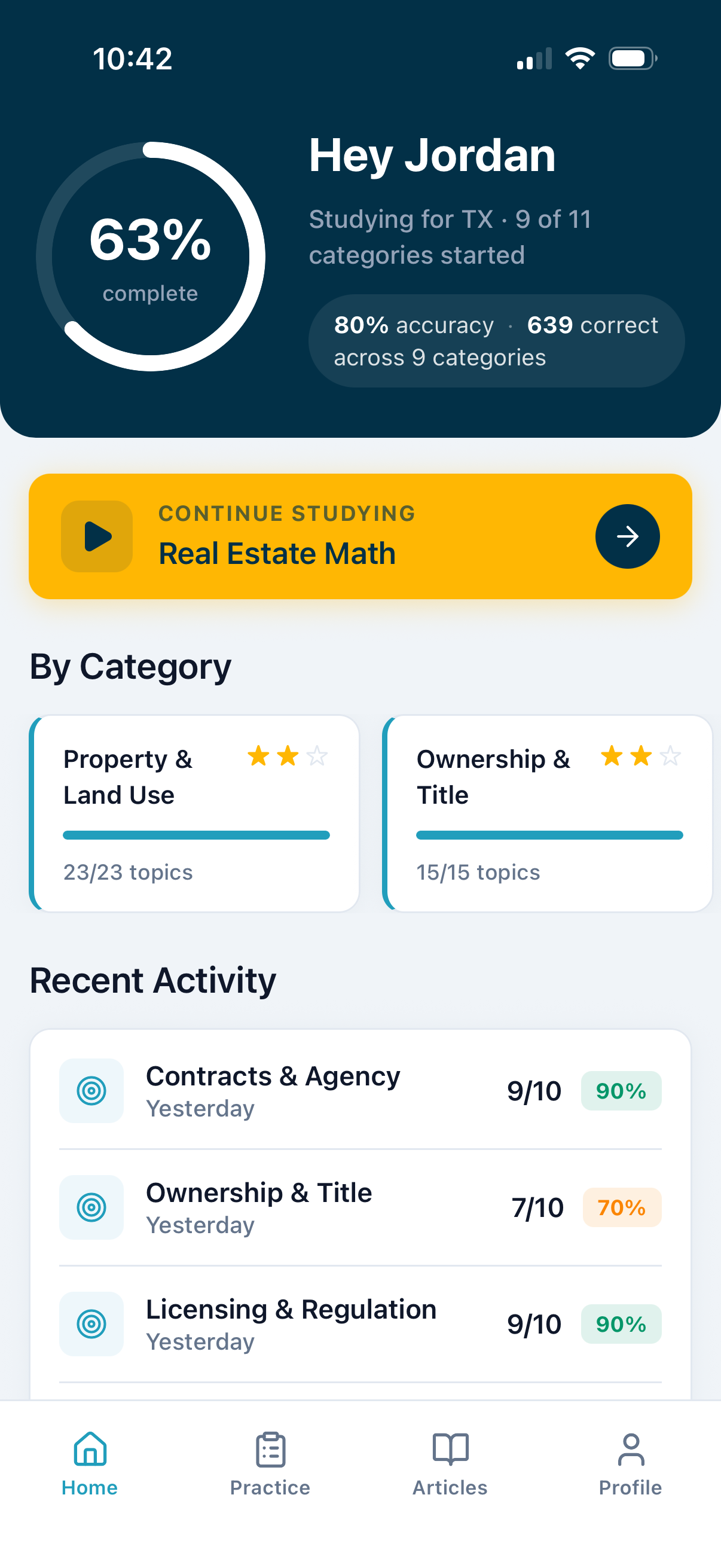
  • Progress tracking with per-category accuracy

Unlike other real estate prep apps, we don't cut off access or charge a monthly subscription fee. It's a one-time $17.99, and it's yours forever.

About the exam

More about the South Carolina real estate exam

The South Carolina real estate salesperson exam trips up close to half of first-time candidates. The national and South Carolina state portions are scored separately, so a strong national score won't rescue a weak state score. That gap on the state section is why South Carolina-specific preparation matters more than another round of national review.

South Carolina runs an unusual real estate commission whose professional members are elected rather than appointed, and the state portion leans on South Carolina's agency and nonagency brokerage relationships, the written disclosure of brokerage relationships, the Residential Property Condition Disclosure, the Real Estate Recovery Fund, and the timeshare, vacation rental, and beachfront rules that come with a coastal market. None of that looks like the material a candidate in a neighboring state studies. A generic real estate practice test won't cut it. You need South Carolina-specific practice questions.

FAQ

South Carolina real estate exam: your questions answered

How many questions are on the South Carolina real estate exam?

The South Carolina salesperson exam has 120 scored questions, split into an 80-question national portion and a 40-question South Carolina state portion. PSI also mixes in 5 to 10 unscored pretest questions that don't count toward your result. You get 200 minutes in total, 120 for the national portion and 80 for the state portion.

What's the passing score for the South Carolina real estate exam?

You need 70 percent on each portion, and the two are scored separately. That works out to 56 of 80 correct on the national portion and 28 of 40 on the state portion. You have to pass both to get licensed, so a high score on one portion doesn't make up for falling short on the other.

How much does the South Carolina real estate exam cost?

PSI charges $63 to sit both portions of the salesperson exam. If you only need to retake a single portion, it's $55. After you pass, South Carolina's initial license fee is $50, and the entry-level license the state issues is called an associate license.

How long is the South Carolina real estate exam?

200 minutes in total. PSI gives you 120 minutes for the 80-question national portion and 80 minutes for the 40-question state portion. Each portion is timed and scored on its own, and your result appears on screen as soon as you finish at the test center.

Who administers the South Carolina real estate exam?

The South Carolina Real Estate Salesperson Examination is administered by PSI for the South Carolina Real Estate Commission. You register and schedule your exam date through PSI.

Is the South Carolina real estate exam hard?

A little more than half of first-time candidates pass both portions on the first attempt, so it earns its reputation. The national portion is manageable for most people who actually studied. The state portion is where candidates stumble, because South Carolina's brokerage-relationship rules, disclosure requirements, and the way the Real Estate Commission is structured don't match what national prep material teaches. Honest practice on South Carolina-specific questions is usually the difference between passing the first time and paying to retake a portion.

What's on the South Carolina real estate exam?

The national portion covers general real estate principles like agency, contracts, financing, property ownership, valuation, and fair housing. The 40-question South Carolina state portion focuses on the statutes governing the activities of licensees and non-licensees, South Carolina agency and nonagency relationships, the Real Estate Commission and its licensing rules, and additional South Carolina statutes and closing practices. The state-specific material carries more weight than its share of questions suggests, since it's the part most candidates have never seen before.

What's the best way to prepare for the South Carolina real estate exam?

After you finish your 90 hours of pre-license coursework, the highest-leverage move is grinding through South Carolina-specific practice questions with honest feedback on every miss. National practice tests help with the 80 national questions but won't catch you on South Carolina's brokerage and disclosure rules. The RealReady app gives you the full South Carolina question bank, plus a missed-question mode and per-category progress tracking so you can drill your weak spots. Most users study 30 to 60 minutes a day for two to four weeks before sitting the exam.

Is RealReady free?

The 20 South Carolina practice questions on this page are free, no account or signup needed. Unlocking the rest of the South Carolina bank is a single in-app purchase you pay once and own, with no recurring charge and no time limit on access.

Does RealReady cover the South Carolina real estate exam?

Yes. RealReady has a dedicated South Carolina question bank built for the South Carolina real estate exam, covering the national principles every candidate sees plus the South Carolina law that trips people up, like the agency and nonagency brokerage relationships, the Residential Property Condition Disclosure, and the Real Estate Recovery Fund.

Is RealReady a real estate license course?

No. RealReady is exam practice, not a pre-license course, so it doesn't count toward South Carolina's required pre-license education hours. Use it after or alongside your coursework to drill realistic practice questions and find your weak spots before exam day.