Maine · Real estate exam prep

Maine Real Estate Practice Test

20 free Maine practice questions with no signup required. When you're ready for more, the full RealReady bank has 1,040 questions for the 2026 exam that cover both national principles and Maine law.

Practice below

Practice

20 Maine Real Estate Test Questions & Answers

Use this like a free Maine real estate practice test: read the question, commit to an answer, then tap to reveal the correct answer and a plain-English explanation. The ones you miss tell you where to focus next.

Q1 of 20 Licensing & Regulation

What is the primary purpose of the Maine Real Estate Commission?

  1. Protect consumers through licensee regulation
  2. Set property values for tax purposes
  3. Approve mortgage loan applications
  4. Negotiate commission rates for agents
Show answer & explanation

Correct: A Protect consumers through licensee regulation

MREC's primary purpose is protecting the public by licensing qualified applicants, investigating violations, and imposing sanctions on licensees who violate the law. It does not set property values, negotiate commissions, or approve loans.

Q2 of 20 Licensing & Regulation

A designated broker decides to retire. How many designated brokers can an agency have at one time?

  1. One per agency
  2. Two per agency
  3. No limit is set
  4. One per office location
Show answer & explanation

Correct: A One per agency

Each real estate agency in Maine must have exactly one designated broker who is responsible for supervising all licensees within that agency. If the designated broker retires, another qualified broker must be appointed before the agency can continue operating.

Q3 of 20 State Practice

In Maine single agency, how many parties does each licensee in the brokerage represent?

  1. One client only
  2. Up to two clients per transaction
  3. Both buyer and seller
  4. Whichever party pays the fee
Show answer & explanation

Correct: A One client only

Under single agency in Maine, all licensees in the brokerage represent the same one client. Unlike appointed agency, no licensee within the firm can represent the opposing party in the same transaction.

Q4 of 20 State Practice

When must a Maine licensee furnish the Brokerage Relationship Disclosure form?

  1. At the closing table only
  2. At the first substantive communication
  3. Within 10 days of listing
  4. After the purchase agreement is signed
Show answer & explanation

Correct: B At the first substantive communication

Maine Commission Rule Chapter 410, Section 9 requires the Real Estate Brokerage Relationship Disclosure form to be furnished at the first 'substantive communication' with a buyer or seller. This includes face-to-face, written, or electronic contact about residential real property.

Q5 of 20 State Practice

Where must a Maine real estate trust account be held?

  1. Any bank in any U.S. state, without Maine authorization
  2. A Commission-operated holding account
  3. A federally insured institution authorized in Maine
  4. An uninsured private escrow company
Show answer & explanation

Correct: C A federally insured institution authorized in Maine

Under 32 M.R.S. Section 13178, every agency must keep client funds in a federally insured account at a financial institution or credit union authorized to do business in Maine, as defined in Title 9-B, Section 131. The institution does not have to be headquartered in Maine — an out-of-state bank or credit union that maintains a Maine branch qualifies — but it must be authorized in the State, and the account must be identified as a real estate trust account.

Q6 of 20 State Practice

A seller is preparing to list a single-family home in Portland. Under Maine law, when must the Property Disclosure Statement be provided?

  1. Before or at time of offer
  2. Only after an accepted purchase offer
  3. Within 10 days of listing
  4. At the closing table
Show answer & explanation

Correct: A Before or at time of offer

Maine Title 33, Sections 171-176 requires sellers of 1-4 unit residential property to provide a written Property Disclosure Statement to prospective buyers before or at the time an offer is made. This gives buyers material information to make an informed decision.

Q7 of 20 State Practice

A Maine licensee takes a verbal listing from a homeowner. Is this listing enforceable?

  1. Only if witnessed by a third party
  2. Yes, if both parties agree
  3. No, listings must be in writing
  4. Yes, for properties under $200,000
Show answer & explanation

Correct: C No, listings must be in writing

Maine requires all listing and brokerage contracts to be in writing to be enforceable. A verbal listing agreement, regardless of the parties' intent, cannot be enforced in court. This protects both the seller and the brokerage from disputes over terms.

Q8 of 20 State Practice

A Maine licensee posts a property listing on social media without displaying the agency trade name. Is this compliant?

  1. Only if posted after business hours
  2. Yes, social media is exempt
  3. Only if the agent's name appears
  4. No, the agency trade name is required
Show answer & explanation

Correct: D No, the agency trade name is required

Maine requires every real estate advertisement to contain the agency's trade name as licensed by the Commission. In print and similar media the name must be prominently displayed; for internet advertising — which the rule defines to include social media — the agency name must prominently appear or be readily accessible (Commission Rule Chapter 410, Section 1(2)). A post that omits the agency name entirely satisfies neither standard and is non-compliant.

Q9 of 20 State Transactions

In Maine, when two unrelated buyers take title together without specifying the form of ownership, what type of tenancy is presumed?

  1. Tenancy in common
  2. Community property ownership
  3. Joint tenancy with survivorship
  4. Tenancy by the entirety
Show answer & explanation

Correct: A Tenancy in common

Maine law defaults to tenancy in common when the deed does not specify the form of co-ownership. Unlike joint tenancy, tenancy in common carries no right of survivorship, and each owner's share passes through their estate at death. Joint tenancy must be expressly created with survivorship language.

Q10 of 20 State Transactions

In Maine, who is legally required to conduct a residential real estate closing?

  1. A licensed escrow officer
  2. A licensed attorney
  3. A title insurance company
  4. No one; Maine mandates no specific closing agent
Show answer & explanation

Correct: D No one; Maine mandates no specific closing agent

Maine does not require an attorney or any particular person to conduct a residential closing. In practice, closings are handled by attorneys or by title companies and their title agents, and the parties may choose. Under Title 9-A, Section 3-311, if a lender requires an attorney for the title search, the buyer gets to select that attorney.

Q11 of 20 State Transactions

What is the maximum security deposit a landlord may collect for an unfurnished rental unit in Maine?

  1. One month's rent
  2. Two months' rent
  3. Three months' rent
  4. No statutory limit exists
Show answer & explanation

Correct: B Two months' rent

Maine limits the security deposit to two months' rent for all residential rental units under Title 14 §6032. This cap protects tenants from excessive upfront costs while allowing landlords reasonable security against damage or unpaid rent.

Q12 of 20 State Transactions

What does Maine's Condominium Act primarily govern?

  1. Only commercial condominium projects
  2. Only rental of condominium units
  3. Only financing of condominium units
  4. Creation, management, and termination of condos
Show answer & explanation

Correct: D Creation, management, and termination of condos

Maine's Condominium Act provides the legal framework for forming, governing, and dissolving condominiums. It covers the declaration, bylaws, common elements, assessments, unit owner rights, and the process for terminating a condominium regime. It applies to all types of condominiums, not just commercial ones.

Q13 of 20 State Transactions

A landowner divides a 100-acre parcel into four lots over three years. Under Maine law, does this qualify as a subdivision?

  1. Yes, 3 or more lots in 5 years is a subdivision
  2. No, only 5+ lots triggers subdivision
  3. No, the 5-year window starts at recording
  4. Only if lots are under 10 acres each
Show answer & explanation

Correct: A Yes, 3 or more lots in 5 years is a subdivision

Maine defines a subdivision as dividing a tract into 3 or more lots within any 5-year period, counting from September 23, 1971 onward. Four lots in three years clearly meets this threshold. The definition includes division by sale, lease, or development regardless of lot size, with limited exceptions.

Q14 of 20 Licensing & Regulation

MREC operates within which state office?

  1. Department of Real Estate
  2. Office of Professional and Occupational Regulation
  3. Office of the Attorney General
  4. Department of Commerce
Show answer & explanation

Correct: B Office of Professional and Occupational Regulation

MREC functions within the Office of Professional and Occupational Regulation (OPOR), which is part of the Department of Professional and Financial Regulation (DPFR). The Commission's Director handles day-to-day administrative operations such as processing applications and complaints.

Q15 of 20 Licensing & Regulation

Which activity requires a real estate license in Maine?

  1. Appraising property value
  2. Selling your own property
  3. Negotiating a sale for compensation
  4. Managing your own rental
Show answer & explanation

Correct: C Negotiating a sale for compensation

Negotiating the sale, purchase, or exchange of real property on behalf of another person for compensation requires a license. Selling or managing your own property does not require a license because you are acting as a principal, not an agent.

Q16 of 20 State Practice

A designated broker wants to use appointed agency. Which step must occur before assigning licensees to specific clients?

  1. Commission pre-approval
  2. Written authorization from the DB
  3. Verbal notice to all licensees in the firm
  4. Filing a new brokerage license
Show answer & explanation

Correct: B Written authorization from the DB

Under 32 M.R.S. Section 13278, appointed agency operates through the designated broker, who appoints licensees in writing to the client, and clients must be informed of the agency's appointed-agent policy and give written consent to it in advance of entering into a brokerage agreement (Commission Rule Chapter 410, Section 8). Some other states call this model designated agency, but in Maine 'designated broker' means the broker in charge of the agency.

Q17 of 20 State Practice

A licensee emails a buyer detailed property information before meeting in person. Has substantive communication occurred?

  1. No, emails are informal contact
  2. No, only face-to-face meetings count
  3. Only if the buyer replies in writing
  4. Yes, electronic contact qualifies
Show answer & explanation

Correct: D Yes, electronic contact qualifies

Substantive communication in Maine includes electronic contact, not just face-to-face meetings. Sending detailed property information via email constitutes substantive communication, triggering the requirement to furnish the Brokerage Relationship Disclosure form.

Q18 of 20 State Practice

A broker labels the trust account as 'ABC Realty Operating Fund.' Does this meet Maine requirements?

  1. Yes, if the broker is the sole signer
  2. No, it must be named a trust account
  3. Yes, any account name is acceptable
  4. Only if the Commission approves the name
Show answer & explanation

Correct: B No, it must be named a trust account

Maine requires trust accounts to be specifically named as 'real estate trust account.' Labeling an account as an operating fund does not meet this requirement and could lead to commingling of client funds with business operating funds, which is prohibited.

Q19 of 20 State Practice

Which property type triggers the Maine seller disclosure requirement?

  1. All commercial property
  2. 1-4 unit residential property
  3. Only single-family homes
  4. Properties over 5 acres
Show answer & explanation

Correct: B 1-4 unit residential property

Maine's Property Disclosure Statement requirement applies to sellers of 1-4 unit residential property under Title 33, Sections 171-176. Commercial properties, vacant land without residential structures, and properties with more than 4 units are not covered by this specific requirement.

Q20 of 20 State Practice

Under 32 M.R.S. Section 13177-A, whose signature must a Maine brokerage (listing) agreement contain at a minimum?

  1. The listing sales agent
  2. The client to be charged
  3. A witnessing notary public
  4. The designated broker of the agency
Show answer & explanation

Correct: B The client to be charged

Maine's brokerage agreement statute requires the agreement to be in writing and to include, at a minimum, the signature of the client to be charged, the terms of the brokerage services, the method or amount of compensation, an expiration date, and a statement that the agreement creates an agency-client relationship. No statute or Commission rule requires the designated broker to personally sign each listing; the designated broker's role is supervisory, including reviewing and initialing documents prepared by a sales agent during the agent's first 90 days with the agency (Commission Rule Chapter 400, Section 2(3)).

Want the rest of Maine's 1,040-question bank?

The RealReady app has all 1,040 questions covering both national real estate principles and Maine-specific law. The full app also includes:

  • Short articles that walk you through the why behind each topic
  • A missed-question drill mode
  • Detailed explanations on every question
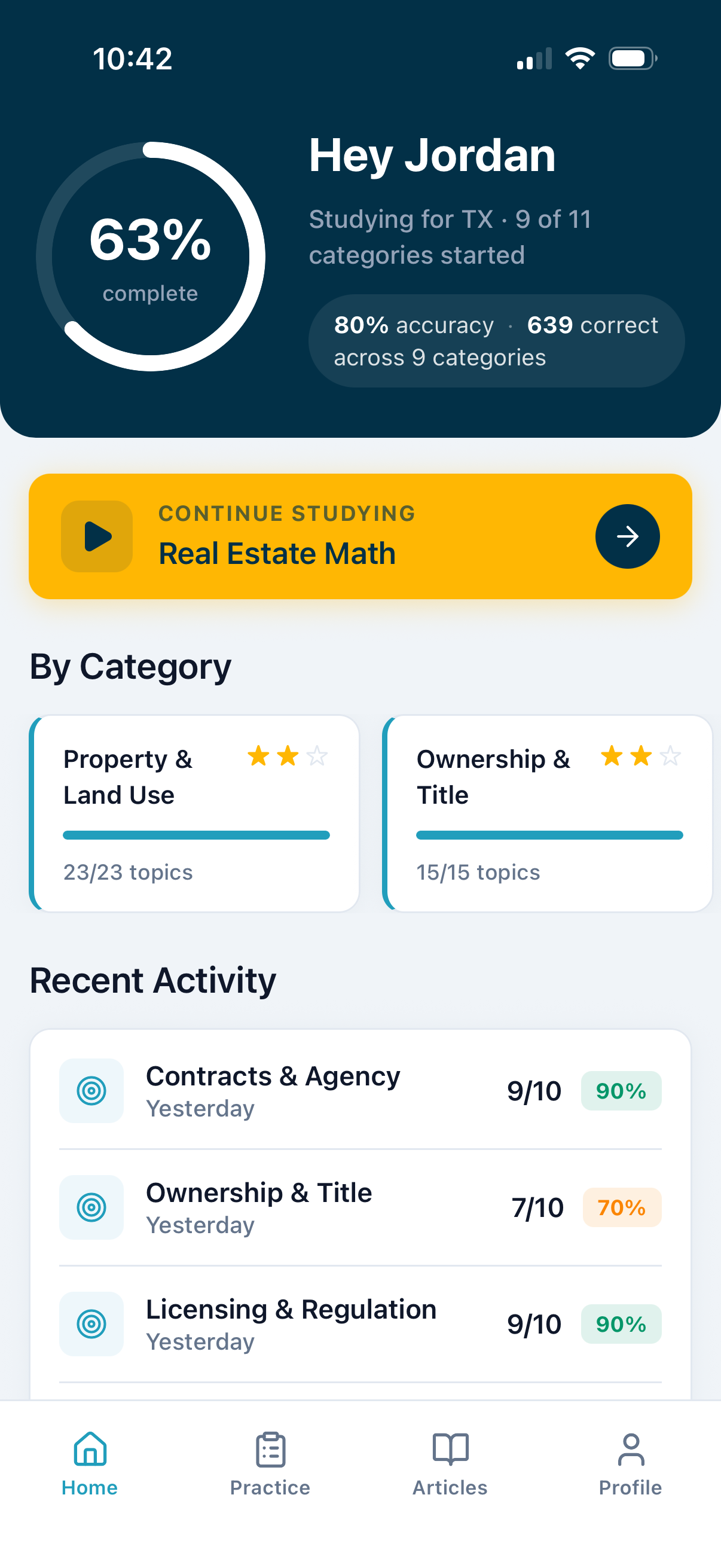
  • Progress tracking with per-category accuracy

Unlike other real estate prep apps, we don't cut off access or charge a monthly subscription fee. It's a one-time $17.99, and it's yours forever.

About the exam

More about the Maine real estate exam

Maine scores its general and 40-question Maine Law portions separately, so a strong general score won't rescue a weak showing on Maine law. That separation is exactly why Maine-specific preparation carries so much weight here.

Maine threads its own rules through the law portion, from mandatory Shoreland Zoning under Title 38 and underground oil storage tank requirements to the Real Estate Brokerage Relationships Form that drives agency disclosure, the state's recognition of transaction brokerage, the Maine Landlord-Tenant Act, and the property-condition disclosures sellers owe on water supply, heating systems, waste disposal, and known hazardous materials. None of that looks like the material a candidate in a neighboring state studies. A generic real estate practice test won't cut it. You need Maine-specific practice questions.

FAQ

Maine real estate exam: your questions answered

How many questions are on the Maine real estate exam?

The sales agent exam has 120 scored questions, split into an 80-question general portion and a 40-question Maine Law portion. Pearson VUE delivers both in one computer-based appointment, and a handful of unscored pretest questions are mixed in that don't count toward your result.

What's the passing score for the Maine real estate exam?

Both portions are scored on a 0 to 100 scaled score, and you need a 75 on each to pass. A scaled 75 is not the same as getting 75 percent of the questions right, since Maine equates scores across different exam forms to keep the difficulty fair. You have to clear 75 on the general portion and 75 on the Maine Law portion separately, so you can't lean on one to carry the other.

How much does the Maine real estate exam cost?

The Maine Real Estate Sales Agent Examination fee is $88 per attempt, paid directly to Pearson VUE when you reserve your seat. It's non-refundable and non-transferable, so it pays to be ready before you book. If you fail one portion, Pearson VUE re-administers just the portion you missed on your next attempt.

How long is the Maine real estate exam?

You get four hours total, broken into 2.5 hours for the 80-question general portion and 1.5 hours for the 40-question Maine Law portion. Most candidates finish with time to spare, but the Maine Law section moves quickly because those questions lean on statutes and rules you either know or you don't. You leave the test center with an official pass or fail score report in hand.

Who administers the Maine real estate exam?

The Maine Real Estate Sales Agent Examination is administered by Pearson VUE for the Maine Real Estate Commission. You register and schedule your exam date through Pearson VUE.

Is the Maine real estate exam hard?

It's a serious exam. The general portion covers the same national real estate principles tested everywhere, and the Maine Law portion adds a dense layer of state statutes, Shoreland Zoning rules, agency-disclosure requirements, and property-disclosure obligations that catch candidates who only studied national material. The questions aren't written to trick you, but they do expect you to understand how Maine actually practices real estate, not just recognize the vocabulary. Most people who fail underestimated the Maine Law portion and leaned too hard on a generic real estate practice test. Honest reps on Maine-specific questions are what move the needle.

What's on the Maine real estate exam?

The 80-question general portion covers eight areas, real property characteristics and land use (about 11 questions), forms of ownership and transfer of title (about 9), property value and appraisal (about 11), contracts and agency (about 16), real estate practice (about 10), property disclosures and environmental issues (about 9), financing and settlement (about 7), and real estate math (about 7). The 40-question Maine Law portion covers the Maine Real Estate Commission's powers and sanctions, the laws and rules governing licensees, agency and brokerage relationships, Maine-specific principles and practices like transfer tax and the Landlord-Tenant Act, and Maine land-use law including mandatory Shoreland Zoning.

What's the best way to prepare for the Maine real estate exam?

After you finish the Commission-approved sales agent course, the highest-leverage move is grinding Maine-specific practice questions with honest feedback on every miss. National principles you can pick up from any course, but the Maine Law portion rewards repetition on the state's own statutes and disclosure rules. The RealReady app gives you the full Maine question bank, detailed explanations, a missed-question drill mode, and per-category progress tracking so you can see where you're weak. Most users study 30 to 60 minutes a day for a few weeks before sitting the exam.

Is RealReady free?

The 20 Maine practice questions on this page are free, no account or signup needed. Unlocking the rest of the Maine bank is a single in-app purchase you pay once and own, with no recurring charge and no time limit on access.

Does RealReady cover the Maine real estate exam?

Yes. RealReady has a dedicated Maine question bank built for the Maine real estate exam, covering the national principles every candidate sees plus the Maine law that trips people up, like mandatory Shoreland Zoning under Title 38, the Real Estate Brokerage Relationships Form, and the property-condition disclosures sellers owe.

Is RealReady a real estate license course?

No. RealReady is exam practice, not a pre-license course, so it doesn't count toward Maine's required pre-license education hours. Use it after or alongside your coursework to drill realistic practice questions and find your weak spots before exam day.