Virginia · Real estate exam prep

Virginia Real Estate Practice Test

20 free Virginia practice questions with no signup required. When you're ready for more, the full RealReady bank has 1,080 questions for the 2026 exam that cover both national principles and Virginia law.

Practice below

Practice

20 Virginia Real Estate Test Questions & Answers

Use this like a free Virginia real estate practice test: read the question, commit to an answer, then tap to reveal the correct answer and a plain-English explanation. The ones you miss tell you where to focus next.

Q1 of 20 Licensing & Regulation

A Virginia real estate firm wants to operate legally. Which license types does the Board issue?

  1. Salesperson and broker licenses only
  2. Salesperson, broker, and firm licenses
  3. Broker and firm licenses only
  4. Salesperson, broker, and appraiser licenses
Show answer & explanation

Correct: B Salesperson, broker, and firm licenses

The Virginia Real Estate Board issues three types of licenses: salesperson, broker, and firm. A real estate firm must hold its own separate firm license in addition to the individual licenses held by its agents and brokers.

Q2 of 20 Licensing & Regulation

Which educational credential is the minimum prerequisite to apply for a Virginia salesperson license?

  1. No formal education is required
  2. Associate degree in business
  3. Bachelor's degree in any field
  4. High school diploma or equivalent
Show answer & explanation

Correct: D High school diploma or equivalent

Virginia requires salesperson applicants to hold a high school diploma or its equivalent (such as a GED). This is in addition to the 60-hour pre-license education and other requirements.

Q3 of 20 Licensing & Regulation

Who may file a complaint against a Virginia real estate licensee with DPOR?

  1. Only the principal broker of the firm
  2. Only clients involved in the transaction
  3. Any person may file a complaint
  4. Only other licensed real estate agents
Show answer & explanation

Correct: C Any person may file a complaint

Virginia allows any person to file a complaint with DPOR against a real estate licensee. The complainant does not need to be a party to the transaction or hold a license. DPOR investigates all valid complaints received.

Q4 of 20 Licensing & Regulation

Who bears ultimate responsibility for proper handling of escrow deposits in Virginia?

  1. The settlement attorney handling the closing
  2. The office manager at the branch location
  3. The principal broker of the firm
  4. The salesperson who drafted the contract
Show answer & explanation

Correct: C The principal broker of the firm

In Virginia, the principal broker is ultimately responsible for the proper handling and safekeeping of all escrow and trust funds received by the brokerage firm.

Q5 of 20 State Practice

Which Virginia brokerage relationship provides full fiduciary duties to the client?

  1. Limited service agent
  2. Standard agent
  3. Independent contractor
  4. Designated agent
Show answer & explanation

Correct: B Standard agent

A standard agent in Virginia owes full fiduciary duties to the client, including loyalty, obedience, confidentiality, accounting, reasonable care, and disclosure of material facts.

Q6 of 20 State Practice

An agent's listing agreement expires. Must the agent still protect the former client's confidential information?

  1. No, all duties end when the agreement expires
  2. Only for 90 days after the agreement ends
  3. Yes, confidentiality survives termination of the relationship
  4. Only if the client requests it in writing
Show answer & explanation

Correct: C Yes, confidentiality survives termination of the relationship

In Virginia, the duty of confidentiality survives the termination of the brokerage relationship. An agent must continue to protect a former client's confidential information indefinitely.

Q7 of 20 State Practice

In Virginia designated agency, who assigns separate licensees to represent each party in a transaction?

  1. The Virginia REB
  2. The listing agent
  3. The managing broker
  4. The principal broker
Show answer & explanation

Correct: D The principal broker

Under Virginia's designated agency, the principal (supervising) broker assigns different licensees from the same firm to represent each party. Each designated agent then owes full fiduciary duties to their assigned client.

Q8 of 20 State Practice

In Virginia, from whom must a salesperson receive all compensation?

  1. The title company at closing
  2. The cooperating broker directly
  3. The client who hired them
  4. Their own principal broker
Show answer & explanation

Correct: D Their own principal broker

Virginia law requires that salespersons receive compensation only from their own principal (supervising) broker. They may never accept payment directly from a client, customer, or another broker.

Q9 of 20 State Practice

Under Virginia's Residential Property Disclosure Act, what must the seller of residential property provide to the buyer?

  1. A certified appraisal of the property's market value
  2. A one-year warranty covering the property's condition
  3. A buyer-beware statement saying the owner makes no representations about the property
  4. A detailed written list of all known material defects
Show answer & explanation

Correct: C A buyer-beware statement saying the owner makes no representations about the property

Virginia uses a buyer-beware approach under the Residential Property Disclosure Act (Va. Code § 55.1-703). The seller furnishes a single standardized disclosure statement saying the owner makes no representations or warranties about the property's condition and that the buyer should exercise due diligence, such as a home inspection, before settlement. It is not a defect-disclosure form like those required in many other states.

Q10 of 20 State Practice

Which Virginia agency administers the Virginia Fair Housing Act?

  1. The Virginia Fair Housing Office within DPOR
  2. The local circuit court in each county
  3. The Virginia Real Estate Board only
  4. The Virginia Attorney General's office
Show answer & explanation

Correct: A The Virginia Fair Housing Office within DPOR

The Virginia Fair Housing Office, housed within the Department of Professional and Occupational Regulation (DPOR), administers the Virginia Fair Housing Act under Code of Virginia §36-96.1.

Q11 of 20 State Transactions

Virginia's Statute of Frauds requires real estate contracts to be in what form to be enforceable?

  1. Notarized but not necessarily written
  2. In writing and signed by the parties
  3. Recorded at the circuit court clerk's office
  4. Oral agreements witnessed by two people
Show answer & explanation

Correct: B In writing and signed by the parties

Under Virginia's Statute of Frauds, contracts for the sale of real estate must be in writing and signed by the party to be charged to be enforceable in court.

Q12 of 20 State Transactions

Under Virginia's Real Estate Settlement Agents Act, who may serve as the settlement agent for a closing?

  1. Only the buyer's real estate agent
  2. A registered attorney, title company, real estate broker, or financial institution
  3. Only the lender's loan officer
  4. Only a licensed Virginia attorney
Show answer & explanation

Correct: B A registered attorney, title company, real estate broker, or financial institution

Virginia is not an attorney-only closing state. Under the Real Estate Settlement Agents Act (formerly CRESPA, Va. Code § 55.1-1000 et seq.), settlement services may be provided by a registered attorney, a title insurance company or agent, a real estate broker, or a financial institution. Non-attorney settlement companies handle many Virginia closings, though only an attorney may give legal advice.

Q13 of 20 State Transactions

In Virginia, at what percentage of fair market value are most properties assessed for tax purposes?

  1. 80% of fair market value
  2. 100% of fair market value
  3. 90% of fair market value
  4. 75% of fair market value
Show answer & explanation

Correct: B 100% of fair market value

Most Virginia localities assess property at 100% of fair market value. The tax rate is then applied per $100 of assessed value to determine the annual tax bill.

Q14 of 20 State Transactions

In Virginia, what is the primary security instrument used to finance real estate?

  1. Land contract
  2. Deed of trust
  3. Promissory note
  4. Mortgage
Show answer & explanation

Correct: B Deed of trust

Virginia uses the deed of trust as its primary security instrument, not the mortgage. The deed of trust involves three parties and provides the trustee with the power of sale for faster foreclosure.

Q15 of 20 State Transactions

Under Virginia's Condominium Act, how many days does a buyer have to cancel a new unit purchase from a developer?

  1. 15 days
  2. 3 days
  3. 10 days
  4. 5 days
Show answer & explanation

Correct: D 5 days

Under the Virginia Condominium Act (Va. Code § 55.1-1974), a purchaser of a new condominium unit from the declarant (developer) may cancel the contract within five calendar days after the contract date or delivery of the current public offering statement, whichever is later.

Q16 of 20 Licensing & Regulation

A licensee violates advertising rules. DPOR investigates and finds probable cause. Who holds the formal hearing?

  1. The Attorney General's office
  2. The circuit court in the licensee's county
  3. The Real Estate Board
  4. DPOR's enforcement division
Show answer & explanation

Correct: C The Real Estate Board

In Virginia, DPOR investigates complaints and presents findings, but the Real Estate Board itself conducts formal hearings and determines disciplinary outcomes. This separation ensures the investigative and adjudicative functions remain distinct.

Q17 of 20 Licensing & Regulation

A newly licensed salesperson has not yet affiliated with a principal broker. What is the license status?

  1. The license is active for 90 days
  2. The license is issued as inactive
  3. The license is automatically voided
  4. The license is placed on probation
Show answer & explanation

Correct: B The license is issued as inactive

In Virginia, a salesperson license is issued on inactive status until the salesperson affiliates with a principal broker. The licensee cannot engage in real estate activities while the license remains inactive.

Q18 of 20 Licensing & Regulation

DPOR completes an investigation and finds probable cause of a violation. What happens next?

  1. DPOR imposes sanctions directly
  2. The matter proceeds to a Board hearing
  3. The case is referred to criminal court
  4. The licensee's broker resolves it internally
Show answer & explanation

Correct: B The matter proceeds to a Board hearing

When DPOR's investigation finds probable cause, the matter is forwarded to the Real Estate Board for a formal hearing. DPOR investigates but does not adjudicate; the Board holds hearings and determines appropriate disciplinary action.

Q19 of 20 Licensing & Regulation

A buyer submits an earnest money deposit on Tuesday. The contract is ratified Thursday. By when must the broker deposit the funds?

  1. By end of the following Thursday
  2. By end of the next calendar day
  3. By end of the following Tuesday
  4. Within 24 hours of receiving the check
Show answer & explanation

Correct: A By end of the following Thursday

Virginia requires deposit by the end of the fifth business day after contract ratification. Ratification on Thursday means the fifth business day falls on the following Thursday.

Q20 of 20 State Practice

A Virginia broker provides only ministerial services such as scheduling showings and delivering documents. What type of relationship is this?

  1. Dual agent with one party
  2. Limited service agent
  3. Independent contractor
  4. Standard agent with reduced duties
Show answer & explanation

Correct: C Independent contractor

In Virginia, performing only ministerial acts (routine, non-discretionary tasks such as scheduling showings or delivering documents) does not create an agency relationship. Among Virginia's brokerage relationships, the independent contractor is the non-agency option, established by a written agreement stating the licensee acts as an independent contractor and not as an agent (Va. Code § 54.1-2138.1). Such a licensee owes only the duties set in that agreement, not the full fiduciary duties of a standard agent.

Want the rest of Virginia's 1,080-question bank?

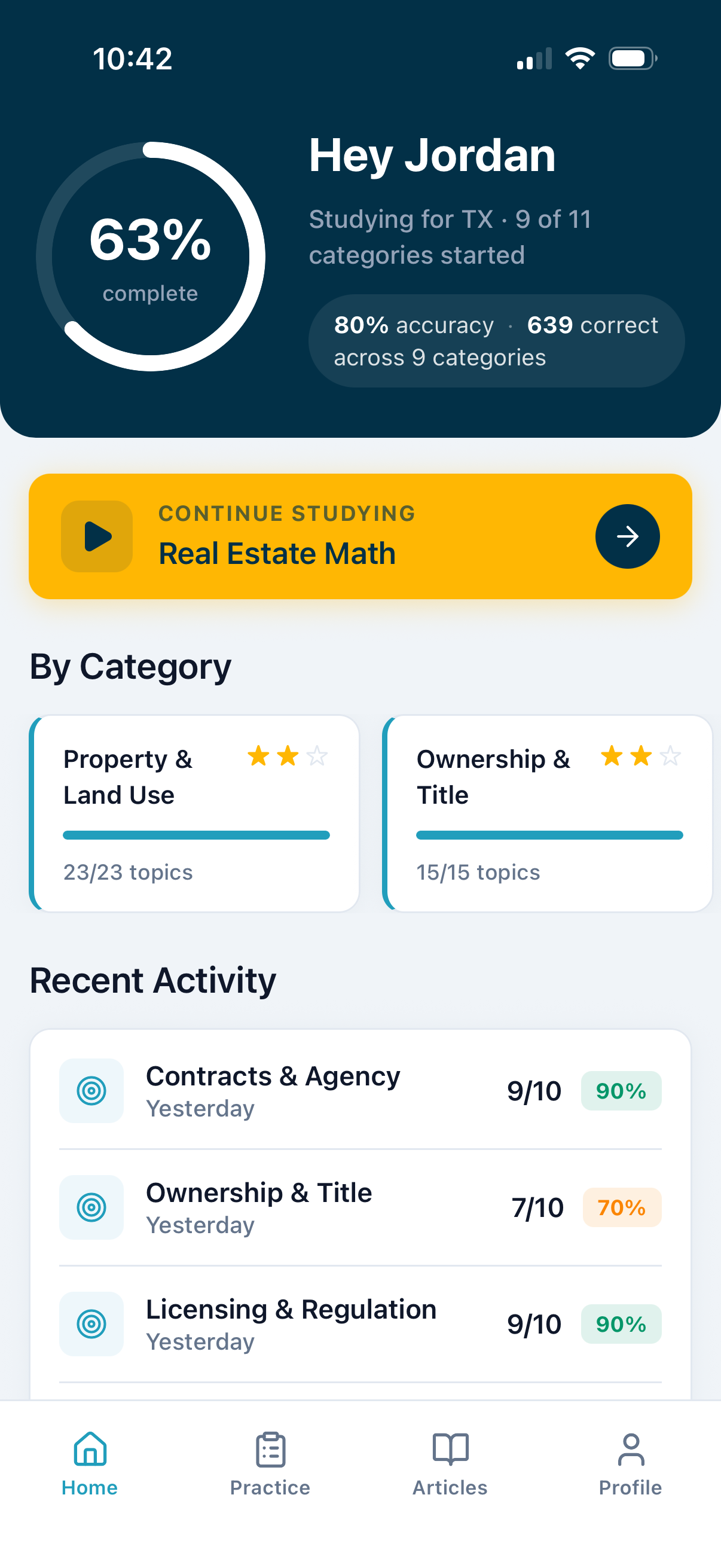
The RealReady app has all 1,080 questions covering both national real estate principles and Virginia-specific law. The full app also includes:

  • Short articles that walk you through the why behind each topic
  • A missed-question drill mode
  • Detailed explanations on every question
  • Progress tracking with per-category accuracy

Unlike other real estate prep apps, we don't cut off access or charge a monthly subscription fee. It's a one-time $17.99, and it's yours forever.

About the exam

More about the Virginia real estate exam

Virginia grades its two exam portions independently and holds the state half to a higher bar than the national side, so a strong national score won't carry you if your grasp of Virginia law is thin. The Virginia Real Estate Board licenses salespersons through the Department of Professional and Occupational Regulation, and Virginia law is woven through the state portion, so Virginia-specific preparation matters as much as the national principles every candidate studies.

Virginia runs on its own rules, including the Real Estate Board license law and regulations, designated and dual agency that require written consent, the buyer-beware Virginia Residential Property Disclosure Act, mandatory disclosures that range from the Chesapeake Bay Preservation Act to stigmatized property, trust and escrow account handling, and the property owners' association and condominium resale packets a seller has to deliver. The Virginia Fair Housing Law also reaches beyond the federal protected classes, down to elderliness and source of funds. None of that looks like the material a candidate in a neighboring state studies. A generic real estate practice test won't cut it. You need Virginia-specific practice questions.

FAQ

Virginia real estate exam: your questions answered

How many questions are on the Virginia real estate exam?

The Virginia Real Estate Salesperson Examination has 120 scored multiple-choice questions, split into an 80-question national portion and a 40-question Virginia state portion. PSI also mixes in a handful of unscored experimental questions that look just like the real ones, and the time you spend on those does not count against you. The two portions are scored separately, so you have to pass both.

What's the passing score for the Virginia real estate exam?

You pass each portion on its own. The national portion takes 56 correct out of 80, which is 70 percent, and the Virginia state portion takes 30 correct out of 40, which is 75 percent. Because the two are scored independently, you can pass one and fail the other, and you only have to retake the portion you missed.

How much does the Virginia real estate exam cost?

The PSI examination fee is $60 per attempt, and it covers both the national and state portions. PSI holds your registration for one year and one exam, and the fee is not refundable or transferable, so it pays to be ready before you schedule. If you fail a portion you re-register and pay the exam fee again to retake it.

How long is the Virginia real estate exam?

PSI gives you 150 minutes of testing time, broken into 105 minutes for the 80-question national portion and 45 minutes for the 40-question Virginia portion. A short tutorial before the exam and the optional review at the end do not eat into that time. PSI runs Virginia test centers in Alexandria, Richmond, Roanoke, Virginia Beach, Norfolk, Fredericksburg, Harrisonburg, Vienna, and several other locations.

Who administers the Virginia real estate exam?

The Virginia Real Estate Salesperson Examination is administered by PSI for the Virginia Real Estate Board, part of the Department of Professional and Occupational Regulation (DPOR). You register and schedule your exam date through PSI.

Is the Virginia real estate exam hard?

The national portion is the same caliber you would find on any PSI real estate exam, and plenty of first-time candidates underestimate it. The Virginia state portion is shorter but unforgiving, since 40 questions leave little room for error at a 75 percent bar, and it draws straight from the Real Estate Board statutes and rules. Most people who struggle spent their study time on national principles and skimped on Virginia's agency, disclosure, and escrow rules. Honest practice on a Virginia-specific practice test is the difference between passing on the first try and paying the $60 exam fee a second time.

What's on the Virginia real estate exam?

The 80-question national portion covers property ownership, land use controls, valuation and market analysis, financing, agency, property disclosures, contracts, leasing and property management, transfer of title, the practice of real estate, and real estate math, in proportions set by PSI's content outline, with contracts and agency carrying the most weight. The 40-question Virginia portion covers license law and Real Estate Board rules, escrow and trust accounts, agency definitions and designated agency, Virginia disclosure requirements, the Virginia Fair Housing Law, and specific acts like the Condominium Act, the Residential Landlord and Tenant Act, and the Property Owners' Association Act.

What's the best way to prepare for the Virginia real estate exam?

After you finish your required pre-license coursework, the highest-leverage thing you can do is grind through practice questions with honest feedback on every miss. Generic real estate practice tests help with national principles, but they will not catch you on Virginia's agency rules, disclosure requirements, or the license law the state portion pulls from. The RealReady app gives you the full Virginia question bank plus the national bank, with progress tracking and a missed-question mode so you can drill what you are weak on. Most users study 30 to 60 minutes a day for two to four weeks before sitting the exam.

Is RealReady free?

The 20 Virginia practice questions on this page are free, no account or signup needed. Unlocking the rest of the Virginia bank is a single in-app purchase you pay once and own, with no recurring charge and no time limit on access.

Does RealReady cover the Virginia real estate exam?

Yes. RealReady has a dedicated Virginia question bank built for the Virginia real estate exam, covering the national principles every candidate sees plus the Virginia law that trips people up, like the Real Estate Board license law, designated and dual agency requiring written consent, and the Virginia Residential Property Disclosure Act.

Is RealReady a real estate license course?

No. RealReady is exam practice, not a pre-license course, so it doesn't count toward Virginia's required pre-license education hours. Use it after or alongside your coursework to drill realistic practice questions and find your weak spots before exam day.