Washington · Real estate exam prep

Washington Real Estate Practice Test

20 free Washington practice questions with no signup required. When you're ready for more, the full RealReady bank has 1,060 questions for the 2026 exam that cover both national principles and Washington law.

Practice below

Practice

20 Washington Real Estate Test Questions & Answers

Use this like a free Washington real estate practice test: read the question, commit to an answer, then tap to reveal the correct answer and a plain-English explanation. The ones you miss tell you where to focus next.

Q1 of 20 Licensing & Regulation

Which agency serves as Washington's regulatory authority for real estate licensing?

  1. Department of Commerce
  2. Real Estate Commission
  3. Division of Real Estate
  4. Department of Licensing
Show answer & explanation

Correct: D Department of Licensing

In Washington, the Department of Licensing (DOL) is the regulatory authority for real estate. Unlike many states, Washington does not have a separate real estate commission that serves as the primary regulator. The DOL issues, suspends, and revokes licenses under RCW 18.85.

Q2 of 20 Licensing & Regulation

In Washington, what is the entry-level real estate license called?

  1. Agent
  2. Sales associate
  3. Salesperson
  4. Broker
Show answer & explanation

Correct: D Broker

Since July 1, 2010, Washington's entry-level license is called 'broker.' Previously it was called 'salesperson.' This terminology differs from many other states where 'broker' refers to a higher-level license.

Q3 of 20 Licensing & Regulation

A candidate passes the licensing exam. What must she do before she can legally practice real estate?

  1. Complete an additional internship
  2. Affiliate with a licensed firm
  3. Wait 30 days for license processing
  4. Pass a second state-specific exam
Show answer & explanation

Correct: B Affiliate with a licensed firm

After passing the exam, a candidate must apply for a license and affiliate with a licensed brokerage firm before practicing real estate. A broker cannot practice independently without firm affiliation in Washington.

Q4 of 20 Licensing & Regulation

A broker is transferring from one firm to another. What step must be completed?

  1. Complete additional CE hours
  2. Notify the DOL of the transfer
  3. Obtain a new license number
  4. Retake the licensing exam
Show answer & explanation

Correct: B Notify the DOL of the transfer

When a broker transfers between firms, the DOL must be notified. The broker keeps the same license and license number but must be affiliated with a firm to actively practice real estate.

Q5 of 20 State Practice

A broker signs a listing agreement with a homeowner in Seattle. Under RCW 18.86, what is the broker's role?

  1. Transaction coordinator only
  2. Limited dual agent by default
  3. Neutral facilitator for both parties
  4. Seller's agent with fiduciary duties
Show answer & explanation

Correct: D Seller's agent with fiduciary duties

Under RCW 18.86, a broker who signs a listing agreement becomes the seller's agent and owes full fiduciary duties exclusively to the seller. This includes loyalty, confidentiality, disclosure, accounting, and obedience.

Q6 of 20 State Practice

Under SB 5191, when must a Washington broker enter a written brokerage service agreement with a buyer?

  1. Within 30 days of initial contact
  2. After the first property showing
  3. Only when writing a purchase offer
  4. Before commencing brokerage services
Show answer & explanation

Correct: D Before commencing brokerage services

SB 5191 requires a written brokerage service agreement with buyers 'as soon as they commence providing real estate brokerage services.' This means the agreement must be in place before the broker begins acting on the buyer's behalf.

Q7 of 20 State Practice

Under RCW 18.85.285, who is responsible for performing monthly reconciliation of the trust account?

  1. The firm's bookkeeper
  2. Each individual broker
  3. The managing broker
  4. The designated broker
Show answer & explanation

Correct: D The designated broker

The designated broker bears ultimate responsibility for the firm's trust account. RCW 18.85.285 makes the designated broker responsible for trust account recordkeeping, and WAC 308-124C-125 and 308-124E-105 require a monthly reconciliation and trial balance. The designated broker may delegate the day-to-day work to a managing broker under WAC 308-124C-137, but stays accountable to the Department of Licensing for it.

Q8 of 20 State Practice

A brokerage firm's trust account has not been reconciled in 45 days. Who bears ultimate responsibility for this failure?

  1. Each affiliated broker
  2. The managing broker
  3. The firm's bookkeeper
  4. The designated broker
Show answer & explanation

Correct: D The designated broker

The designated broker is responsible for ALL brokerage activities of the firm, including ensuring monthly reconciliation of trust accounts. This duty cannot be fully delegated away — the designated broker remains ultimately accountable.

Q9 of 20 State Practice

A listing firm agrees to share compensation with a buyer's firm. Under Washington law, is this permitted?

  1. Yes, firm-to-firm sharing is allowed
  2. Only for commercial transactions only
  3. No, compensation sharing is prohibited
  4. Only with prior DOL approval needed
Show answer & explanation

Correct: A Yes, firm-to-firm sharing is allowed

Effective January 1, 2024, SB 5191 explicitly permits firm-to-firm compensation sharing in Washington. This allows listing firms and buyer's firms to share commissions as agreed between the parties.

Q10 of 20 State Practice

A broker deposits a client's earnest money into their personal checking account. What violation has occurred?

  1. Failure to disclose material facts
  2. Unauthorized practice of law
  3. Misrepresentation of property value
  4. Commingling of trust and personal funds
Show answer & explanation

Correct: D Commingling of trust and personal funds

Commingling occurs when a broker mixes client trust funds with personal funds. Washington law strictly prohibits this practice. Client funds must be deposited into the firm's designated trust account.

Q11 of 20 State Practice

A landlord refuses to rent to a tenant based on their immigration status. Under Washington law, is this lawful?

  1. Only if the tenant lacks a valid visa
  2. Yes, immigration status is not protected
  3. No, immigration status is a protected class
  4. Only in commercial lease transactions
Show answer & explanation

Correct: C No, immigration status is a protected class

Washington's Law Against Discrimination (WLAD) added citizenship or immigration status as a protected class in 2020. Refusing to rent based on immigration status violates state fair housing law, even though it is not a federal protected class.

Q12 of 20 State Transactions

A buyer asks who is responsible for completing the Washington Seller Disclosure Statement. What is the correct answer?

  1. The escrow agent
  2. The listing broker
  3. The buyer's agent
  4. The seller personally
Show answer & explanation

Correct: D The seller personally

In Washington, the Seller Disclosure Statement is completed by the seller, not the broker. The broker should not fill out the form on the seller's behalf, as it reflects the seller's personal knowledge of the property's condition.

Q13 of 20 State Transactions

In Washington, who typically handles real estate closings?

  1. County clerks
  2. The listing broker
  3. Real estate attorneys
  4. Licensed escrow agents
Show answer & explanation

Correct: D Licensed escrow agents

Washington is an escrow state, not an attorney state. Closings are handled by licensed escrow agents, which may include title companies, banks, or independent escrow companies. Attorneys are not required for closing.

Q14 of 20 State Transactions

A married couple in Washington purchases a home during their marriage using joint earnings. How is title classified?

  1. Joint tenancy
  2. Community property
  3. Tenancy in common
  4. Separate property
Show answer & explanation

Correct: B Community property

Washington is one of 9 community property states. All property acquired during marriage using marital funds is community property, owned 50/50 by both spouses regardless of whose name is on the title.

Q15 of 20 State Transactions

In a Washington deed of trust, who is the trustee?

  1. The escrow agent
  2. A neutral third party
  3. The lender
  4. The borrower
Show answer & explanation

Correct: B A neutral third party

A deed of trust involves three parties: the trustor (borrower), the beneficiary (lender), and the trustee (neutral third party). The trustee holds legal title as security and has authority to conduct a foreclosure sale if the borrower defaults.

Q16 of 20 Licensing & Regulation

A consumer files a complaint against a broker for misrepresentation. Which entity investigates and takes disciplinary action?

  1. Local Board of Realtors
  2. Real Estate Commission
  3. Attorney General's Office
  4. Department of Licensing
Show answer & explanation

Correct: D Department of Licensing

The DOL investigates complaints against licensees and takes disciplinary action, including suspension or revocation of licenses. The Real Estate Commission serves in an advisory capacity but does not directly investigate or discipline licensees.

Q17 of 20 Licensing & Regulation

Before July 1, 2010, Washington's entry-level license was called what?

  1. Salesperson
  2. Broker
  3. Associate broker
  4. Managing broker
Show answer & explanation

Correct: A Salesperson

Washington renamed its license types effective July 1, 2010. The entry-level 'salesperson' became 'broker,' the mid-level 'broker' became 'managing broker,' and the top-level license became the 'designated broker' endorsement.

Q18 of 20 Licensing & Regulation

A brokerage firm wants to open a second location. What must the firm obtain from the DOL?

  1. A new designated broker endorsement
  2. Only a change-of-address notice
  3. Permission from the Real Estate Commission
  4. A separate branch office license
Show answer & explanation

Correct: D A separate branch office license

Each branch office location requires its own branch office license from the DOL. Additionally, a managing broker must be assigned to supervise each branch location to ensure adequate oversight.

Q19 of 20 Licensing & Regulation

A broker left her firm last month and has not yet joined another. Can she continue practicing real estate?

  1. Yes, with DOL written approval
  2. Yes, for up to 90 days
  3. No, must be with a firm to practice
  4. Yes, as an independent contractor
Show answer & explanation

Correct: C No, must be with a firm to practice

Washington requires brokers to be affiliated with a firm to actively practice real estate. A broker who is between firms cannot conduct real estate business until they affiliate with a new firm and notify the DOL.

Q20 of 20 State Practice

A buyer hires a broker to help purchase a condo in Tacoma. Which statement best describes the broker's obligation?

  1. Full fiduciary duties to the buyer
  2. Advisory duties without loyalty
  3. Equal duties to buyer and seller
  4. Duties only when an offer is written
Show answer & explanation

Correct: A Full fiduciary duties to the buyer

A buyer's agent under RCW 18.86 owes full fiduciary duties exclusively to the buyer. These duties include loyalty, confidentiality, full disclosure, accounting, and obedience to lawful instructions.

Want the rest of Washington's 1,060-question bank?

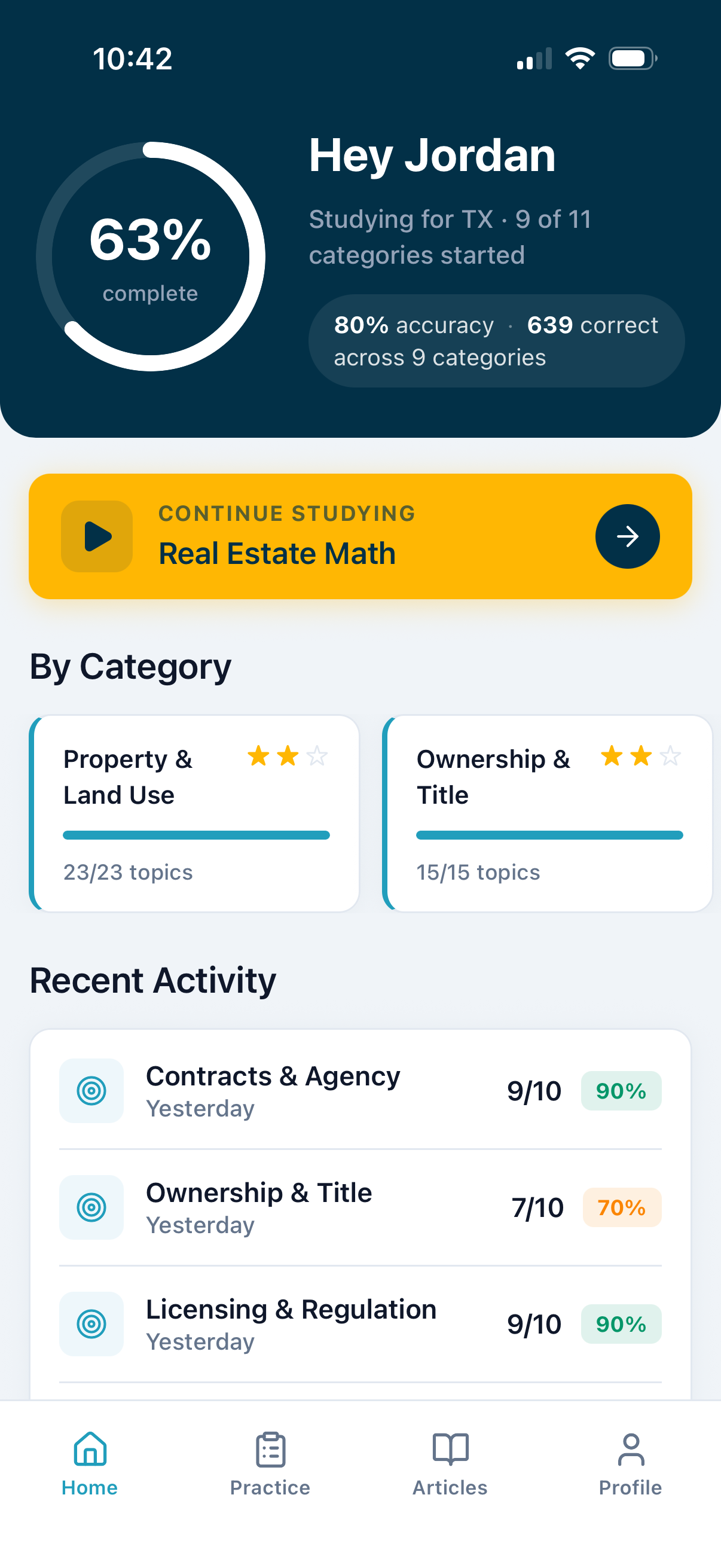
The RealReady app has all 1,060 questions covering both national real estate principles and Washington-specific law. The full app also includes:

  • Short articles that walk you through the why behind each topic
  • A missed-question drill mode
  • Detailed explanations on every question
  • Progress tracking with per-category accuracy

Unlike other real estate prep apps, we don't cut off access or charge a monthly subscription fee. It's a one-time $17.99, and it's yours forever.

About the exam

More about the Washington real estate exam

In Washington the entry-level credential is the broker license, not salesperson, and on that exam the separately scored 30-question state section is where first-timers come up short. The Washington State Department of Licensing scores the national and Washington portions separately, so a strong national score won't rescue a weak state score. That gap on the Washington section is why Washington-specific preparation matters more here than another round of national review.

Washington runs on its own rules, including the license law in RCW 18.85, the brokerage relationships act in RCW 18.86 that sets each agent's statutory duties, the Form 17 seller disclosure statement, trust account and earnest money handling by the designated broker, the real estate excise tax, and the community property rules that decide how married couples hold and convey title. None of that looks like the material a candidate in a neighboring state studies. A generic real estate practice test won't cut it. You need Washington-specific practice questions.

FAQ

Washington real estate exam: your questions answered

How many questions are on the Washington real estate exam?

The Washington Real Estate Broker Examination has 130 scored questions, split into a 100-question national portion and a 30-question Washington state portion. PSI also mixes in a small number of unscored pretest questions, usually 5 to 10, that look just like the real ones and do not count toward your score. The two portions are scored separately, so you have to pass both.

What's the passing score for the Washington real estate exam?

You need a scaled score of 70 on each portion, and the two are scored separately. PSI reports a scaled score rather than a raw percentage, so the exact number of questions you must answer correctly can shift a little from one form of the test to the next, but the bar sits at 70 on both the national and Washington portions. You can pass one and fail the other, and you only have to retake the portion you missed.

How much does the Washington real estate exam cost?

PSI charges $210 to sit the broker exam, and that single fee covers both the national and Washington portions. You pay PSI when you schedule, and the fee is not refundable or transferable. If you fail one portion, you only have to repeat that portion, but you re-register and pay again to take it.

How long is the Washington real estate exam?

Four hours of testing time in total. PSI gives you two and a half hours for the 100-question national portion and ninety minutes for the 30-question Washington portion. You take both portions at a PSI test center, and your unofficial result is available as soon as you finish.

Who administers the Washington real estate exam?

The Washington Real Estate Broker Examination is administered by PSI for the Washington Real Estate Commission and the Department of Licensing (DOL). You register and schedule your exam date through PSI.

Is the Washington real estate exam hard?

The national portion is the same caliber you would find on any PSI real estate exam, and plenty of first-time candidates underestimate it. The Washington portion is shorter but unforgiving, since 30 questions leave little room for error and the material comes straight from Washington statute and rule. Most people who struggle spent their study time on national principles and skimped on Washington's agency law, disclosure rules, and trust account handling. Honest practice on a Washington-specific practice test is the difference between passing on the first try and paying to retake a portion.

What's on the Washington real estate exam?

The 100-question national portion covers general real estate principles, including property ownership, land use controls, valuation, financing, agency, property disclosures, contracts, transfer of title, the practice of real estate, and real estate math, with contracts and agency carrying the most weight. The 30-question Washington portion leans hardest on the statutes and rules that govern licensee activity, things like trust accounts and the handling of money, prohibited conduct, compensation, advertising, property management, and supervision. It also covers the powers of the Real Estate Commission and the Director, Washington licensing requirements, and the brokerage relationships and agency duties set out in RCW 18.86.

What's the best way to prepare for the Washington real estate exam?

After you finish your required pre-license coursework, the highest-leverage thing you can do is grind through practice questions with honest feedback on every miss. Generic real estate practice tests help with the national principles, but they will not catch you on Washington's statutory agency rules, disclosure requirements, or trust account handling. The RealReady app gives you the full Washington question bank plus the national bank, with progress tracking and a missed-question mode so you can drill what you are weak on. Most users study 30 to 60 minutes a day for two to four weeks before sitting the exam.

Is RealReady free?

The 20 Washington practice questions on this page are free, no account or signup needed. Unlocking the rest of the Washington bank is a single in-app purchase you pay once and own, with no recurring charge and no time limit on access.

Does RealReady cover the Washington real estate exam?

Yes. RealReady has a dedicated Washington question bank built for the Washington real estate exam, covering the national principles every candidate sees plus the Washington law that trips people up, like the license law in RCW 18.85, the brokerage relationships act in RCW 18.86, and the Form 17 seller disclosure statement.

Is RealReady a real estate license course?

No. RealReady is exam practice, not a pre-license course, so it doesn't count toward Washington's required pre-license education hours. Use it after or alongside your coursework to drill realistic practice questions and find your weak spots before exam day.