Kansas · Real estate exam prep

Kansas Real Estate Practice Test

Practice Kansas real estate questions free below. RealReady has 1,040 questions in the bank covering both national real estate principles and Kansas state law. Pay $17.99 once and own it forever. No subscription like the other prep services.

The Kansas real estate salesperson exam is one of the toughest in the country. Pearson VUE delivers it for the Kansas Real Estate Commission as a 110-question test split into an 80-question general portion and a 30-question Kansas state-law portion, with 2.5 hours allowed for the general portion and 1.5 hours for the state portion. Both sections are scored separately on a 0 to 100 scaled score and you need at least 70 on each to pass, so Kansas-specific prep matters as much as the national material.

State-specific prep matters more here than almost anywhere else. The Brokerage Relationships in Real Estate Transactions Act (BRRETA) defines exactly how Kansas treats seller, buyer, designated, and transaction-broker relationships and is by far the largest chunk of the state portion. Add the duties and disciplinary powers of the Kansas Real Estate Commission, the prohibited-acts list under K.S.A. 58-3062, the required residential contract language, Kansas advertising and recordkeeping rules, place-of-business and supervision standards, and the Real Estate Recovery Revolving Fund, and you see why a Missouri or Nebraska prep tool will not catch what Kansas tests. None of that looks like the material a candidate in a neighboring state studies. A generic real estate practice test won't cut it. You need Kansas-specific practice questions.

Below are 20 free Kansas real estate test questions and answers from RealReady's full Kansas bank. Each tests a specific topic with the correct answer and a plain-English explanation under the card. Read each one, commit to an answer, then reveal. Treat it like a real KREC practice test, and the ones you miss show you what to focus on next.

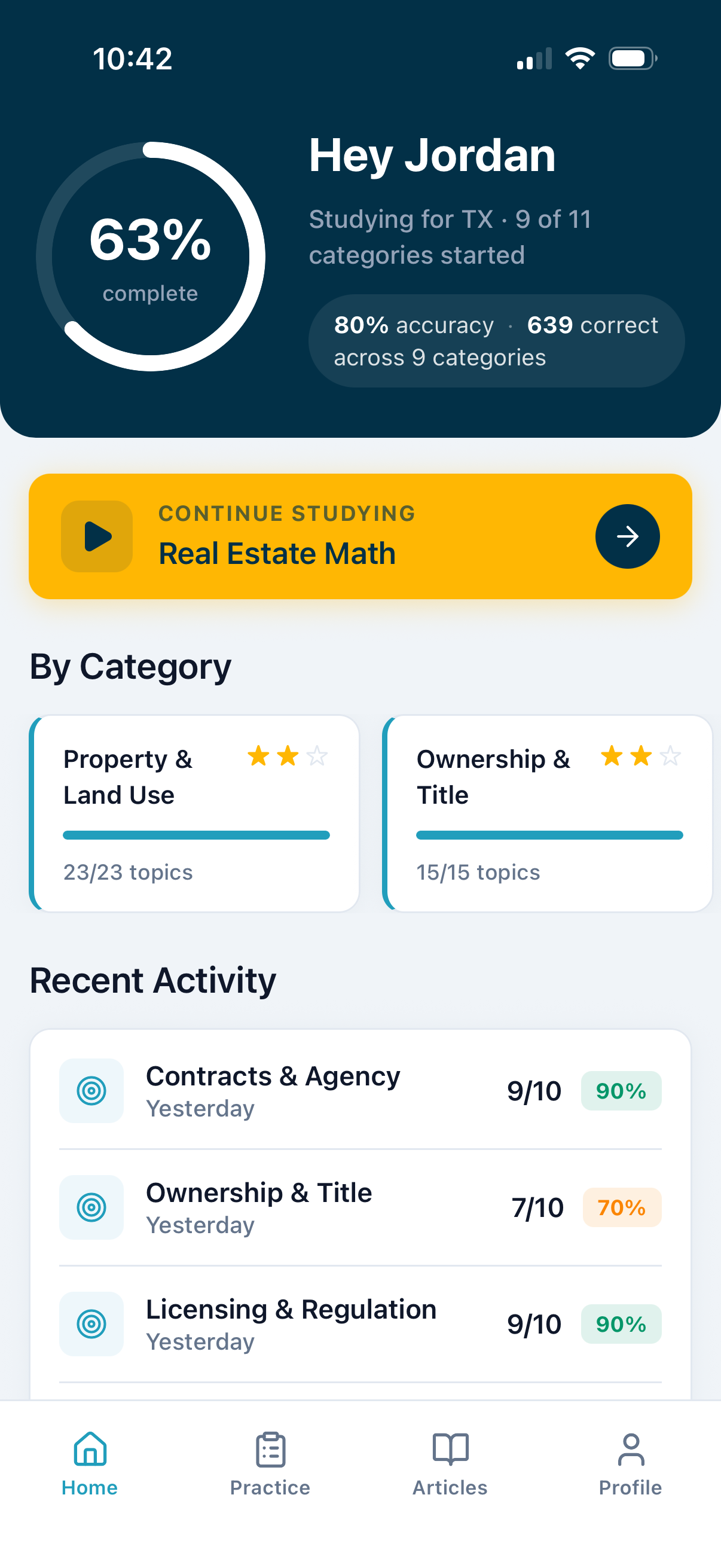
Get the RealReady app on iPhone, iPad, or Android for the rest of the Kansas question bank. The full app includes short articles that walk you through the why behind each topic, detailed explanations on every question, a missed-question drill mode, and progress tracking that shows your per-category accuracy.

Practice

20 Kansas Real Estate Test Questions & Answers

Use this like a free Kansas real estate practice test: read the question, commit to an answer, then tap to reveal the correct answer and a plain-English explanation. The ones you miss tell you where to focus next.

Q1 of 20 Licensing & Regulation

How many members serve on the Kansas Real Estate Commission (KREC)?

  1. 7 members
  2. 5 members
  3. 9 members
  4. 3 members
Show answer & explanation

Correct: B 5 members

KREC consists of 5 members appointed by the Governor and confirmed by the Kansas Senate. At least 3 must be licensed brokers, and 1 must be a public (non-licensee) member.

Q2 of 20 Licensing & Regulation

A property owner sells their own home without using a real estate agent. Does this activity require a Kansas real estate license?

  1. No, owners selling their own property are exempt
  2. Only if the property is commercial
  3. Yes, all real estate sales require a license
  4. Only if the sale price exceeds $100,000
Show answer & explanation

Correct: A No, owners selling their own property are exempt

Property owners dealing with their own real estate are exempt from licensing requirements. A license is required when someone lists, sells, buys, or leases real estate for another person for compensation.

Q3 of 20 Licensing & Regulation

A Kansas broker falsified a purchase agreement to conceal a dual agency relationship. Which ground for discipline applies?

  1. Incomplete transaction records
  2. Failure to maintain E&O insurance
  3. Fraud in a real estate transaction
  4. Late renewal of broker license
Show answer & explanation

Correct: C Fraud in a real estate transaction

Under K.S.A. 58-3050, fraud in a real estate transaction is a specific ground for discipline by KREC. Falsifying documents to conceal material facts constitutes fraud.

Q4 of 20 Licensing & Regulation

A consumer was defrauded by a Kansas licensee and suffered a $12,000 loss. What is the primary purpose of the Kansas Real Estate Recovery Fund?

  1. Fund KREC enforcement investigations
  2. Compensate consumers harmed by licensee misconduct
  3. Reimburse licensees for legal defense costs
  4. Provide grants for licensee education
Show answer & explanation

Correct: B Compensate consumers harmed by licensee misconduct

The Kansas Real Estate Recovery Fund exists to protect consumers who suffer financial losses due to the misconduct of licensed real estate professionals, funded by licensee assessments under K.S.A. 58-3066.

Q5 of 20 State Practice

A seller's agent in Kansas learns the buyer is willing to pay more than the listed price. What duty requires the agent to share this with the seller?

  1. Duty of accounting to both parties
  2. Duty of disclosure to the client
  3. Duty of confidentiality to the buyer
  4. Duty of obedience to the buyer
Show answer & explanation

Correct: B Duty of disclosure to the client

A seller's agent owes full fiduciary duties to the seller, including disclosure of all material information that could benefit the client's position, such as the buyer's willingness to pay more.

Q6 of 20 State Practice

When must a Kansas licensee provide the BRRETA brokerage relationship brochure to a prospective buyer?

  1. After the buyer makes an offer
  2. At the time of contract signing
  3. At the first practical opportunity
  4. Within 48 hours of first contact
Show answer & explanation

Correct: C At the first practical opportunity

Under BRRETA, licensees must provide brokerage relationship information at the first practical opportunity, which is before any substantive discussions about a specific property.

Q7 of 20 State Practice

A brokerage has both the buyer and seller as clients in the same transaction. What must the broker do to allow full representation of each party?

  1. Reduce duties owed to both parties equally
  2. Designate separate licensees for each party
  3. Refer one party to a different brokerage
  4. Obtain a court order permitting dual service
Show answer & explanation

Correct: B Designate separate licensees for each party

When both buyer and seller are clients of the same brokerage in Kansas, the broker may designate separate affiliated licensees to represent each party. Each designated agent then owes full fiduciary duties to their assigned client, preserving advocacy for both sides.

Q8 of 20 State Practice

A Kansas licensee posts a property listing on social media without identifying the responsible broker. What type of violation is this?

  1. A minor paperwork omission only
  2. A prohibited blind ad
  3. A federal Fair Housing Act violation
  4. An acceptable informal marketing post
Show answer & explanation

Correct: B A prohibited blind ad

Kansas prohibits blind ads, which are advertisements that fail to clearly identify the responsible broker. All advertising, including social media posts, must include the broker's name so consumers know which brokerage is responsible for the listing.

Q9 of 20 State Practice

In Kansas, who sets the commission rate that a broker may charge a seller?

  1. KREC establishes a standard rate
  2. The local MLS board sets the rate
  3. The broker and client by negotiation
  4. State statute prescribes maximum rates
Show answer & explanation

Correct: C The broker and client by negotiation

In Kansas, real estate commissions are freely negotiable between the broker and the client. There is no standard, set, or prescribed rate. KREC does not establish commission rates, nor does any MLS board or state statute mandate a specific percentage.

Q10 of 20 State Transactions

Under K.S.A. 58-3062, what is the consequence for a licensee who commits substantial misrepresentation in a real estate transaction?

  1. A mandatory fine of $1,000
  2. Grounds for license discipline by KREC
  3. Automatic license revocation
  4. A warning letter with no further action
Show answer & explanation

Correct: B Grounds for license discipline by KREC

K.S.A. 58-3062 provides that substantial misrepresentation or fraud in a real estate transaction constitutes grounds for discipline by KREC. Discipline can include suspension, revocation, or other penalties, but the statute does not mandate automatic revocation or a specific fine amount.

Q11 of 20 State Transactions

A Kansas broker deposits a buyer's earnest money into her personal checking account. What violation has occurred?

  1. Breach of fiduciary duty only
  2. Unauthorized dual agency
  3. Conversion of escrow funds
  4. Commingling of trust funds
Show answer & explanation

Correct: D Commingling of trust funds

Depositing trust funds into a personal account constitutes commingling, which is a prohibited act under Kansas law. Trust funds must be kept in a separate, designated trust account and never mixed with personal or operating funds.

Q12 of 20 State Transactions

Under K.S.A. 58-3061, every Kansas broker must maintain what type of account for client funds?

  1. A personal savings account
  2. A general business checking account
  3. A separate designated trust account
  4. A joint account with the seller
Show answer & explanation

Correct: C A separate designated trust account

K.S.A. 58-3061 requires every broker to maintain a separate trust account specifically designated as such. This account must be distinct from the broker's personal and operating accounts to protect client funds.

Q13 of 20 State Transactions

Does Kansas have a mandatory statutory seller disclosure law?

  1. Yes, all sellers must complete a state form
  2. Yes, but only for commercial properties
  3. No, but industry practice uses a disclosure form
  4. No, and no disclosure is ever recommended
Show answer & explanation

Correct: C No, but industry practice uses a disclosure form

Kansas does not have a mandatory statutory seller disclosure law. However, industry practice widely uses a Seller Property Condition Disclosure Statement. Sellers are expected to disclose known material defects even without a statutory mandate.

Q14 of 20 Licensing & Regulation

A newly appointed KREC member must meet which requirement before being officially seated?

  1. Approval by the state legislature
  2. Confirmation by the Kansas Senate
  3. Endorsement by KREC members
  4. Passing a background check
Show answer & explanation

Correct: B Confirmation by the Kansas Senate

KREC members are appointed by the Governor but must be confirmed by the Kansas Senate before taking office. Members serve 4-year staggered terms.

Q15 of 20 Licensing & Regulation

An attorney negotiates a real estate transaction as part of their legal representation of a client. Is a real estate license required?

  1. No, attorneys in their practice are exempt
  2. Yes, all negotiations require a license
  3. Only if they are representing the buyer
  4. Only if they receive a separate commission
Show answer & explanation

Correct: A No, attorneys in their practice are exempt

Attorneys acting within the scope of their law practice are exempt from real estate licensing requirements. This does not extend to acting as a real estate broker outside their legal duties.

Q16 of 20 Licensing & Regulation

A licensee was convicted of felony embezzlement in federal court. What is the effect on their Kansas license?

  1. Felony conviction is grounds for discipline
  2. No effect unless crime involved real estate
  3. License suspended only during incarceration
  4. Automatic license revocation upon conviction
Show answer & explanation

Correct: A Felony conviction is grounds for discipline

Under K.S.A. 58-3050, a felony conviction is a listed ground for discipline by KREC regardless of whether the felony is related to real estate practice.

Q17 of 20 Licensing & Regulation

A buyer obtains a court judgment against a licensee for fraud. What must the buyer do BEFORE filing a Recovery Fund claim?

  1. Attempt collection via writ of execution
  2. File a complaint with KREC first
  3. Negotiate a settlement with the licensee
  4. Obtain a second independent appraisal
Show answer & explanation

Correct: A Attempt collection via writ of execution

Before claiming from the Recovery Fund, the claimant must obtain a final court judgment, then attempt to collect through a writ of execution. Only after these efforts fail can the claimant seek Recovery Fund payment.

Q18 of 20 State Practice

Which set of duties does a buyer's agent owe to the buyer client in Kansas?

  1. Obedience, loyalty, disclosure, confidentiality
  2. Honesty and competent services only
  3. Fair dealing and reasonable care only
  4. Disclosure of material facts only
Show answer & explanation

Correct: A Obedience, loyalty, disclosure, confidentiality

A buyer's agent in Kansas owes the full range of fiduciary duties: obedience, loyalty, disclosure, confidentiality, accounting, and reasonable care to the buyer client.

Q19 of 20 State Practice

A seller calls a licensee to discuss listing a property. The licensee begins discussing pricing strategy. Has the licensee met the BRRETA disclosure requirement?

  1. No, disclosure is due after signing the listing
  2. Yes, disclosure is only required for buyers
  3. No, the brochure was due before that discussion
  4. Yes, pricing is not a substantive topic
Show answer & explanation

Correct: C No, the brochure was due before that discussion

The BRRETA brochure must be provided before substantive discussions about a specific property. Discussing pricing strategy is a substantive discussion, so the licensee missed the deadline.

Q20 of 20 State Practice

Agent Kim is designated to represent the seller in an in-house transaction. What level of duty does Kim owe to the seller?

  1. Reduced duties shared with the buyer
  2. Transaction broker duties
  3. Full fiduciary duties
  4. Limited duties of honesty only
Show answer & explanation

Correct: C Full fiduciary duties

In Kansas designated agency, each designated agent owes full fiduciary duties to their assigned client. Kim, as the seller's designated agent, owes loyalty, confidentiality, disclosure, obedience, accounting, and reasonable care to the seller alone.

Want the rest of Kansas's 1,040-question bank?

The RealReady app has all 1,040 questions covering both national real estate principles and Kansas-specific law. The full app also includes:

  • Short articles that walk you through the why behind each topic
  • A missed-question drill mode
  • Detailed explanations on every question
  • Progress tracking with per-category accuracy

Unlike other real estate prep apps, we don't cut off access or charge a monthly subscription fee. Once you buy, it's yours forever.

FAQ

Kansas real estate exam — questions answered

How many questions are on the Kansas real estate exam?

The Kansas Real Estate Salesperson Examination has 110 scored multiple-choice questions, split into an 80-question general portion and a 30-question Kansas state-law portion. Pearson VUE also includes 5 unscored pretest items on the general portion and 10 unscored pretest items on the state portion that look identical to the scored questions, and the time spent on those does not count against you.

What's the passing score for the Kansas real estate exam?

You need a scaled score of at least 70 on each portion, scored separately. Pearson VUE reports a scaled score from 0 to 100 rather than a raw percentage, so the exact number of questions you need correct depends on the difficulty of the form you draw. If you pass one portion and fail the other, you only have to retake the portion you failed, as long as both portions are passed within six months of each other.

How much does the Kansas real estate exam cost?

The Pearson VUE examination fee is $70 per portion, and the salesperson combination exam (taking both portions on the same day) is also $70 total under the two-for-one combo price. Failed retakes are also $70. After you pass, the salesperson license fee paid to the Kansas Real Estate Commission is $125.

How long is the Kansas real estate exam?

240 minutes total when you take both portions on the same day. The general portion is allotted 2.5 hours (150 minutes) and the Kansas state portion is allotted 1.5 hours (90 minutes), taken back-to-back at a Pearson VUE testing center. Pearson VUE runs Kansas sites in Hays, Overland Park, Topeka, and Wichita, plus a Kansas City, Missouri location and additional rural sites at Emporia, Fort Riley, Garden City, Pittsburg, and Salina. You receive an on-screen pass or fail notification before you leave the test center.

Is the Kansas real estate exam hard?

The state portion is where most first-time candidates lose ground. The general portion is the same content you'd find on any Pearson VUE real estate exam, but Kansas's 30 state-law questions skew heavily toward BRRETA agency rules, KREC's disciplinary authority, the prohibited-acts list, and required residential contract language, which national prep tools barely touch. Honest practice on a Kansas-specific practice exam is the difference between passing on the first try and retaking the $70 exam.

What's on the Kansas real estate exam?

The 80-question general portion covers property ownership, land-use controls, valuation, financing, contracts, agency, property disclosures, transfer of title, the general practice of real estate, and real estate math, in proportions set by Pearson VUE's national content outline. The 30-question Kansas state portion is weighted by Pearson VUE as roughly: 2 items on duties and powers of the Kansas Real Estate Commission, 4 items on licensing requirements, 5 items on requirements governing licensee activities (records, advertising, commissions, required residential contract language, supervision), 8 items on prohibited acts, and 11 items on the Brokerage Relationships in Real Estate Transactions Act (BRRETA), which is by far the largest single bucket on the state exam.

What's the best way to prepare for the Kansas real estate exam?

After finishing your 30-hour Principles of Real Estate course and your 30-hour Kansas Practice Course at a KREC-approved school, the highest-leverage thing you can do is grind through Kansas-specific practice questions with honest feedback on every miss. Generic real estate practice tests will help with national principles but won't catch you on Kansas's unique rules, especially BRRETA agency relationships and the prohibited-acts list under K.S.A. 58-3062. The RealReady app gives you the full bank of Kansas questions plus the national bank, with progress tracking and a missed-question mode so you can drill what you're weak on.