Florida · Real estate exam prep

Florida Real Estate Practice Test

20 free Florida practice questions with no signup required. When you're ready for more, the full RealReady bank has 1,035 questions for the 2026 exam that cover both national principles and Florida law.

Practice below

Practice

20 Florida Real Estate Test Questions & Answers

Use this like a free Florida real estate practice test: read the question, commit to an answer, then tap to reveal the correct answer and a plain-English explanation. The ones you miss tell you where to focus next.

Q1 of 20 Licensing & Regulation

A newly appointed FREC member must be confirmed by which body before taking office?

  1. The Governor's Cabinet
  2. The Florida House
  3. The DBPR Secretary
  4. The Florida Senate
Show answer & explanation

Correct: D The Florida Senate

FREC members are appointed by the Governor but must be confirmed by the Florida Senate before serving. Each member serves a 4-year term.

Q2 of 20 Licensing & Regulation

A sales associate candidate has passed the state exam. What must happen before the license becomes active?

  1. Join a local REALTOR board
  2. Complete post-licensing education
  3. Obtain errors and omissions insurance
  4. Register under an employing broker
Show answer & explanation

Correct: D Register under an employing broker

A Florida sales associate must be registered under an employing broker for the license to be active. Without a broker, the license is automatically involuntary inactive.

Q3 of 20 Licensing & Regulation

A consumer files a complaint against a licensee. What is the first action taken after DBPR receives the complaint?

  1. Notify the licensee's employing broker first
  2. Refer the matter to the full FREC commission
  3. Immediately suspend the licensee's license
  4. Investigate whether the complaint is legally sufficient
Show answer & explanation

Correct: D Investigate whether the complaint is legally sufficient

After receiving a complaint, DBPR first investigates to determine if it is legally sufficient. If it is, the investigation continues and evidence is presented to a probable cause panel of FREC members for review.

Q4 of 20 Licensing & Regulation

Florida's Fair Housing Act covers which types of housing transactions?

  1. Sale, rental, and financing of dwellings
  2. Commercial and residential properties equally
  3. Only rental properties in the state
  4. Only properties listed through a brokerage
Show answer & explanation

Correct: A Sale, rental, and financing of dwellings

Florida's Fair Housing Act, like its federal counterpart, covers the sale, rental, and financing of residential dwellings. It protects against discrimination based on race, color, national origin, sex, disability, familial status, and religion.

Q5 of 20 State Practice

In Florida, what is the default brokerage relationship if no written agreement is established?

  1. No brokerage relationship
  2. Transaction broker
  3. Dual agent
  4. Single agent
Show answer & explanation

Correct: B Transaction broker

Florida is one of the few states where the default brokerage relationship is transaction broker — not single agent. Unless the broker and customer agree otherwise in writing, the broker operates as a transaction broker.

Q6 of 20 State Practice

A Florida brokerage opens a second location. What must the broker do regarding this branch office?

  1. Obtain FREC approval at the next meeting
  2. Simply update the main office records
  3. Register it separately with DBPR
  4. No action is required for branches
Show answer & explanation

Correct: C Register it separately with DBPR

Every branch office must be separately registered with DBPR. Each branch must also have the required entrance sign showing the broker's name, trade name if any, and the words 'Licensed Real Estate Broker.'

Q7 of 20 State Practice

A Florida broker receives an earnest money deposit on Wednesday. By when must it be deposited into the escrow account?

  1. Within 5 business days
  2. By the end of the following Monday
  3. Within 24 hours of receipt
  4. By Friday of the same week
Show answer & explanation

Correct: B By the end of the following Monday

Escrow funds must be deposited by the end of the 3rd business day after receipt. If received Wednesday, the 3rd business day is Monday (Thursday = 1, Friday = 2, Monday = 3).

Q8 of 20 State Practice

Which activity may an unlicensed personal assistant legally perform in a Florida brokerage?

  1. Showing properties to prospective buyers
  2. Explaining contract terms to clients
  3. Scheduling appointments and organizing files
  4. Negotiating the listing price
Show answer & explanation

Correct: C Scheduling appointments and organizing files

Unlicensed assistants may perform clerical duties such as scheduling, filing, and placing signs. They may not show property, discuss pricing, negotiate, explain contracts, or answer real estate questions.

Q9 of 20 State Practice

Under Florida law, a radon gas disclosure statement must be included in which real estate documents?

  1. Residential contracts in high-risk counties only
  2. Only if radon has been detected
  3. Sale contracts and rental agreements for any building
  4. Only contracts for homes built before 1978
Show answer & explanation

Correct: C Sale contracts and rental agreements for any building

Under s. 404.056(5), F.S., the radon warning must appear on at least one document executed at or before a contract for the sale and purchase of any building, or at execution of a rental agreement for any building — regardless of whether radon has ever been detected. Vacant-land contracts are not covered, and rentals of 45 days or less are exempt.

Q10 of 20 State Practice

Development seaward of the Coastal Construction Control Line in Florida requires permits from which agency?

  1. Florida Fish and Wildlife Commission
  2. Department of Environmental Protection (DEP)
  3. Army Corps of Engineers only
  4. Department of Business and Professional Regulation
Show answer & explanation

Correct: B Department of Environmental Protection (DEP)

Construction seaward of the Coastal Construction Control Line (CCCL) requires permits from the Florida Department of Environmental Protection (DEP). This protects Florida's beaches and dune systems.

Q11 of 20 State Transactions

Under Florida's homestead protection, a residence inside a municipality is protected on up to how much land?

  1. One-half acre
  2. One acre
  3. Five acres
  4. One-quarter acre
Show answer & explanation

Correct: A One-half acre

Inside a municipality, Florida homestead protection covers up to 1/2 acre regardless of the home's value. Outside a municipality, the protection extends to 160 acres.

Q12 of 20 State Transactions

Florida condominiums are governed by which chapter of Florida Statutes?

  1. Chapter 718
  2. Chapter 720
  3. Chapter 475
  4. Chapter 721
Show answer & explanation

Correct: A Chapter 718

The Florida Condominium Act is Chapter 718, F.S. Chapter 720 covers homeowners' associations, and Chapter 721 covers timeshares. These are three distinct statutory frameworks.

Q13 of 20 State Transactions

Under Florida's Statute of Frauds, real estate contracts must be in what form to be enforceable?

  1. In writing
  2. Approved by FREC
  3. Verbal with two witnesses
  4. Notarized and recorded
Show answer & explanation

Correct: A In writing

The Statute of Frauds requires real estate contracts to be in writing to be enforceable. Oral real estate agreements are not enforceable in court, regardless of the parties' intent.

Q14 of 20 State Transactions

Florida law requires how many subscribing witnesses for a deed conveying real property to be valid?

  1. One witness
  2. Two witnesses
  3. Three witnesses
  4. No witnesses required
Show answer & explanation

Correct: B Two witnesses

Section 689.01, F.S., requires the grantor to sign a deed in the presence of two subscribing witnesses for the deed to validly convey real property — witnesses go to the deed's validity, not merely recording. Acknowledgment (notarization) is the separate requirement for recording under s. 695.03. Since 2020, witnessing may also be completed remotely through Florida's online notarization procedures.

Q15 of 20 State Transactions

In Florida, who is responsible for assessing the value of real property for tax purposes?

  1. A private appraiser hired by the county
  2. The county tax collector
  3. The county property appraiser
  4. The Florida Department of Revenue
Show answer & explanation

Correct: C The county property appraiser

The county property appraiser determines the assessed value of all real property in the county. The tax collector then uses the assessed value and millage rates set by local taxing authorities to calculate the tax bill.

Q16 of 20 State Transactions

Florida follows which mortgage theory, meaning the borrower retains title to the property?

  1. Equity theory
  2. Intermediate theory
  3. Title theory
  4. Lien theory
Show answer & explanation

Correct: D Lien theory

Florida is a lien theory state — the mortgage creates a lien on the property, but the borrower retains title. In title theory states, the lender holds title until the loan is paid off.

Q17 of 20 Licensing & Regulation

FREC adopts rules to implement Florida's real estate license law. These administrative rules carry what legal weight?

  1. They have the force of law
  2. They expire after each legislative session
  3. They are advisory guidelines only
  4. They apply only to brokers, not associates
Show answer & explanation

Correct: A They have the force of law

FREC's administrative rules have the force and effect of law. They implement Chapter 475, F.S. and are codified in the Florida Administrative Code. Licensees must comply with these rules just as they would with the statute itself.

Q18 of 20 Licensing & Regulation

A sales associate's broker closes the brokerage. The associate has not found a new broker. What is the license status?

  1. Suspended
  2. Involuntary inactive
  3. Null and void
  4. Voluntary inactive
Show answer & explanation

Correct: B Involuntary inactive

When a sales associate is no longer registered under a broker, the license automatically becomes involuntary inactive. It is not null and void — the associate can reactivate by registering with a new broker.

Q19 of 20 Licensing & Regulation

After DBPR investigates a complaint, which group reviews the evidence to determine probable cause?

  1. The full seven-member FREC commission
  2. The DBPR Secretary and legal staff
  3. A probable cause panel of FREC members
  4. A panel of three administrative judges
Show answer & explanation

Correct: C A probable cause panel of FREC members

A probable cause panel consisting of FREC members (not the full commission) reviews evidence from the DBPR investigation. If probable cause is found, formal charges are filed via an Administrative Complaint.

Q20 of 20 Licensing & Regulation

Which state agency administers the Florida Fair Housing Act?

  1. Florida Commission on Human Relations
  2. Florida Real Estate Commission
  3. Florida Housing Finance Corporation
  4. Department of Business and Professional Regulation
Show answer & explanation

Correct: A Florida Commission on Human Relations

The Florida Commission on Human Relations (FCHR) administers the Florida Fair Housing Act. FCHR investigates complaints and attempts conciliation before recommending further action.

Want the rest of Florida's 1,035-question bank?

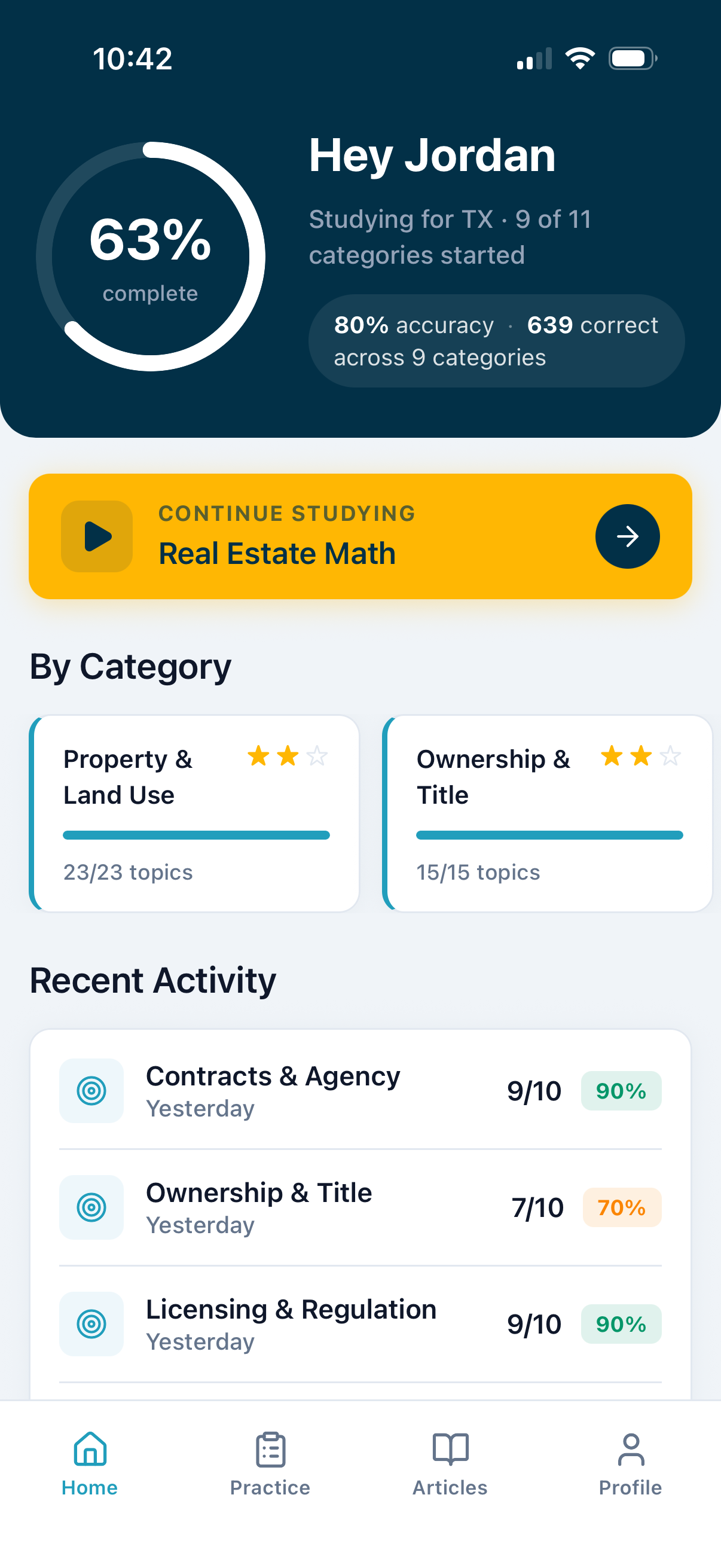
The RealReady app has all 1,035 questions covering both national real estate principles and Florida-specific law. The full app also includes:

  • Short articles that walk you through the why behind each topic
  • A missed-question drill mode
  • Detailed explanations on every question
  • Progress tracking with per-category accuracy

Unlike other real estate prep apps, we don't cut off access or charge a monthly subscription fee. It's a one-time $17.99, and it's yours forever.

About the exam

More about the Florida real estate exam

Only about half of Florida real estate candidates pass on the first try, roughly 52% by the DBPR's own numbers. The Department of Business and Professional Regulation (DBPR) gives the exam through the Florida Real Estate Commission (FREC). Every question can weave Chapter 475 of the Florida Statutes and the FREC rules in Chapter 61J2 of the Florida Administrative Code into general real estate principles, so memorizing national content alone won't get you there.

Florida tests its own rules in ways a national course never touches. Florida's three brokerage relationships (transaction broker as the default, single agent, and no brokerage relationship), the homestead protections in the Florida Constitution, the Real Estate Recovery Fund, FREC disciplinary powers, time-share and condominium law, and the state's documentary stamp taxes on deeds and mortgages all show up on the exam. None of that looks like the material a candidate in a neighboring state studies. A generic real estate practice test won't cut it. You need Florida-specific practice questions.

FAQ

Florida real estate exam: your questions answered

How many questions are on the Florida real estate exam?

The Florida Real Estate Sales Associate Examination has 100 multiple-choice questions. DBPR administers it as a single unified test through Pearson VUE, so there's no separate national portion. The content mix runs roughly 45 questions on general real estate principles, 45 on Florida and federal real estate law, and 10 math problems. You have three and a half hours to finish.

What's the passing score for the Florida real estate exam?

75%, which is 75 of 100 questions correct. All questions are weighted equally, there's no partial credit, and DBPR doesn't curve. Pilot questions on the exam aren't counted toward your score, and you find out whether you passed before leaving the test center.

How much does the Florida real estate exam cost?

The state examination fee is $36.75 per attempt, paid to Pearson VUE when you schedule. If you fail and retake, you pay $36.75 again. The separate DBPR application fee that makes you eligible to sit for the exam is $83.75, and it's good for two years from the date your course completion is dated.

How long is the Florida real estate exam?

Three and a half hours (210 minutes) for the sales associate exam. Pearson VUE runs it at testing centers across Florida, you'll go through a short tutorial first that doesn't count against your time, and your photo-bearing exam result report prints out before you leave.

Who administers the Florida real estate exam?

The Florida Real Estate Sales Associate Examination is administered by Pearson VUE for the Florida Real Estate Commission (FREC). You register and schedule your exam date through Pearson VUE.

Is the Florida real estate exam hard?

Per DBPR's own exam performance data, the first-time pass rate sat at roughly 52% in early 2024 (and closer to 47% once retakes are mixed in). The questions aren't tricky for the sake of being tricky. They're written to test whether you actually understand Chapter 475 of the Florida Statutes, the FREC rules in Chapter 61J2 of the Florida Administrative Code, and how those interact with national real estate principles. Most people who fail underestimated how much Florida-specific material is on the test (the three brokerage relationships, agency disclosures, the Real Estate Recovery Fund, FREC's disciplinary process) and over-prepared on national content. Honest practice on a Florida-specific practice exam is the difference between passing on the first try and paying another $36.75 for a retake.

What's on the Florida real estate exam?

The 100-question DBPR exam is built from 19 content areas. The heaviest Florida-specific weighting falls on real estate brokerage activities and procedures (about 12%), Florida real estate contracts (about 12%), property rights including condos and time-shares (about 8%), license law and qualifications (about 6%), authorized relationships and disclosures (about 7%), violations and penalties (about 3%), and FREC commission rules (about 2%). National principles fill out the rest: titles and deeds (about 7%), residential mortgages (about 9%), appraisal (about 8%), legal descriptions (about 5%), real estate computations (about 6%), and a handful of smaller topics. The 10 math questions are usually about commissions, closing prorations, and Florida documentary stamp tax.

What's the best way to prepare for the Florida real estate exam?

After finishing your 63-hour FREC-approved Course I, the highest-leverage thing you can do is grind through Florida-specific practice questions with honest feedback on every miss. Generic real estate practice tests will help with national principles but won't catch you on Florida's transaction-broker default, homestead protections, FREC disciplinary rules, or documentary stamp tax math. The RealReady app gives you the full bank of Florida questions, plus progress tracking and a missed-question mode so you can drill what you're weak on. Most users study 30-60 minutes a day for 2-4 weeks before sitting the DBPR exam.

Is RealReady free?

The 20 Florida practice questions on this page are free, no account or signup needed. Unlocking the rest of the Florida bank is a single in-app purchase you pay once and own, with no recurring charge and no time limit on access.

Does RealReady cover the Florida real estate exam?

Yes. RealReady has a dedicated Florida question bank built for the Florida real estate exam, covering the national principles every candidate sees plus the Florida law that trips people up, like the three brokerage relationships (transaction broker, single agent, and no brokerage relationship), the Real Estate Recovery Fund, and the documentary stamp taxes on deeds and mortgages.

Is RealReady a real estate license course?

No. RealReady is exam practice, not a pre-license course, so it doesn't count toward Florida's required pre-license education hours. Use it after or alongside your coursework to drill realistic practice questions and find your weak spots before exam day.