Washington DC · Real estate exam prep

Washington DC Real Estate Practice Test

20 free Washington DC practice questions with no signup required. When you're ready for more, the full RealReady bank has 1,025 questions for the 2026 exam that cover both national principles and Washington DC law.

Practice below

Practice

20 Washington DC Real Estate Test Questions & Answers

Use this like a free Washington DC real estate practice test: read the question, commit to an answer, then tap to reveal the correct answer and a plain-English explanation. The ones you miss tell you where to focus next.

Q1 of 20 Licensing & Regulation

Which DC agency replaced DCRA in 2022 as the body responsible for professional licensing, including real estate?

  1. Office of the Tenant Advocate
  2. Department of Licensing and Consumer Protection
  3. Department of Consumer and Business Affairs
  4. Department of Housing and Community Development
Show answer & explanation

Correct: B Department of Licensing and Consumer Protection

In 2022, DCRA was reorganized and replaced by the Department of Licensing and Consumer Protection (DLCP), which now oversees professional licensing in DC, including real estate.

Q2 of 20 Licensing & Regulation

Before a DC salesperson can receive their license, they must be affiliated with which type of licensee?

  1. A licensed DC attorney
  2. Any licensed salesperson
  3. A licensed DC broker
  4. A licensed property manager
Show answer & explanation

Correct: C A licensed DC broker

DC salespersons must be sponsored by a licensed DC broker. Salespersons cannot operate independently and must work under broker supervision.

Q3 of 20 Licensing & Regulation

A licensee changes broker affiliation in DC. What must they do?

  1. Wait 30 days before practicing under the new broker
  2. Report the change to DLCP
  3. Complete an additional 6 hours of CE
  4. Retake the state licensing exam
Show answer & explanation

Correct: B Report the change to DLCP

Changes in broker affiliation must be promptly reported to DLCP. The licensee does not need to retake exams or complete additional education for a simple broker change.

Q4 of 20 Licensing & Regulation

Which of the following is grounds for disciplinary action against a DC licensee?

  1. Advertising a property at its listed price
  2. Commingling trust funds with personal funds
  3. Refusing to represent both parties in a deal
  4. Charging a commission below market rate
Show answer & explanation

Correct: B Commingling trust funds with personal funds

Commingling trust funds with personal or business operating funds is a serious violation that can result in discipline. Agents are free to set their own commission rates and can decline dual agency.

Q5 of 20 State Practice

Which agency relationship exists when a DC licensee represents only the seller in a transaction?

  1. Subagent
  2. Transaction broker
  3. Dual agent
  4. Seller's agent
Show answer & explanation

Correct: D Seller's agent

A seller's agent (listing agent) represents only the seller's interests. DC recognizes seller's agents, buyer's agents, and dual agents but does not formally use the term 'transaction broker.'

Q6 of 20 State Practice

Where must a DC broker maintain trust account funds?

  1. Any bank in the Washington metro area
  2. A federally insured institution in the District
  3. A personal savings account with proper records
  4. A financial institution in any US state
Show answer & explanation

Correct: B A federally insured institution in the District

DC requires trust funds to be held in a separate trust or escrow account at a federally insured financial institution located in the District of Columbia.

Q7 of 20 State Practice

Under DC law, a salesperson can receive compensation from which source?

  1. Directly from the buyer or seller
  2. From any licensed broker in the transaction
  3. Only through their sponsoring broker
  4. From the title company at closing
Show answer & explanation

Correct: C Only through their sponsoring broker

DC salespersons can only receive compensation through their sponsoring broker. They cannot accept direct payment from clients, other brokers, or any other party to the transaction.

Q8 of 20 State Practice

What must all DC real estate advertising include?

  1. The salesperson's license number
  2. The broker's registered name
  3. The property's assessed value
  4. The listing price in bold text
Show answer & explanation

Correct: B The broker's registered name

DC requires all real estate advertising to include the broker's name as registered with DLCP. The salesperson's name may also appear, but broker identification is mandatory.

Q9 of 20 State Practice

Approximately how many traits does the DC Human Rights Act protect in housing?

  1. About 20 traits
  2. 7 traits
  3. 15 traits
  4. 10 traits
Show answer & explanation

Correct: A About 20 traits

The DCHRA protects approximately 20 traits in housing, including race, religion, sex, age, marital status, personal appearance, sexual orientation, gender identity, source of income, sealed eviction records, and more.

Q10 of 20 State Transactions

Under DC law, sellers of residential property must provide buyers with which document?

  1. A Seller's Disclosure Statement
  2. A building inspection report
  3. A property condition warranty
  4. A certificate of occupancy
Show answer & explanation

Correct: A A Seller's Disclosure Statement

DC requires sellers to provide a Seller's Disclosure Statement disclosing known material defects and conditions affecting the property. This is a disclosure, not a warranty or inspection.

Q11 of 20 State Transactions

What right does TOPA give tenants in DC when their landlord decides to sell?

  1. A guaranteed lease extension of 2 years
  2. A right of first refusal to purchase the property
  3. The right to match any buyer's offer after closing
  4. Automatic relocation assistance of $10,000
Show answer & explanation

Correct: B A right of first refusal to purchase the property

TOPA gives DC tenants a right of first refusal when a landlord decides to sell a rental property. Tenants must receive written notice and have a defined period to express interest in purchasing.

Q12 of 20 State Transactions

DC imposes two separate taxes on real property transfers. Which party typically pays each?

  1. Seller pays transfer tax; buyer pays recordation tax
  2. Buyer pays both taxes at closing
  3. Each party pays half of both taxes
  4. Seller pays both taxes at closing
Show answer & explanation

Correct: A Seller pays transfer tax; buyer pays recordation tax

DC's two-tax system assigns the transfer tax to the seller and the recordation tax to the buyer. Both are paid at closing when the deed and deed of trust are recorded.

Q13 of 20 State Transactions

DC's rent stabilization program under the Rental Housing Act of 1985 primarily applies to buildings built before which date?

  1. December 31, 1975
  2. January 1, 1970
  3. January 1, 1985
  4. December 31, 1990
Show answer & explanation

Correct: A December 31, 1975

DC's rent control primarily covers apartment buildings built before December 31, 1975. Buildings constructed after this date are generally exempt from rent stabilization.

Q14 of 20 Licensing & Regulation

A newly licensed DC salesperson needs to file a complaint about another licensee's conduct. To which agency should they submit the complaint?

  1. DLCP
  2. DC Superior Court
  3. DC Attorney General
  4. Office of Human Rights
Show answer & explanation

Correct: A DLCP

DLCP handles complaint intake against real estate licensees. It investigates and may refer the matter to the Real Estate Commission for disciplinary action.

Q15 of 20 Licensing & Regulation

What distinguishes a DC broker license from a salesperson license?

  1. Salespersons can supervise other licensees
  2. Brokers can operate firms and hold trust accounts
  3. Brokers do not need continuing education
  4. Brokers only need 60 hours of education
Show answer & explanation

Correct: B Brokers can operate firms and hold trust accounts

DC brokers can operate their own firms, supervise salespersons, and hold trust accounts. Salespersons must work under a broker and cannot perform these functions independently.

Q16 of 20 Licensing & Regulation

A DC homeowner believes their agent failed to disclose a material defect. Where should they file a complaint?

  1. DC Superior Court only
  2. The local police department
  3. DLCP
  4. The National Association of Realtors
Show answer & explanation

Correct: C DLCP

Complaints against licensees are filed with DLCP, which investigates and may refer the matter to the Real Estate Commission for disciplinary action. The consumer may also pursue a private lawsuit.

Q17 of 20 State Practice

A DC buyer's agent learns that the seller's property has foundation problems. What fiduciary duty requires the agent to share this with the buyer?

  1. Loyalty
  2. Disclosure
  3. Accounting
  4. Obedience
Show answer & explanation

Correct: B Disclosure

The duty of disclosure requires an agent to share all material facts that could affect the client's decision. Foundation problems are a material fact that must be disclosed to the buyer client.

Q18 of 20 State Practice

A buyer submits a $10,000 earnest money deposit. The contract does not specify a deposit deadline. When must the broker deposit it?

  1. By the next business day
  2. Within a reasonable time
  3. Within 7 days of receipt
  4. Within 3 business days of receipt
Show answer & explanation

Correct: C Within 7 days of receipt

Per D.C. Code § 42-1704, escrow funds must be deposited within 7 days in a financial institution located within the District. A contract can specify a shorter deadline that the broker must honor, but the 7-day statutory deadline is the default when the contract is silent.

Q19 of 20 State Practice

A DC broker allows a newly licensed salesperson to work without oversight on their first listing. Is this acceptable?

  1. No, the broker must supervise salesperson activities
  2. Only if the property is under $500,000
  3. Yes, supervision is optional for listings
  4. Yes, if the salesperson completed 60 hours of education
Show answer & explanation

Correct: A No, the broker must supervise salesperson activities

DC brokers are responsible for supervising their sponsored salespersons. Allowing a salesperson to work without oversight, especially a new licensee, violates the broker's supervisory obligations.

Q20 of 20 State Practice

A DC salesperson posts a property listing on social media using only their personal name, without mentioning their broker. Is this permitted?

  1. Only if the property is their own listing
  2. Yes, if the post is not a paid advertisement
  3. Yes, social media is exempt from ad rules
  4. No, all advertising must include the broker's name
Show answer & explanation

Correct: D No, all advertising must include the broker's name

DC advertising rules apply to all media including social media. Every ad must include the broker's name. Posting without broker identification is a 'blind ad,' which is prohibited.

Want the rest of Washington DC's 1,025-question bank?

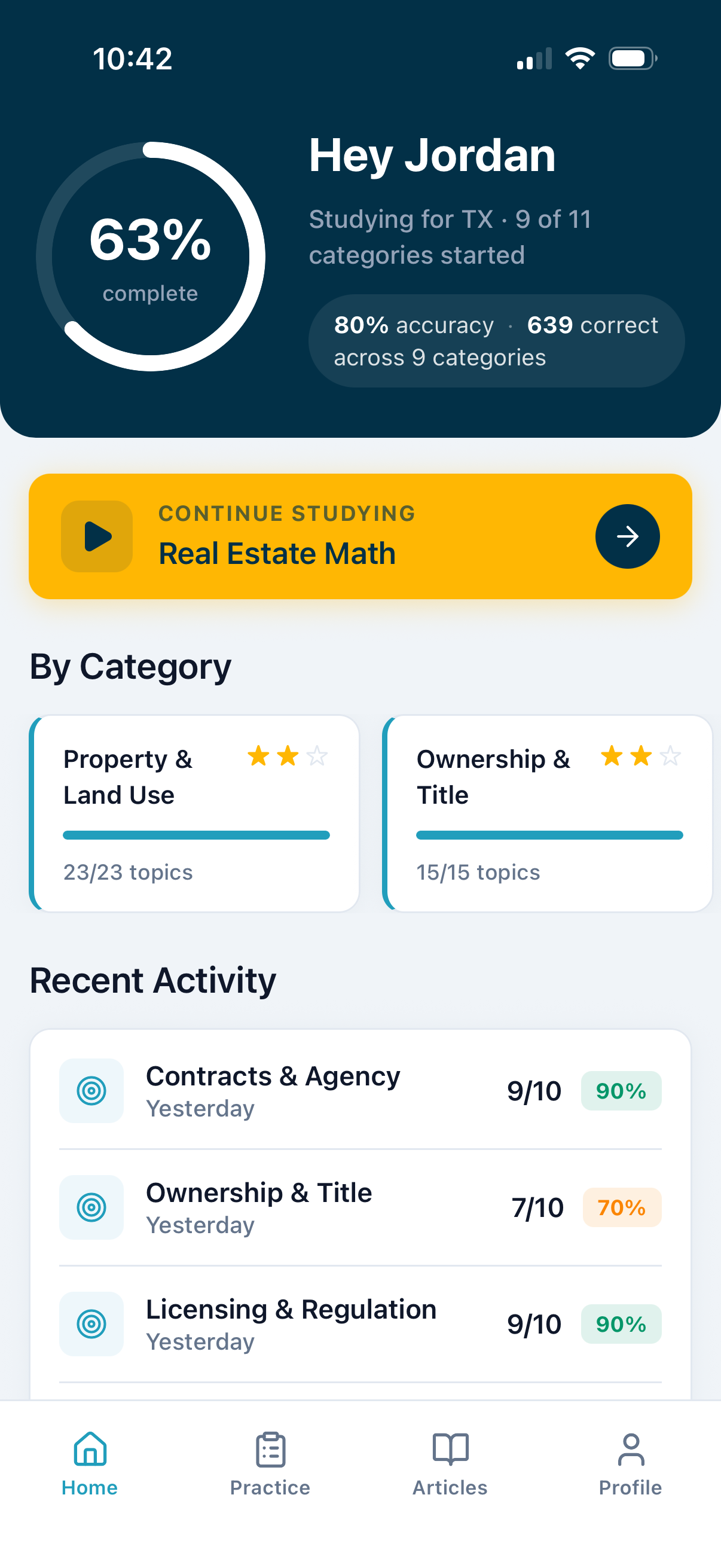
The RealReady app has all 1,025 questions covering both national real estate principles and Washington DC-specific law. The full app also includes:

  • Short articles that walk you through the why behind each topic
  • A missed-question drill mode
  • Detailed explanations on every question
  • Progress tracking with per-category accuracy

Unlike other real estate prep apps, we don't cut off access or charge a monthly subscription fee. It's a one-time $17.99, and it's yours forever.

About the exam

More about the Washington DC real estate exam

Washington, DC scores its national and DC-specific portions separately, so a strong national score will not rescue a weak DC portion. The DC Real Estate Commission (DCREC) sits within the Department of Licensing and Consumer Protection, and clearing the DC half on the first try comes down to DC-specific prep.

The DC portion leans heavily on the DCREC's own statutes and rules, including the Real Estate Guaranty and Education Fund, the DCREC advertising requirements at 17 DCMR § 2615, the Tenant Opportunity to Purchase Act, rent control under the Rental Housing Act, and the broader fair-housing protected classes under the DC Human Rights Act of 1977. None of that looks like the material a candidate in a neighboring state studies. A generic real estate practice test won't cut it. You need Washington DC-specific practice questions.

FAQ

Washington DC real estate exam: your questions answered

How many questions are on the DC real estate exam?

The District of Columbia Real Estate Salesperson Examination has 110 scored questions, split into an 80-item national portion and a 30-item DC-specific portion. PSI administers both portions in one sitting at a DC test site, and the two portions are scored separately.

What's the passing score for the DC real estate exam?

75% on each portion separately. PSI uses scaled scoring rather than a literal raw percentage, but plan to clear roughly 60 of 80 on the national side and 23 of 30 on the DC side to be safely above the line. If you pass one portion and fail the other, you only need to retake the failed portion, and you have six months from your first attempt to clear it.

How much does the DC real estate exam cost?

PSI charges $61.50 per examination attempt, and that single fee covers both portions whether you sit them together or retake one. After passing, the DC salesperson license fee is $130 for an initial two-year term per DCREC, with renewal also $130 on the same two-year cycle.

How long is the DC real estate exam?

210 minutes of scored time total, broken into 120 minutes for the national portion and 90 minutes for the DC portion. PSI delivers both portions back-to-back at the DC testing center, and you find out whether you passed before you leave.

Who administers the Washington DC real estate exam?

The District of Columbia Real Estate Salesperson Examination is administered by PSI for the District of Columbia Real Estate Commission (DCREC). You register and schedule your exam date through PSI.

Is the DC real estate exam hard?

The split-portion format is where most candidates trip up. They over-prepare on national real estate principles and underestimate the 30-question DC portion, which is densely DC-specific (DCREC enforcement powers, the Real Estate Guaranty and Education Fund, advertising rules under 17 DCMR, the DC Human Rights Act's expanded fair-housing protections, rent control, and the Tenant Opportunity to Purchase Act). The questions are written to test whether you actually understand DC real estate law, not to trick you. Honest practice on DC-specific questions is the difference between a first-time pass and a $61.50 retake.

What's on the DC real estate exam?

The 80-question national portion covers ten content areas, with contracts (about 17%), practice of real estate (about 13%), general principles of agency (about 13%), financing (about 10%), and real estate calculations (about 10%) carrying the heaviest weights. The 30-question DC portion is heavier still on state law. Half of it tests statutory requirements governing licensee activity (advertising, handling of monies, agency, commissions, fair housing, tenant's right to purchase, property disclosures), and the remaining 50% splits between DCREC's duties and powers (about 25%) and DC licensing rules (about 25%).

What's the best way to prepare for the DC real estate exam?

After finishing your DCREC-approved pre-license course, the highest-leverage thing you can do is grind through DC-specific practice questions with honest feedback on every miss. Generic real estate practice tests will help with national principles but will not catch you on DC's unique rules, especially the half of the state portion that hangs on statutory requirements governing licensee activity. The RealReady app gives you the full bank of DC questions, plus progress tracking and a missed-question mode so you can drill what you're weak on. Most users study 30 to 60 minutes a day for 2 to 4 weeks before sitting the DC exam.

Is RealReady free?

The 20 Washington DC practice questions on this page are free, no account or signup needed. Unlocking the rest of the Washington DC bank is a single in-app purchase you pay once and own, with no recurring charge and no time limit on access.

Does RealReady cover the Washington DC real estate exam?

Yes. RealReady has a dedicated Washington DC question bank built for the Washington DC real estate exam, covering the national principles every candidate sees plus the Washington DC law that trips people up, like the Real Estate Guaranty and Education Fund, the Tenant Opportunity to Purchase Act, and rent control under the Rental Housing Act.

Is RealReady a real estate license course?

No. RealReady is exam practice, not a pre-license course, so it doesn't count toward Washington DC's required pre-license education hours. Use it after or alongside your coursework to drill realistic practice questions and find your weak spots before exam day.