North Carolina · Real estate exam prep

North Carolina Real Estate Practice Test

20 free North Carolina practice questions with no signup required. When you're ready for more, the full RealReady bank has 1,085 questions for the 2026 exam that cover both national principles and North Carolina law.

Practice below

Practice

20 North Carolina Real Estate Test Questions & Answers

Use this like a free North Carolina real estate practice test: read the question, commit to an answer, then tap to reveal the correct answer and a plain-English explanation. The ones you miss tell you where to focus next.

Q1 of 20 Licensing & Regulation

A broker falsified disclosure documents. Which actions can NCREC take against this broker?

  1. Only issue a warning letter
  2. Refer the matter solely to local courts
  3. Suspend, revoke, or impose civil penalties
  4. Suspend the license but not revoke it
Show answer & explanation

Correct: C Suspend, revoke, or impose civil penalties

NCREC has broad disciplinary authority including the power to suspend, revoke, or deny licenses. The Commission can also reprimand licensees and assess civil penalties. Falsifying disclosure documents is a serious violation warranting any of these actions.

Q2 of 20 Licensing & Regulation

What is the entry-level individual license category in North Carolina?

  1. Broker Apprentice
  2. Associate Broker
  3. Provisional Broker
  4. Sales Associate
Show answer & explanation

Correct: C Provisional Broker

The entry-level license in North Carolina is the Provisional Broker (PB). Unlike many states that use 'sales associate' or 'salesperson,' NC starts all new licensees as Provisional Brokers who must work under BIC supervision and complete postlicensing education.

Q3 of 20 Licensing & Regulation

Under Rule 58A .0103, what must a broker report to the Commission?

  1. Annual income from commissions
  2. Changes in name or address
  3. All closed transactions over $200,000
  4. Changes in marital status
Show answer & explanation

Correct: B Changes in name or address

Rule 58A .0103 requires brokers to notify the Commission of changes in their name or address. This ensures the Commission can maintain current contact information for all licensees and communicate important regulatory updates.

Q4 of 20 Licensing & Regulation

Under NCGS 93A-4.2, who is responsible for supervising Provisional Brokers in a brokerage office?

  1. The firm's managing partner
  2. The Broker-in-Charge
  3. The senior Provisional Broker
  4. Any full Broker in the office
Show answer & explanation

Correct: B The Broker-in-Charge

NCGS 93A-4.2 specifically assigns supervisory responsibility for Provisional Brokers to the Broker-in-Charge (BIC). Full Brokers who are not designated as BIC do not have this supervisory authority, even if they are experienced.

Q5 of 20 State Practice

A broker lists a commercial property for sale. Is the WWREA disclosure form required for this transaction?

  1. Only if the property exceeds a certain value
  2. No, WWREA applies only to residential sales
  3. Only if the buyer is an individual
  4. Yes, it is required for all sales transactions
Show answer & explanation

Correct: D Yes, it is required for all sales transactions

Under Rule 58A .0104(c), the WWREA disclosure form must be provided for all residential AND commercial sales transactions. Many brokers mistakenly believe it applies only to residential deals, but the requirement covers all property sales. Property management and lease transactions are the exceptions.

Q6 of 20 State Practice

Why does NC law consider dual agency an inherent concern for consumers?

  1. It increases closing costs for buyers
  2. It violates federal antitrust laws
  3. It reduces the broker's commission
  4. It creates a conflict of interest
Show answer & explanation

Correct: D It creates a conflict of interest

Dual agency creates an inherent conflict of interest because one broker attempts to serve two principals with opposing goals. The seller wants the highest price while the buyer wants the lowest. This tension limits the broker's ability to fully advocate for either party.

Q7 of 20 State Practice

Under NCGS 93A-6(a)(13), what is the standard for delivering a completed copy of a purchase agreement to the buyer and seller?

  1. Within a reasonable time
  2. Within 3 days
  3. Only at the closing
  4. Within 5 business days
Show answer & explanation

Correct: A Within a reasonable time

Under NCGS 93A-6(a)(13), a broker must deliver a completed copy of any purchase agreement or offer to buy and sell to both the buyer and the seller within a reasonable time. The statute sets a reasonable-time standard rather than a fixed number of days, and failing to do so is grounds for disciplinary action by the Commission.

Q8 of 20 State Practice

A broker provides brokerage services to a seller under a verbal listing and never puts it in writing. Under NC license law, is the broker's conduct lawful?

  1. No, operating without a written listing is unlawful
  2. Yes, oral listings are lawful for up to 30 days
  3. Yes, oral listings are fully lawful in NC
  4. Yes, if the seller does not object
Show answer & explanation

Correct: A No, operating without a written listing is unlawful

Rule 58A .0104(a) requires every agency agreement between a broker and a property owner to be in writing and signed at the time it is formed, so a broker who provides brokerage services to a seller under an oral listing is violating NC license law and can be disciplined. Separately, G.S. 93A-13 makes an oral broker agreement unenforceable, meaning the broker could not sue to recover a commission on it. The key point for licensees is that NC does not merely treat the oral listing as unenforceable, it prohibits operating without a written listing in the first place.

Q9 of 20 State Practice

A buyer agent receives a property disclosure statement from the listing agent. Before presenting it to the buyer, the agent notices water stain marks on the basement ceiling that aren't mentioned. What should the agent do?

  1. Disclose the observed condition to the buyer
  2. Recommend the buyer skip the inspection
  3. Accept the disclosure as complete
  4. Ask the listing agent to amend the form
Show answer & explanation

Correct: A Disclose the observed condition to the buyer

A buyer agent has a duty to discover and disclose material facts to the buyer. Water stains suggest possible water intrusion, which is a material fact the buyer needs to know regardless of what the seller's disclosure says. Relying solely on the seller's disclosure would breach the agent's duty.

Q10 of 20 State Practice

A listing broker knows a home had polybutylene pipes that leaked but were fully replaced with copper. Must the broker disclose this to prospective buyers?

  1. Only if the pipes leaked within five years
  2. Only if the buyer specifically asks
  3. Yes, prior polybutylene leaks are material facts
  4. No, the issue has been fully corrected
Show answer & explanation

Correct: C Yes, prior polybutylene leaks are material facts

In North Carolina, polybutylene pipes that leaked are considered a material fact even if they have been repaired or replaced. The broker must volunteer this information to all parties. The history of the defect, not just its current status, is what makes it material under NC law.

Q11 of 20 State Transactions

A buyer pays a $2,000 due diligence fee at contract execution. Where is this money held?

  1. In the listing broker's trust account
  2. It is paid directly to the seller
  3. In the buyer's attorney's escrow account
  4. In a joint account held by both agents
Show answer & explanation

Correct: B It is paid directly to the seller

The due diligence fee is paid directly to the seller, not held in trust. This is a key distinction from earnest money, which is held by an escrow agent. The DDF compensates the seller for taking the property off the market during the due diligence period.

Q12 of 20 State Transactions

A broker receives a $3,000 earnest money deposit from a buyer. Where must this money be deposited?

  1. The broker's personal business account
  2. A properly designated trust account
  3. Any FDIC-insured savings account
  4. The firm's general operating account
Show answer & explanation

Correct: B A properly designated trust account

Trust money must be deposited into an account properly designated as a trust account and insured by FDIC. Placing trust funds in a personal, business, or general operating account constitutes commingling, which is prohibited under NC statute 93A-6(a)(12).

Q13 of 20 State Transactions

Under the NC Good Funds Act, when may settlement funds be disbursed?

  1. At the settlement meeting itself
  2. When the buyer signs all documents
  3. After the deed and deed of trust are recorded
  4. Once the lender wires the loan amount
Show answer & explanation

Correct: C After the deed and deed of trust are recorded

The NC Good Funds Act requires that the deed and deed of trust be recorded before any disbursement of funds. Funds cannot be disbursed at the settlement meeting. This protects parties by ensuring proper recording before money changes hands.

Q14 of 20 State Transactions

How often must North Carolina counties reappraise property for ad valorem tax purposes?

  1. Every 5 years
  2. Every 8 years
  3. Every 10 years
  4. Every 4 years
Show answer & explanation

Correct: B Every 8 years

North Carolina follows an octennial reappraisal cycle, meaning counties must reappraise all property every 8 years. A horizontal reappraisal is possible at the 4th year midpoint, but the full reappraisal occurs on the 8-year schedule.

Q15 of 20 State Transactions

A tenant's apartment has a severe roof leak making it uninhabitable. The landlord refuses to repair it. What remedy is available to the tenant?

  1. Withhold rent while remaining in the unit
  2. Make repairs and deduct from next month's rent
  3. Vacate the unit claiming constructive eviction
  4. Change the locks until repairs are completed
Show answer & explanation

Correct: C Vacate the unit claiming constructive eviction

Under NC law, a tenant may vacate a unit and claim constructive eviction if it becomes uninhabitable. However, a tenant cannot unilaterally withhold rent while remaining in possession. The tenant must vacate to claim constructive eviction; only a court can grant the right to withhold rent.

Q16 of 20 State Transactions

A married couple purchases property in North Carolina without specifying a form of ownership. How is title presumed to be held?

  1. Tenancy by the entirety
  2. Community property
  3. Joint tenancy with survivorship
  4. Tenants in common
Show answer & explanation

Correct: A Tenancy by the entirety

In NC, tenancy by the entirety is the default form of ownership for married couples. It includes automatic survivorship that overrides a will. Both spouses must sign to convey the property. NC is not a community property state.

Q17 of 20 Licensing & Regulation

A broker argues that NCREC only regulates residential transactions. Is this correct?

  1. Yes, commercial falls under a separate board
  2. Yes, unless the property exceeds $500,000
  3. No, NCREC governs both residential and commercial
  4. No, but only if the broker holds a BIC designation
Show answer & explanation

Correct: C No, NCREC governs both residential and commercial

NCREC governs both residential and commercial real estate brokerage in North Carolina. There is no separate board for commercial transactions. All brokers engaged in either type of activity must be licensed and regulated by the Commission.

Q18 of 20 Licensing & Regulation

An out-of-state commercial broker wants to handle a single NC commercial transaction. Which license type applies?

  1. Temporary Commercial Permit
  2. Provisional Broker
  3. Full Broker with reciprocity
  4. Limited Nonresident Commercial Broker
Show answer & explanation

Correct: D Limited Nonresident Commercial Broker

North Carolina offers the Limited Nonresident Commercial Broker license for out-of-state brokers who need to handle limited commercial transactions in NC. This special category allows commercial activity without obtaining a full NC license.

Q19 of 20 Licensing & Regulation

A broker is convicted of misdemeanor assault. Under Rule 58A .0113, what is her obligation?

  1. Report only if she receives jail time
  2. No reporting needed for misdemeanors
  3. Only report if the crime involves fraud
  4. Report the conviction to the Commission
Show answer & explanation

Correct: D Report the conviction to the Commission

Rule 58A .0113 requires brokers to report criminal convictions to the Commission. This obligation covers all criminal convictions, not just those involving fraud or real estate. Failure to report is itself a violation that can result in disciplinary action.

Q20 of 20 Licensing & Regulation

A BIC delegates daily trust account entries to an office administrator. The administrator makes an error causing a shortage. Who is responsible?

  1. Responsibility is shared equally among all brokers
  2. The firm owner exclusively
  3. The office administrator who made the error
  4. The BIC remains responsible for the account
Show answer & explanation

Correct: D The BIC remains responsible for the account

Even when a BIC delegates trust account maintenance tasks to others, the BIC retains ultimate responsibility for the trust account. Delegation does not transfer accountability. The BIC must ensure proper procedures are followed and any errors are corrected.

Want the rest of North Carolina's 1,085-question bank?

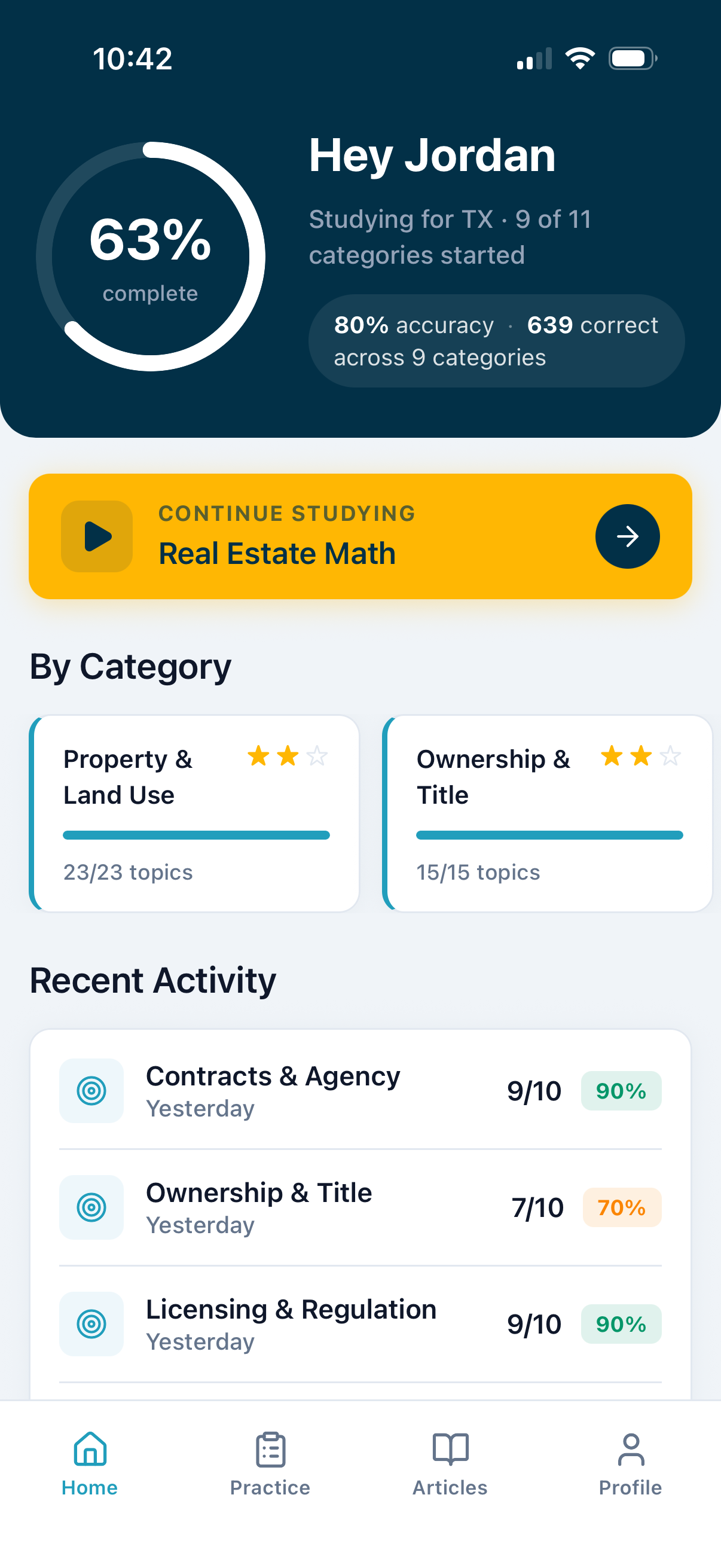
The RealReady app has all 1,085 questions covering both national real estate principles and North Carolina-specific law. The full app also includes:

  • Short articles that walk you through the why behind each topic
  • A missed-question drill mode
  • Detailed explanations on every question
  • Progress tracking with per-category accuracy

Unlike other real estate prep apps, we don't cut off access or charge a monthly subscription fee. It's a one-time $17.99, and it's yours forever.

About the exam

More about the North Carolina real estate exam

North Carolina is a broker-only state, so every new agent is licensed as a broker and sits the North Carolina Real Estate Commission (NCREC) exam to get there. The national half tests general principles, but the state half is built entirely around North Carolina law, which is where most candidates lose points. That makes North Carolina-specific preparation matter as much as the national material.

North Carolina tests its own rules in ways a national course never touches. The state's Broker-in-Charge system, the Working With Real Estate Agents disclosure, the state's trust account rules, the Residential Property and Owners' Association Disclosure Statement, and the Commission's enforcement powers under Chapter 93A all show up on the state section. None of that looks like the material a candidate in a neighboring state studies. A generic real estate practice test won't cut it. You need North Carolina-specific practice questions.

FAQ

North Carolina real estate exam: your questions answered

How many questions are on the North Carolina real estate exam?

The North Carolina Real Estate Broker License Examination has 140 scored questions, split into an 80-question national section and a 60-question North Carolina section. Each section also includes 5 unscored pretest questions that don't count toward your result. The two sections are timed and scored separately during the same appointment.

What's the passing score for the North Carolina real estate exam?

You need to score 75% on each section, the national and the state, and they're scored separately. You have to pass both within the same 180-day eligibility window. If you pass one section but fail the other, you keep credit for the passed section only as long as that window hasn't expired.

How much does the North Carolina real estate exam cost?

The Pearson exam fee is $63 for the two-part comprehensive exam, and you pay it each time you sit both sections. If you only need to retake one section, the single-section fee is $53. Separately, the North Carolina Real Estate Commission charges a $105 license application fee that you pay when you file your application, before you can schedule the exam.

How long is the North Carolina real estate exam?

You get four hours of total testing time. The national section is timed at 2.5 hours and the North Carolina section at 1.5 hours, and the two are timed separately within the same appointment. You take both back to back at a Pearson VUE test center.

Who administers the North Carolina real estate exam?

The North Carolina Real Estate Broker License Examination is administered by Pearson VUE for the North Carolina Real Estate Commission (NCREC). You register and schedule your exam date through Pearson VUE.

Is the North Carolina real estate exam hard?

Yes, it has a reputation as one of the harder state exams, and plenty of candidates fail at least one section on the first attempt. The questions aren't tricky for the sake of it. They're written to test whether you actually understand both national real estate principles and North Carolina license law. Most people who fail underestimated the 60-question state section, which is dense with North Carolina-specific rules like the Broker-in-Charge system and the Commission's trust account requirements. Honest practice on North Carolina-specific questions is the difference between passing on the first try and paying to retake a section.

What's on the North Carolina real estate exam?

The 80-question national section covers real property, ownership, valuation, contracts and agency, real estate practice, property disclosures, financing, and real estate math. The 60-question North Carolina section leans heavily on agency (about 16 questions) and brokerage practice (about 12 questions), with the rest spread across licensure, supervision and compensation, taxes and insurance, contracts and closing, landlord and tenant law, and other North Carolina statutes. North Carolina law is the focus of the entire state section, so that's where state-specific study pays off most.

What's the best way to prepare for the North Carolina real estate exam?

After you finish the 75-hour North Carolina Broker Prelicensing Course, the highest-leverage thing you can do is grind through North Carolina-specific practice questions with honest feedback on every miss. Generic real estate practice tests will help with the national section but won't catch you on North Carolina's unique rules. The RealReady app gives you the full bank of North Carolina questions, plus progress tracking and a missed-question mode so you can drill what you're weak on. Most users study 30 to 60 minutes a day for a few weeks before sitting the exam.

Is RealReady free?

The 20 North Carolina practice questions on this page are free, no account or signup needed. Unlocking the rest of the North Carolina bank is a single in-app purchase you pay once and own, with no recurring charge and no time limit on access.

Does RealReady cover the North Carolina real estate exam?

Yes. RealReady has a dedicated North Carolina question bank built for the North Carolina real estate exam, covering the national principles every candidate sees plus the North Carolina law that trips people up, like the Broker-in-Charge system, the Working With Real Estate Agents disclosure, and the Residential Property and Owners' Association Disclosure Statement.

Is RealReady a real estate license course?

No. RealReady is exam practice, not a pre-license course, so it doesn't count toward North Carolina's required pre-license education hours. Use it after or alongside your coursework to drill realistic practice questions and find your weak spots before exam day.