Vermont · Real estate exam prep

Vermont Real Estate Practice Test

20 free Vermont practice questions with no signup required. When you're ready for more, the full RealReady bank has 1,050 questions for the 2026 exam that cover both national principles and Vermont law.

Practice below

Practice

20 Vermont Real Estate Test Questions & Answers

Use this like a free Vermont real estate practice test: read the question, commit to an answer, then tap to reveal the correct answer and a plain-English explanation. The ones you miss tell you where to focus next.

Q1 of 20 Licensing & Regulation

Under which state office does the Vermont Real Estate Commission operate?

  1. Agency of Commerce
  2. Office of the Attorney General
  3. Office of Professional Regulation
  4. Department of Financial Regulation
Show answer & explanation

Correct: C Office of Professional Regulation

The Vermont Real Estate Commission operates under the Office of Professional Regulation (OPR), which falls under the Secretary of State's office.

Q2 of 20 Licensing & Regulation

A property owner sells their own home without hiring an agent. Does this require a real estate license in Vermont?

  1. Only if the owner advertises online
  2. Only if the sale exceeds $100,000
  3. No, property owners are exempt
  4. Yes, all sales require a license
Show answer & explanation

Correct: C No, property owners are exempt

Property owners selling their own real estate are exempt from Vermont licensing requirements. A license is required only when someone lists, sells, buys, or manages property for compensation on behalf of another.

Q3 of 20 Licensing & Regulation

A licensee deposits client earnest money into their personal checking account. What ground for discipline does this represent?

  1. Breach of fiduciary duty only
  2. Commingling of funds
  3. Unauthorized practice of law
  4. Failure to advertise properly
Show answer & explanation

Correct: B Commingling of funds

Commingling occurs when a licensee mixes client funds with personal funds. Vermont law specifically lists commingling as grounds for disciplinary action against a licensee.

Q4 of 20 State Practice

When must a Vermont licensee provide the consumer disclosure form to a prospective client?

  1. At first reasonable opportunity
  2. Within 30 days of initial contact
  3. At the closing table only
  4. After an offer is accepted
Show answer & explanation

Correct: A At first reasonable opportunity

Vermont requires licensees to provide the mandatory consumer disclosure at the first reasonable opportunity, before any confidential information is shared. This ensures consumers understand the agency relationship early.

Q5 of 20 State Practice

A newly licensed salesperson wants to open their own office and operate independently. Is this permitted in Vermont?

  1. Yes, after one year of experience
  2. Yes, with Commission approval given
  3. Yes, after completing 40 hours CE
  4. No, must work under a broker
Show answer & explanation

Correct: D No, must work under a broker

Vermont requires all salespersons to work under the supervision of a licensed broker. Salespersons cannot operate independently or maintain their own trust accounts.

Q6 of 20 State Practice

A buyer submits a $5,000 earnest money check on Friday. By when must the broker deposit it into the trust account?

  1. Within 10 calendar days of receipt
  2. Within 5 banking days of receipt
  3. By the next business day
  4. Within 3 banking days of receipt
Show answer & explanation

Correct: B Within 5 banking days of receipt

Vermont law requires that earnest money deposits be placed into a trust or escrow account within 5 banking days of receipt. This timeline protects the buyer's funds while giving the broker reasonable time to process the deposit.

Q7 of 20 State Practice

A salesperson posts a property listing on social media using only her personal name. Is this compliant with Vermont advertising rules?

  1. Yes, personal posts are not advertisements
  2. Yes, social media is exempt from ad rules
  3. No, the brokerage firm name must be included
  4. Yes, if her license number is included
Show answer & explanation

Correct: C No, the brokerage firm name must be included

Vermont requires all real estate advertisements, including social media posts, to include the brokerage firm name as licensed. A salesperson may include her own name, but the brokerage name must appear prominently. Social media follows the same rules as traditional advertising.

Q8 of 20 State Practice

Does Vermont mandate the use of state-approved listing agreement forms?

  1. No, Vermont does not mandate state forms
  2. Yes, but brokers may add custom clauses
  3. Yes, all forms must be Commission-approved
  4. Yes, only for residential properties
Show answer & explanation

Correct: A No, Vermont does not mandate state forms

Vermont does not mandate the use of state-approved listing agreement forms. However, the Vermont Association of Realtors (VAR) provides standard forms that are widely used in practice. Written agreements are recommended for enforceability.

Q9 of 20 State Practice

What does the Vermont Seller Property Information Report require sellers to disclose?

  1. All defects found in a professional inspection
  2. Known defects based on personal knowledge
  3. Only defects that affect the sale price
  4. Defects covered by a home warranty
Show answer & explanation

Correct: B Known defects based on personal knowledge

The Vermont Seller Property Information Report requires sellers to disclose known defects based on their personal knowledge of the property. It is not a warranty or guarantee, and the seller is not required to conduct inspections to discover unknown issues.

Q10 of 20 State Transactions

What is the Vermont property transfer tax rate for a principal residence on the first $200,000?

  1. 1.25%
  2. 0.5%
  3. 1.47%
  4. 0.22%
Show answer & explanation

Correct: B 0.5%

Vermont's property transfer tax for a principal residence is 0.5% on the first $200,000 of value. This reduced rate benefits primary homeowners and is exempt from the additional clean water surcharge that applies to amounts above $200,000.

Q11 of 20 State Transactions

A speculator buys 50 acres in Vermont and resells it 18 months later at a large profit. Which tax is specifically designed to discourage this activity?

  1. The real estate excise tax
  2. The property transfer tax
  3. The capital gains tax
  4. The land gains tax
Show answer & explanation

Correct: D The land gains tax

Vermont's land gains tax is specifically imposed on gains from the sale of Vermont land held less than 6 years that has been subdivided by the transferor. Its purpose is to discourage speculative land flipping.

Q12 of 20 State Transactions

A Vermont landlord refuses to rent to a 22-year-old applicant solely because of the applicant's age. Under Vermont fair housing law, is this lawful?

  1. Yes, age is not a protected class
  2. No, age 18+ is a protected class in VT
  3. Yes, if the tenant is under 25
  4. No, but only for buyers, not renters
Show answer & explanation

Correct: B No, age 18+ is a protected class in VT

Vermont fair housing law protects all persons age 18 and older from age-based discrimination. This goes beyond federal law, which does not include age as a protected class in housing.

Q13 of 20 State Transactions

What is the primary purpose of Vermont's Act 250 environmental law?

  1. Set property tax rates
  2. License real estate brokers
  3. Regulate major land developments
  4. Control residential rents
Show answer & explanation

Correct: C Regulate major land developments

Act 250, enacted in 1970, is one of the most comprehensive state-level land use laws in the nation. It requires permits for major developments and subdivisions, evaluating projects against 10 environmental and community criteria.

Q14 of 20 State Transactions

A Vermont tenant signs a 10-month lease at $1,200 per month. Under state law, what is the maximum security deposit the landlord may collect?

  1. There is no statewide cap on the amount
  2. $600, equal to half of one month's rent
  3. $1,200, equal to one month's rent
  4. $2,400, equal to two months' rent
Show answer & explanation

Correct: A There is no statewide cap on the amount

Vermont's security deposit law, 9 V.S.A. § 4461, sets no statewide limit on the amount a landlord may collect. It governs how deposits are held and returned, not their size. A few municipalities such as Burlington cap deposits at one month's rent by local ordinance, but there is no statewide maximum.

Q15 of 20 State Transactions

Vermont is classified as what type of state regarding real estate closings?

  1. A notary-closing state
  2. A title-company-closing state
  3. An escrow-closing state
  4. An attorney-closing state
Show answer & explanation

Correct: D An attorney-closing state

Vermont is an attorney-closing state. Only licensed attorneys or those with a Vermont title insurance producer license may conduct closings and issue title insurance.

Q16 of 20 Licensing & Regulation

Which of the following is a power of the Vermont Real Estate Commission?

  1. Set property tax rates
  2. Approve education providers
  3. Issue building permits
  4. Prosecute criminal cases
Show answer & explanation

Correct: B Approve education providers

The Commission has the power to approve education providers, adopt rules, issue licenses, and delegate administrative functions to the OPR Director.

Q17 of 20 Licensing & Regulation

An attorney handles real estate transactions as part of administering a deceased client's estate. Must the attorney hold a real estate license?

  1. Yes, any sale requires a license
  2. Only if the property value exceeds $250,000
  3. No, estate administration is exempt
  4. Only if the attorney collects a commission
Show answer & explanation

Correct: C No, estate administration is exempt

Attorneys acting in connection with estate, trust, or bankruptcy matters are exempt from Vermont real estate licensing. This exemption recognizes the attorney's existing professional regulation.

Q18 of 20 Licensing & Regulation

An agent represents both the buyer and seller without obtaining written consent from either party. What violation has occurred?

  1. Operating without a branch license
  2. Failure to carry E&O insurance
  3. Undisclosed dual representation
  4. Unauthorized practice of law
Show answer & explanation

Correct: C Undisclosed dual representation

Acting for both parties without their informed consent is a specific ground for discipline under Vermont law. Licensees must disclose and obtain consent for any dual representation.

Q19 of 20 State Practice

A buyer shares sensitive financial details before receiving any agency disclosure. What requirement did the agent violate?

  1. Disclose within 48 hours of showing
  2. Disclose before sharing confidential info
  3. Disclose at the closing table only
  4. Disclose after the written offer stage
Show answer & explanation

Correct: B Disclose before sharing confidential info

Vermont mandates that the consumer disclosure be provided before confidential information is shared. Allowing a buyer to share sensitive details without first disclosing agency status violates this requirement.

Q20 of 20 State Practice

A salesperson asks if they can maintain their own trust account for client deposits. What is the correct answer?

  1. Yes, after passing a trust account exam
  2. No, only brokers may hold trust accounts
  3. Yes, with written broker approval
  4. Yes, if the amount is under $5,000
Show answer & explanation

Correct: B No, only brokers may hold trust accounts

In Vermont, salespersons cannot hold trust accounts. All client funds must be deposited into the broker's trust account. The broker is responsible for proper handling of these funds.

Want the rest of Vermont's 1,050-question bank?

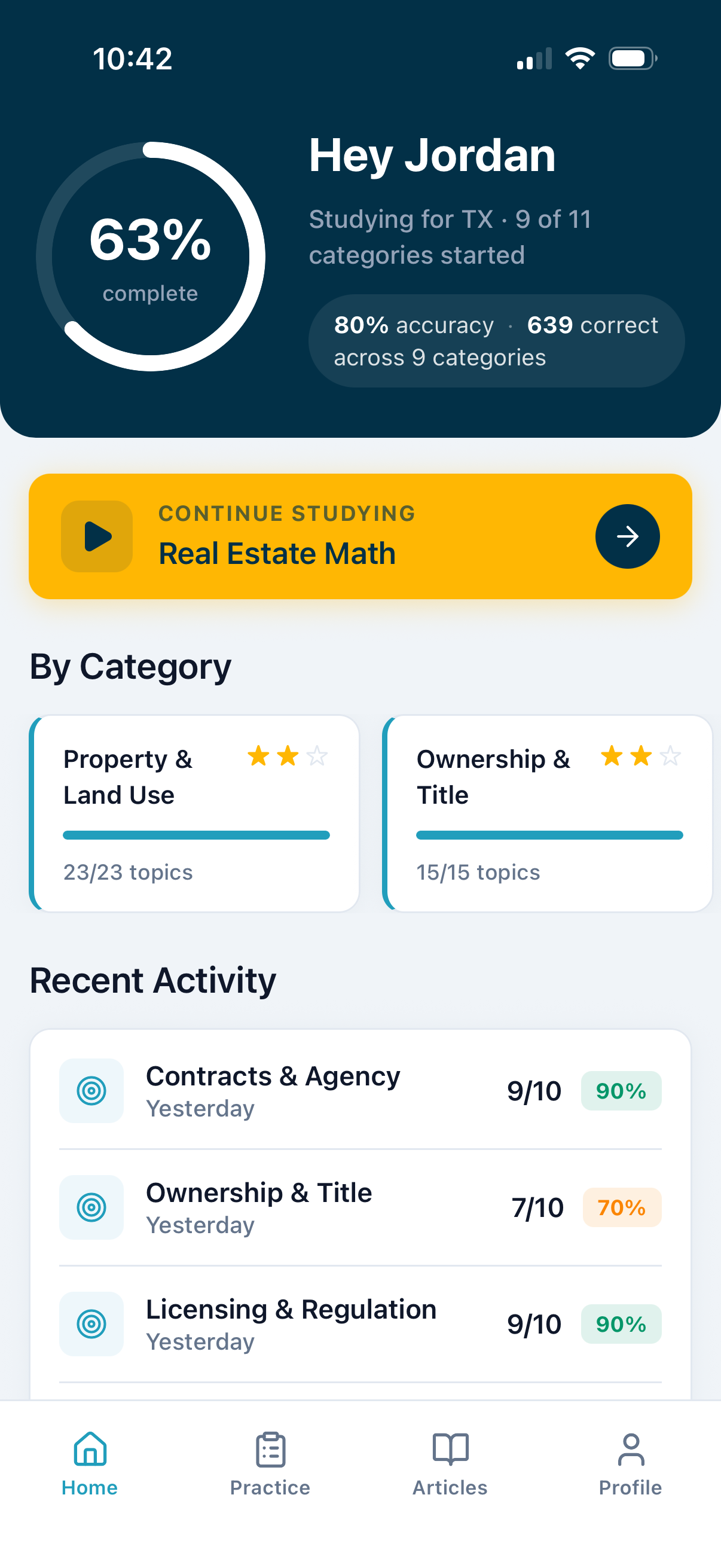
The RealReady app has all 1,050 questions covering both national real estate principles and Vermont-specific law. The full app also includes:

  • Short articles that walk you through the why behind each topic
  • A missed-question drill mode
  • Detailed explanations on every question
  • Progress tracking with per-category accuracy

Unlike other real estate prep apps, we don't cut off access or charge a monthly subscription fee. It's a one-time $17.99, and it's yours forever.

About the exam

More about the Vermont real estate exam

Vermont handles its state-law requirement unlike anywhere else: a 50-question open-book jurisprudence exam filed with your application, on top of the proctored national test. The Vermont Office of Professional Regulation and its Real Estate Commission license salespersons here, so Vermont-specific law carries as much weight as the national material.

Vermont runs on its own rules, including the mandatory consumer disclosure a licensee must provide before listing or showing, designated versus non-designated agency firm duties, dual agency that requires written consent from every party, the Vermont Land Gains Tax, Act 250 land-use permits, and the on-premises sign limits under Title 10. The Vermont Fair Housing and Public Accommodations Act also protects more classes than federal law, down to receipt of public assistance. None of that looks like the material a candidate in a neighboring state studies. A generic real estate practice test won't cut it. You need Vermont-specific practice questions.

FAQ

Vermont real estate exam: your questions answered

How many questions are on the Vermont real estate exam?

The national portion of the Vermont Real Estate Salesperson Examination has 100 scored multiple-choice questions, administered by PSI at a testing center. PSI also mixes in a few unscored pretest questions that look identical to the scored ones, and the time spent on those does not count against you. On top of that, Vermont requires a separate 50-question state jurisprudence exam that you complete open-book and upload with your online application.

What's the passing score for the Vermont real estate exam?

You need a scaled score of 75 percent on the national portion. The state jurisprudence exam is scored out of 100 points, with 50 questions worth two points each, and you need 75 points to pass. If you fail the state exam you redo it, so it pays to know Vermont law cold before you submit your application.

How much does the Vermont real estate exam cost?

The PSI examination fee is $110 per attempt, paid to PSI when you schedule the national portion. The state jurisprudence exam carries no separate exam fee because you complete it as part of your online application to the Office of Professional Regulation.

How long is the Vermont real estate exam?

PSI allows two and a half hours, which is 150 minutes, for the 100-question national portion at the testing center. The 50-question state jurisprudence exam is open-book and done on your own time before you submit your application, so there is no proctored clock on that part. PSI runs Vermont test sites in Burlington and South Burlington, with additional centers across the border in New Hampshire and Massachusetts.

Who administers the Vermont real estate exam?

The Vermont Real Estate Salesperson Examination is administered by PSI for the Vermont Office of Professional Regulation and its Real Estate Commission. You register and schedule your exam date through PSI.

Is the Vermont real estate exam hard?

The national portion is the same caliber of content you would find on any PSI real estate exam, and plenty of first-time candidates underestimate it. The Vermont state jurisprudence exam is open-book, but it draws straight from the Real Estate Commission statutes and rules, so vague familiarity will not get you to 75 points. Most people who struggle spent their study time on national principles and skimped on Vermont's agency, disclosure, escrow, and advertising rules. Honest practice on a Vermont-specific practice test is the difference between passing on the first try and retaking the $110 national exam.

What's on the Vermont real estate exam?

The 100-question national portion covers agency relationships and contracts, real property ownership and interests, finance, property valuation, marketing and settlement, property management, and real estate math, in proportions set by PSI's content outline. The Vermont state jurisprudence exam covers the Real Estate Commission statutes and administrative rules, plus Vermont-specific topics like the mandatory consumer disclosure, designated and non-designated agency, trust account and escrow handling, advertising and on-premises sign rules, the Land Gains Tax, and the Vermont Fair Housing and Public Accommodations Act.

What's the best way to prepare for the Vermont real estate exam?

After you finish your pre-license coursework, the highest-leverage thing you can do is grind through practice questions with honest feedback on every miss. Generic real estate practice tests will help with national principles, but they will not catch you on Vermont's agency rules, disclosure requirements, or the jurisprudence material the state exam pulls from. The RealReady app gives you the full Vermont question bank plus the national bank, with progress tracking and a missed-question mode so you can drill what you are weak on. Most users study 30 to 60 minutes a day for two to four weeks before sitting the exam.

Is RealReady free?

The 20 Vermont practice questions on this page are free, no account or signup needed. Unlocking the rest of the Vermont bank is a single in-app purchase you pay once and own, with no recurring charge and no time limit on access.

Does RealReady cover the Vermont real estate exam?

Yes. RealReady has a dedicated Vermont question bank built for the Vermont real estate exam, covering the national principles every candidate sees plus the Vermont law that trips people up, like the mandatory consumer disclosure, the Vermont Land Gains Tax, and Act 250 land-use permits.

Is RealReady a real estate license course?

No. RealReady is exam practice, not a pre-license course, so it doesn't count toward Vermont's required pre-license education hours. Use it after or alongside your coursework to drill realistic practice questions and find your weak spots before exam day.