Iowa · Real estate exam prep

Iowa Real Estate Practice Test

20 free Iowa practice questions with no signup required. When you're ready for more, the full RealReady bank has 1,030 questions for the 2026 exam that cover both national principles and Iowa law.

Practice below

Practice

20 Iowa Real Estate Test Questions & Answers

Use this like a free Iowa real estate practice test: read the question, commit to an answer, then tap to reveal the correct answer and a plain-English explanation. The ones you miss tell you where to focus next.

Q1 of 20 Licensing & Regulation

How are IREC members confirmed after the Governor nominates them?

  1. No confirmation process is required
  2. Simple majority of the Iowa House
  3. Two-thirds vote of the Iowa Senate
  4. Approval by the Attorney General
Show answer & explanation

Correct: C Two-thirds vote of the Iowa Senate

All IREC members are appointed by the Governor and must be confirmed by a two-thirds vote of the Iowa Senate. This confirmation process provides a check on the appointment power.

Q2 of 20 Licensing & Regulation

An Iowa licensee wants to switch from inactive to active status. What must she have in place?

  1. Only proof of current CE completion
  2. Only a sponsoring broker is needed
  3. Must retake the licensing exam first
  4. A sponsoring broker and current CE
Show answer & explanation

Correct: D A sponsoring broker and current CE

To reactivate, a salesperson needs a broker willing to hold her license, evidence that all deficient continuing education has been completed, and proof of E&O insurance. The Commission processes the reactivation once these requirements are met.

Q3 of 20 Licensing & Regulation

A broker deposits a client's earnest money into her personal checking account. Which violation has she committed?

  1. Unauthorized practice of law
  2. Commingling of funds
  3. Breach of fiduciary duty only
  4. Misrepresentation
Show answer & explanation

Correct: B Commingling of funds

Depositing client funds into a personal account is commingling, a specific ground for discipline under Iowa Code Chapter 543B. Client funds must be kept in a separate trust or escrow account, never mixed with personal or business operating funds.

Q4 of 20 Licensing & Regulation

An applicant passed the exam and completed Buying Practices and Listing Practices but skipped Professionalism/Ethics. Can she be licensed?

  1. Yes, if she has 24 total hours
  2. Yes, two of three is sufficient
  3. Only if she takes Ethics as CE later
  4. No, all three courses are mandatory
Show answer & explanation

Correct: D No, all three courses are mandatory

All three 12-hour courses are required with the original application: Developing Professionalism and Ethical Practices, Buying Practices, and Listing Practices. An application without evidence of all three cannot be approved.

Q5 of 20 State Practice

A seller's agent learns the buyer plans to offer above list price. Under Iowa Chapter 543B, what must the agent do?

  1. Disclose this to the seller client
  2. Keep it confidential from all parties
  3. Advise the buyer to lower the offer
  4. Share it only if asked by the seller
Show answer & explanation

Correct: A Disclose this to the seller client

Under Iowa agency law (Chapter 543B), a seller's agent owes the duty of disclosure to the client (seller). Information about a buyer's willingness to pay more is material and must be communicated. The agent has no duty of confidentiality to the buyer in a seller-agency relationship.

Q6 of 20 State Practice

An Iowa broker wants to open a trust account at an online-only bank headquartered in another state. Is this permitted?

  1. No, the account must be at an Iowa institution
  2. No, online-only banks are categorically prohibited
  3. Yes, if the institution is federally insured
  4. Only if the Commission grants a waiver
Show answer & explanation

Correct: C Yes, if the institution is federally insured

Iowa Code §543B.46(1) requires the trust account to be maintained in a federally insured depository institution. Neither the statute nor IAC 193E—13.1 imposes an in-Iowa location requirement, so an online-only or out-of-state bank may be used as long as it carries federal deposit insurance (FDIC or NCUA) and the broker files the required Consent to Examine and Audit Trust Account form with the Commission.

Q7 of 20 State Practice

An Iowa salesperson's unlicensed assistant gives a buyer pricing advice at an open house. Who faces disciplinary action?

  1. No one, if the advice was accurate
  2. The supervising broker
  3. The unlicensed assistant only
  4. The salesperson only
Show answer & explanation

Correct: B The supervising broker

Providing pricing advice is an activity barred to unlicensed support personnel. Both the designated broker and the employing salesperson are responsible for supervising an unlicensed assistant, with the salesperson bearing primary responsibility; the broker can face discipline for inadequate supervision unless the rule's safe-harbor conditions are met. The assistant may also face a civil penalty for unlicensed practice (Iowa Code 543B.34(3)). Accuracy of the advice is no defense.

Q8 of 20 State Practice

An unlicensed assistant at an Iowa brokerage answers phones and schedules showing appointments. Is this activity permitted?

  1. No, scheduling showings requires a license
  2. Only if the assistant has a license pending
  3. Yes, these are permitted clerical activities
  4. Yes, but only under direct agent observation
Show answer & explanation

Correct: C Yes, these are permitted clerical activities

Iowa law allows unlicensed assistants to perform clerical and administrative tasks such as answering phones and scheduling appointments. These activities do not require real estate licensure because they do not involve negotiation, property evaluation, or substantive real estate advice.

Q9 of 20 State Practice

The Iowa Civil Rights Act was enacted in 1965. How does this relate to the federal Fair Housing Act?

  1. Iowa adopted the FHA unchanged in 1965
  2. They were enacted in the same year
  3. Iowa's law predates the federal FHA
  4. The federal FHA came first by 5 years
Show answer & explanation

Correct: C Iowa's law predates the federal FHA

The Iowa Civil Rights Act was enacted in 1965, three years before the federal Fair Housing Act of 1968. Housing discrimination was added to the Iowa act by a 1967 amendment — still before the federal government acted, making Iowa one of the states with pre-FHA housing protections.

Q10 of 20 State Transactions

In Iowa, when does a purchase agreement become binding on all parties?

  1. When the seller verbally agrees to terms
  2. When the buyer signs the initial offer
  3. When the earnest money is deposited
  4. On acceptance and communication to buyer
Show answer & explanation

Correct: D On acceptance and communication to buyer

In Iowa, a purchase agreement becomes binding when the seller accepts the offer AND that acceptance is communicated back to the buyer or buyer's agent. Simply signing the acceptance without communication is insufficient to create a binding contract.

Q11 of 20 State Transactions

In an Iowa contract for deed, who holds legal title during the payment period?

  1. The seller retains legal title
  2. The buyer holds legal title
  3. The county recorder holds title
  4. Title is held in escrow
Show answer & explanation

Correct: A The seller retains legal title

Under an Iowa contract for deed, the seller retains legal title to the property until the buyer completes all payments. The buyer receives equitable title and possession, but legal title does not transfer until the contract is fulfilled.

Q12 of 20 State Transactions

When is a seller disclosure statement required in Iowa?

  1. Only when the buyer requests one
  2. Only for commercial properties
  3. Only for new construction
  4. For residential property transfers
Show answer & explanation

Correct: D For residential property transfers

Iowa law requires sellers to provide a disclosure statement for residential property transfers. The statement covers known defects related to structural, mechanical, water/sewer, environmental, and other conditions of the property.

Q13 of 20 State Transactions

In Iowa, is a real estate license required to manage property for compensation?

  1. Only if managing 10 or more units
  2. Yes, a license is required
  3. Only for commercial properties
  4. No, anyone can manage property
Show answer & explanation

Correct: B Yes, a license is required

Iowa requires a real estate license to manage property for compensation. Property managers must operate under a licensed broker and maintain written property management agreements specifying scope, compensation, duration, and responsibilities.

Q14 of 20 State Transactions

What is Iowa's real estate transfer tax rate?

  1. $2.00 per $1,000 of value
  2. $0.50 per $1,000 of value
  3. $1.00 per $500 of value
  4. $0.80 per $500 of value
Show answer & explanation

Correct: D $0.80 per $500 of value

Iowa's real estate transfer tax is 80 cents for each $500, or fractional part of $500, of consideration in excess of $500 — the first $500 is not taxed (Iowa Code 428A.1). This equates to $1.60 per $1,000 above the exempt first $500. The tax is paid to the county recorder at the time of recording.

Q15 of 20 Licensing & Regulation

An applicant had her license revoked in Nebraska 18 months ago. Can she apply for an Iowa salesperson license?

  1. Yes, if she retakes pre-license education
  2. Yes, other states don't affect Iowa
  3. No, revocation is a permanent bar
  4. No, revocation bars her for 2 years
Show answer & explanation

Correct: D No, revocation bars her for 2 years

Iowa denies applications from anyone whose license was revoked in any state within the preceding 2 years. Since this applicant's revocation was only 18 months ago, she must wait an additional 6 months before applying.

Q16 of 20 Licensing & Regulation

What type of insurance must all active Iowa real estate licensees maintain?

  1. Surety bond coverage
  2. General liability insurance
  3. Homeowner's warranty coverage
  4. Errors and omissions insurance
Show answer & explanation

Correct: D Errors and omissions insurance

Iowa requires all active licensees to carry errors and omissions (E&O) insurance; inactive licensees are exempt. Proof of coverage must be submitted before an original license is issued. A licensee who fails to prove coverage on request can be placed on inactive status and faces possible discipline.

Q17 of 20 Licensing & Regulation

A licensee pays a $500 referral fee to an unlicensed friend who recommended a buyer. What disciplinary ground does this trigger?

  1. Commingling client funds in escrow
  2. Paying unlicensed persons for referrals
  3. Inducing a breach of contract
  4. Acting without written consent
Show answer & explanation

Correct: B Paying unlicensed persons for referrals

Iowa law prohibits paying compensation to unlicensed individuals for performing activities that require a real estate license. Referral fees to unlicensed persons are a specific ground for disciplinary action under Chapter 543B.

Q18 of 20 State Practice

Which duty does an Iowa licensee owe to ALL parties in a transaction, not just clients?

  1. Advice on price and negotiation strategy
  2. Honesty and good faith
  3. Confidentiality of motivations
  4. Placing the party's interests first
Show answer & explanation

Correct: B Honesty and good faith

Iowa Code 543B.56(1) lists the duties owed to all parties: honesty and good faith, disclosure of known material adverse facts, and accounting for any party's property in the licensee's possession. Placing a client's interests first, keeping motivations confidential, and giving negotiation advice are client-level duties under 543B.56(2) and the commission's agency rules.

Q19 of 20 State Practice

What type of bank account must an Iowa broker use for a trust account?

  1. Money market savings without check access
  2. Certificate of deposit
  3. Non-interest demand deposit only
  4. Interest-bearing federally insured account
Show answer & explanation

Correct: D Interest-bearing federally insured account

Iowa Code §543B.46(1) requires the broker's trust account to be an interest-bearing account in a federally insured depository institution. Interest earned is transferred quarterly to the Iowa Finance Authority for the state housing trust fund (Iowa Code §16.181) unless the buyer and seller agree in writing to direct it elsewhere. Fixed-term accounts like CDs cannot be used without the written consent of the parties whose funds are deposited (IAC 193E—13.1(1)"b").

Q20 of 20 State Practice

Where must a resident Iowa broker's principal place of business be located?

  1. Within the broker's MLS territory
  2. Wherever the broker resides
  3. In Iowa
  4. In any state with reciprocity
Show answer & explanation

Correct: C In Iowa

Iowa Code 543B.31 requires every real estate broker, except nonresidents covered by 543B.22, to maintain a place of business in Iowa. A nonresident broker licensed in Iowa is not required to maintain an Iowa office so long as the broker maintains an active place of business in the broker's state of domicile. For a resident Iowa brokerage, the principal place of business must be in Iowa.

Want the rest of Iowa's 1,030-question bank?

The RealReady app has all 1,030 questions covering both national real estate principles and Iowa-specific law. The full app also includes:

  • Short articles that walk you through the why behind each topic
  • A missed-question drill mode
  • Detailed explanations on every question
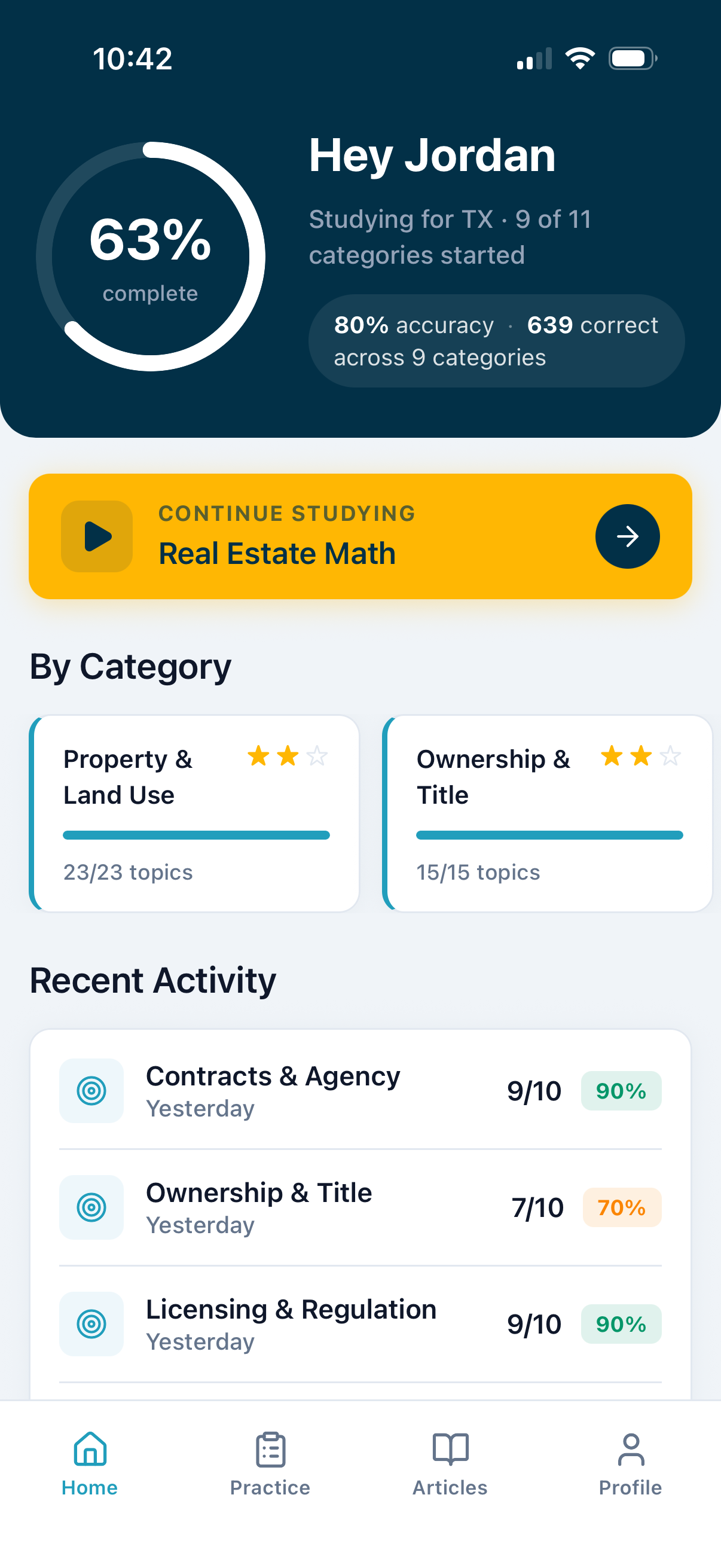
  • Progress tracking with per-category accuracy

Unlike other real estate prep apps, we don't cut off access or charge a monthly subscription fee. It's a one-time $17.99, and it's yours forever.

About the exam

More about the Iowa real estate exam

Most Iowa candidates who fail do fine on national principles and get caught out by the separately scored 40-question state-law portion. A strong national score won't carry you if your grasp of Iowa law is thin, so Iowa-specific prep matters as much as the national material.

Iowa Code Chapter 543B and Iowa Administrative Code Chapter 193E define IREC's membership and disciplinary powers, the strict trust-account rules brokers follow when handling earnest money, the agency-disclosure framework before a brokerage agreement is signed, the seller's property condition disclosure under Chapter 558A, the Iowa Civil Rights Act of 1965 that adds protected classes beyond the federal Fair Housing Act, the supervision rules for unlicensed assistants, the contract-for-deed framework common in rural transactions, and the state real estate transfer tax under Chapter 428A. None of that looks like the material a candidate in a neighboring state studies. A generic real estate practice test won't cut it. You need Iowa-specific practice questions.

FAQ

Iowa real estate exam: your questions answered

How many questions are on the Iowa real estate exam?

The Iowa Real Estate Salesperson Examination has 120 scored multiple-choice questions, split into an 80-question national portion and a 40-question Iowa state-law portion. PSI may also include a small number of unscored experimental questions that look identical to the scored ones, and the time spent on those does not count against you.

What's the passing score for the Iowa real estate exam?

PSI scores the two sections separately and requires a combined score of 84 of 120 with at least 28 of 40 on the state portion — the bulletin's summary table also expresses this as 70 percent per section (56 of 80 national, 28 of 40 state). If you don't pass, you must re-register with PSI, pay the fee again, and retake the examination. Your application to the Commission must be filed no later than the last working day of the sixth month after the exam pass date.

How much does the Iowa real estate exam cost?

The PSI examination fee is $95 per attempt, paid when you schedule the test with PSI. Registration fees are not refundable or transferable. After you pass, the initial salesperson license fee paid to the Iowa Real Estate Commission is $125, and the license is issued for three calendar years from the date the application is processed, counting the remaining portion of the year of issue as one full year.

How long is the Iowa real estate exam?

180 minutes total. The national portion is allotted two hours and the state portion is one hour, taken back-to-back at a PSI testing center or through PSI's remote-proctored option. PSI runs Iowa sites in West Des Moines, Cedar Rapids, Council Bluffs, and Waterloo. Each registration expires after 90 days, so you must sit for the exam within 90 days of registering.

Who administers the Iowa real estate exam?

The Iowa Real Estate Salesperson Examination is administered by PSI for the Iowa Real Estate Commission (IREC). You register and schedule your exam date through PSI.

Is the Iowa real estate exam hard?

The state portion is where most first-time candidates lose ground. The national portion is the same content you'd find on any PSI real estate exam, but Iowa's 40 state-law questions cover narrow topics like the powers of IREC, the disciplinary framework under Chapter 543B, trust-account handling, Iowa-specific agency rules, the Chapter 558A seller's disclosure, the Iowa Civil Rights Act of 1965, broker supervision of unlicensed assistants, and the contract-for-deed framework. Honest practice on an Iowa-specific practice exam is the difference between passing on the first try and retaking the $95 exam.

What's on the Iowa real estate exam?

The 80-question national portion covers property ownership, land-use controls, valuation and market analysis, financing, contracts, agency, property disclosures, transfer of title, the general practice of real estate, and real estate math, in proportions set by PSI's content outline. The 40-question Iowa state portion is weighted toward contracts (7 items), agency (6 items), property disclosure requirements (5 items), and disciplinary actions (4 items), then covers licensing requirements, license maintenance, real estate education, trust accounts, the Iowa Civil Rights Act of 1965, unlicensed assistants, broker responsibilities, and property management. PSI publishes the exact item counts in its current Iowa Licensing Information Bulletin.

What's the best way to prepare for the Iowa real estate exam?

After finishing your 60-hour Commission-approved pre-license course in real estate principles, the highest-leverage thing you can do is grind through Iowa-specific practice questions with honest feedback on every miss. Generic real estate practice tests will help with national principles but won't catch you on Iowa's unique rules, especially Chapter 543B disciplinary procedures, Iowa's trust-account requirements, and the additional protected classes under the Iowa Civil Rights Act of 1965. The RealReady app gives you the full bank of Iowa questions plus the national bank, with progress tracking and a missed-question mode so you can drill what you're weak on.

Is RealReady free?

The 20 Iowa practice questions on this page are free, no account or signup needed. Unlocking the rest of the Iowa bank is a single in-app purchase you pay once and own, with no recurring charge and no time limit on access.

Does RealReady cover the Iowa real estate exam?

Yes. RealReady has a dedicated Iowa question bank built for the Iowa real estate exam, covering the national principles every candidate sees plus the Iowa law that trips people up, like IREC's disciplinary powers under Iowa Code Chapter 543B, the seller's property condition disclosure under Chapter 558A, and the Iowa Civil Rights Act protected classes.

Is RealReady a real estate license course?

No. RealReady is exam practice, not a pre-license course, so it doesn't count toward Iowa's required pre-license education hours. Use it after or alongside your coursework to drill realistic practice questions and find your weak spots before exam day.