How many questions are on the New York real estate exam?
The New York State Real Estate Salesperson Examination has 75 multiple-choice questions. The Department of State administers it as a single combined test, so there is no separate national portion. You have 90 minutes to finish.
What's the passing score for the New York real estate exam?
You need 70% to pass, which is 53 of the 75 questions correct. The Department of State reports your result as simply passed or failed with no numerical score, so every question counts.
How much does the New York real estate exam cost?
The state examination fee is $15 per attempt, the lowest in the country, and you schedule each sitting through your eAccessNY account. If you pass, the salesperson license fee is $65, and a passed exam result stays valid for two years while you find a sponsoring broker.
How long is the New York real estate exam?
Ninety minutes for all 75 questions. The Department of State runs the test at exam sites across the state, and because the result is pass or fail you'll want to keep a steady pace rather than agonize over any single item.
Who administers the New York real estate exam?
The New York State Real Estate Salesperson Examination is administered directly by the New York Department of State, Division of Licensing Services. You register and schedule your exam date through the state's eAccessNY system.
Is the New York real estate exam hard?
The first-time pass rate sits around 51%, so roughly half of candidates walk out needing a retake. The questions aren't tricky for the sake of being tricky. They test whether you actually understand New York real estate law and practice. Most people who fail underestimated how much New York-specific material is on the test (Article 12-A license law, agency disclosure, rent regulation, co-op and condo rules) and leaned too hard on national principles. Honest practice on a New York-specific practice test is what separates a first-try pass from paying the $15 fee again.
What's on the New York real estate exam?
The 75-question test is built from the 77-hour qualifying curriculum and blends national principles with New York law. Expect license law and regulation under Article 12-A, the law of agency and disclosure, estates and interests, liens and easements, deeds and conveyances, title closing and costs, contracts of sale and leases, real estate finance, land use regulation, construction and environmental issues, and the valuation process. New York-specific material runs through the whole thing, especially agency disclosure, the Property Condition Disclosure Act, rent regulation, and the Department of State's enforcement role.
What's the best way to prepare for the New York real estate exam?
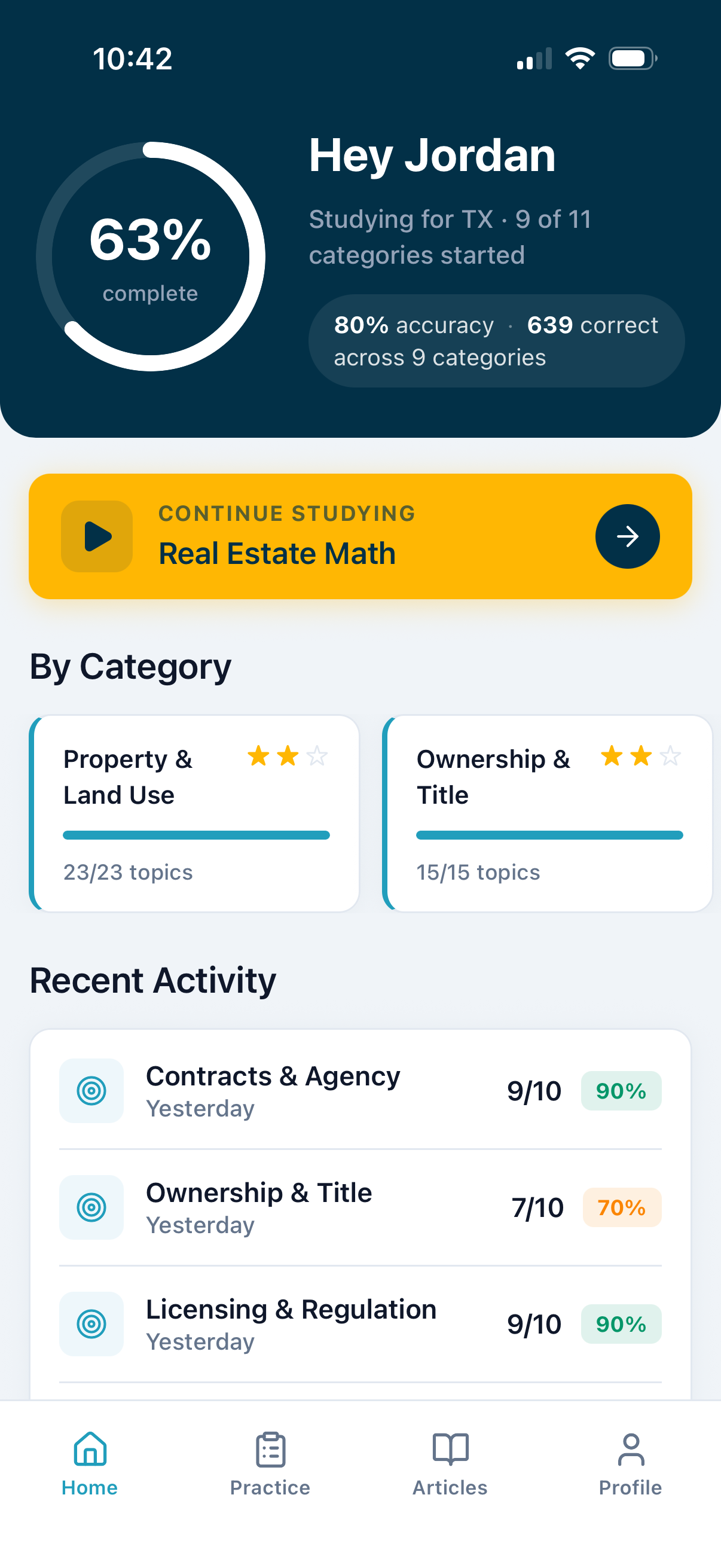
After your 77-hour qualifying course, the highest-leverage thing you can do is grind through New York-specific practice questions with honest feedback on every miss. Generic real estate practice tests cover national principles but won't catch you on New York's own rules. The RealReady app gives you the full New York question bank, plus progress tracking and a missed-question mode so you can drill your weak spots. Most users study 30 to 60 minutes a day for two to four weeks before sitting the exam.
Is RealReady free?
The 20 New York practice questions on this page are free, no account or signup needed. Unlocking the rest of the New York bank is a single in-app purchase you pay once and own, with no recurring charge and no time limit on access.
Does RealReady cover the New York real estate exam?
Yes. RealReady has a dedicated New York question bank built for the New York real estate exam, covering the national principles every candidate sees plus the New York law that trips people up, like New York's Article 12-A license law, the Property Condition Disclosure Act, and rent regulation under the 2019 Housing Stability and Tenant Protection Act.
Is RealReady a real estate license course?
No. RealReady is exam practice, not a pre-license course, so it doesn't count toward New York's required pre-license education hours. Use it after or alongside your coursework to drill realistic practice questions and find your weak spots before exam day.